Extended Red Blood Cell Matching Linked To Less Alloimmunization
Standard Compared With Extended Red Blood Cell Antigen Matching for Prevention of Subsequent Hemolytic Disease of the Fetus and Newborn: A Systematic Review
Systematic review and random-effects meta-analysisBenefit found
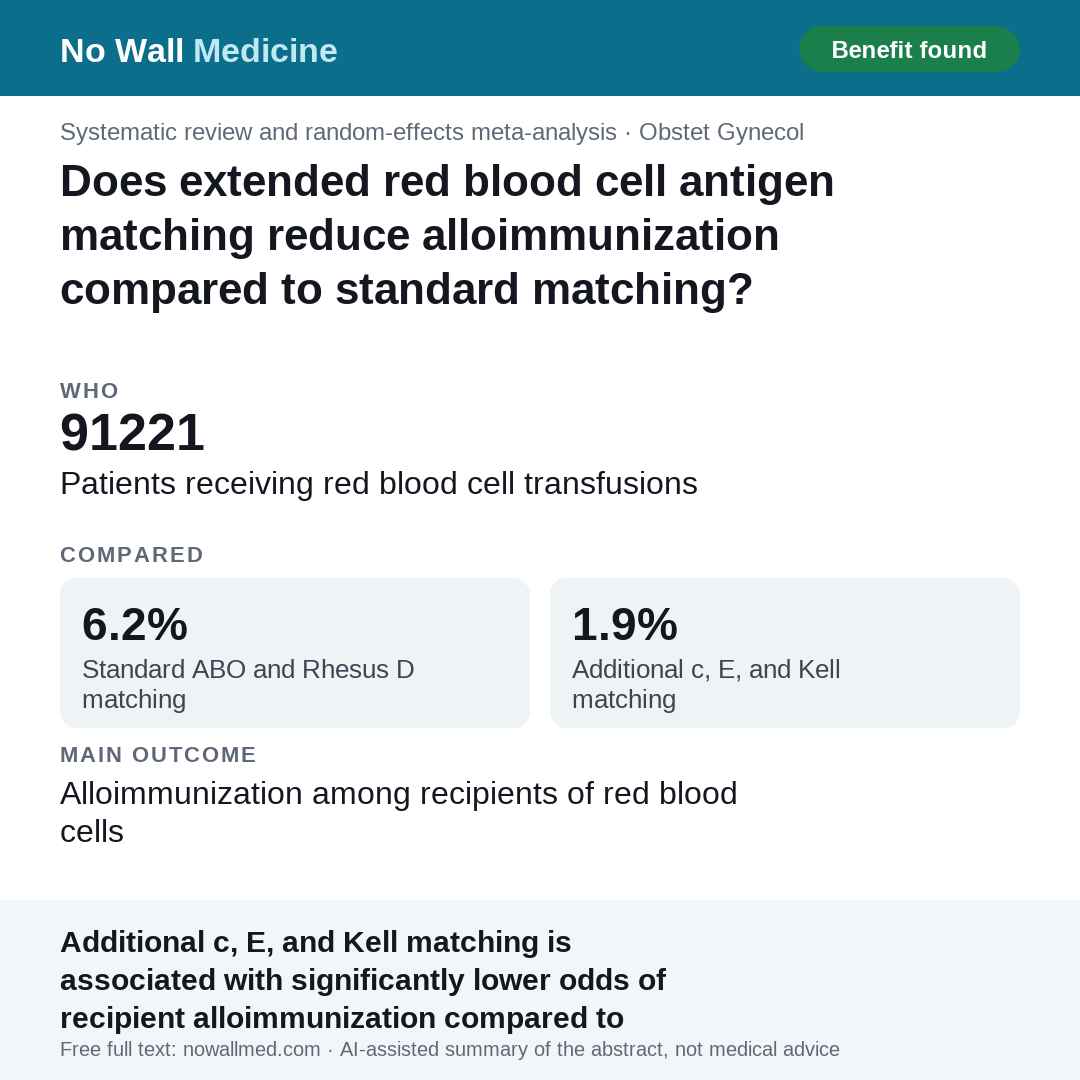
Does extended red blood cell antigen matching reduce alloimmunization compared to standard matching?
Who
91221
Patients receiving red blood cell transfusions
Compared
6.2%Standard ABO and Rhesus D matching (95% CI, 2.5-14.9%)
1.9%Additional c, E, and Kell matching (95% CI, 0.7-5.1%)
Main outcome
Alloimmunization among recipients of red blood cells
Result: odds ratio 0.37 (95% CI, 0.20-0.69)
Bottom line: Additional c, E, and Kell matching is associated with significantly lower odds of recipient alloimmunization compared to standard matching.
Obstet Gynecol · 2024-08-08Download image
Clinical question: Does extended red blood cell antigen matching reduce alloimmunization compared to standard matching?
Why it matters: Standard and extended red blood cell antigen matching protocols are compared for preventing hemolytic disease
Key points
- 91,221 patients received red blood cells matched for ABO+D or ABO+D and cEK antigens.
- Alloimmunization rate was 6.2% with ABO+D match and 1.9% with added cEK match.
- Additional cEK match was associated with lower odds of alloimmunization, odds ratio 0.37.
Limitation the authors note: None stated in the abstract
Headline and key points written with AI from the paper’s abstract, with every number checked against it. Read the paper before relying on them.
Topics
Cite this article
Sugrue RP, Olsen J, Abi Antoun ME, Skalla LA, Cate J, James AH. Standard Compared With Extended Red Blood Cell Antigen Matching for Prevention of Subsequent Hemolytic Disease of the Fetus and Newborn: A Systematic Review. Obstet Gynecol. 2024. doi:10.1097/AOG.0000000000005701
Spotted a mistake? Suggest a correction
Top studies every Monday
The week’s key trials and guidelines in your specialties, plus any topics you follow. By email, free.
Get the weekly digest