Standard-dose dolutegravir achieved similar viral suppression to double-dose in people with HIV and tuberculosis
Standard-dose versus double-dose dolutegravir in HIV-associated tuberculosis in South Africa (RADIANT-TB): a phase 2, non-comparative, randomised controlled trial
Infectious DiseaseAdult and pediatric
Phase 2b, randomised, double-blind, placebo-controlled trialNo clear difference
Are virological outcomes acceptable with standard-dose dolutegravir in HIV-associated tuberculosis?
Who
108
Adults with HIV-associated tuberculosis on rifampicin-based antituberculosis therapy · Single site in Khayelitsha, Cape Town, South Africa
Compared
83%supplemental dolutegravir (43/52)
83%placebo (44/53)
Main outcome
proportion of participants with virological suppression at week 24
Bottom line: Twice-daily dolutegravir might be unnecessary in people with HIV-associated tuberculosis.
Funded by: Wellcome Trust
Lancet HIV · 2023-05-22Download image
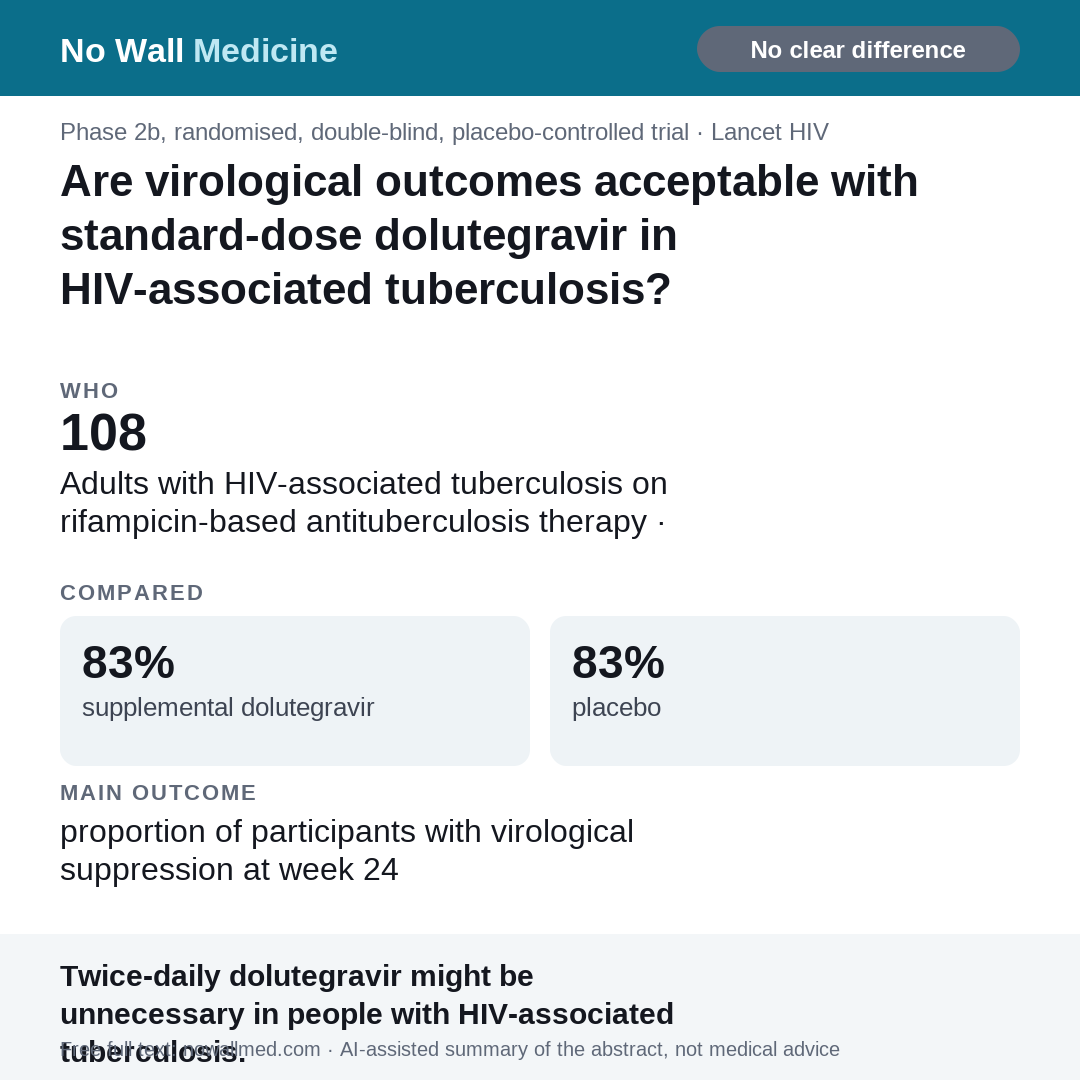
Clinical question: Are virological outcomes acceptable with standard-dose dolutegravir in HIV-associated tuberculosis?
Why it matters: It is difficult to implement supplemental dosing to manage drug interactions between rifampicin and dolutegravir in high-burden settings.
Key points
- Researchers randomized 108 participants in South Africa to receive either a standard dose of dolutegravir plus a supplemental 50 mg dose or a standard dose plus a placebo.
- At week 24, 83% of participants in the supplemental dolutegravir group and 83% in the placebo group achieved virological suppression, which is HIV-1 RNA levels below 50 copies per mL.
- No treatment-emergent dolutegravir resistance mutations were detected up to week 48 in the 19 participants who experienced virological failure.
Headline and key points written with AI from the paper’s abstract, with every number checked against it. Read the paper before relying on them.
Was this summary helpful?
Abstract
Background
The drug-drug interaction between rifampicin and dolutegravir can be overcome by supplemental dolutegravir dosing, which is difficult to implement in high-burden settings. We aimed to test whether virological outcomes with standard-dose dolutegravir-based antiretroviral therapy (ART) are acceptable in people with HIV on rifampicin-based antituberculosis therapy. Methods
RADIANT-TB was a phase 2b, randomised, double-blind, non-comparative, placebo-controlled trial at a single site in Khayelitsha, Cape Town, South Africa. Participants were older than 18 years of age, with plasma HIV-1 RNA greater than 1000 copies per mL, CD4 count greater than 100 cells per μL, ART-naive or first-line ART interrupted, and on rifampicin-based antituberculosis therapy for less than 3 months. By use of permuted block (block size of 6) randomisation, participants were assigned (1:1) to receive either tenofovir disoproxil fumarate, lamivudine, and dolutegravir plus supplemental 50 mg dolutegravir 12 h later or tenofovir disoproxil fumarate, lamivudine, and dolutegravir plus matched placebo 12 h later. Participants received standard antituberculosis therapy (rifampicin, isoniazid, pyrazinamide, and ethambutol for the first 2 months followed by isoniazid and rifampicin for 4 months). The primary outcome was the proportion of participants with virological suppression (HIV-1 RNA <50 copies per mL) at week 24 analysed in the modified intention-to-treat population. This study is registered with ClinicalTrials.gov, NCT03851588. Findings
Between Nov 28, 2019, and July 23, 2021, 108 participants (38 female, median age 35 years [IQR 31-40]) were randomly assigned to supplemental dolutegravir (n=53) or placebo (n=55). Median baseline CD4 count was 188 cells per μL (IQR 145-316) and median HIV-1 RNA was 5·2 log10 copies per mL (4·6-5·7). At week 24, 43 (83%, 95% CI 70-92) of 52 participants in the supplemental dolutegravir arm and 44 (83%, 95% CI 70-92) of 53 participants in the placebo arm had virological suppression. No treatment-emergent dolutegravir resistance mutations were detected up to week 48 in the 19 participants with study-defined virological failure. Grade 3 and 4 adverse events were similarly distributed between the study arms. The most frequent grade 3 and 4 adverse events were weight loss (4/108 [4%]), insomnia (3/108 [3%]), and pneumonia (3/108 [3%]). Interpretation
Our findings suggest that twice-daily dolutegravir might be unnecessary in people with HIV-associated tuberculosis. Funding
Wellcome Trust.
Abstract reproduced under the article’s CC BY licence.
Subject terms
Cite this article
Griesel R, Zhao Y, Simmons B, Omar Z, Wiesner L, Keene CM. Standard-dose versus double-dose dolutegravir in HIV-associated tuberculosis in South Africa (RADIANT-TB): a phase 2, non-comparative, randomised controlled trial. Lancet HIV. 2023. doi:10.1016/S2352-3018(23)00081-4
Spotted a mistake? Suggest a correction
Top studies every Monday
The week’s key trials and guidelines in your specialties, plus any topics you follow. By email, free.
Get the weekly digest