Visual abstractsVisuals
Meta-analysisIntensive Care Medicine · Jul 28, 2026

Expert panel develops new reporting standards for acute kidney injury biomarker studies

STARDaki: a consensus-based STARD extension for standardized reporting of diagnostic accuracy in acute kidney injury

Yu H, Li Y, Mo GP, Luo Z, Zarbock A, Fuhrman D, et al
Critical CareAdult
Systematic literature review and modified Delphi processMixed results
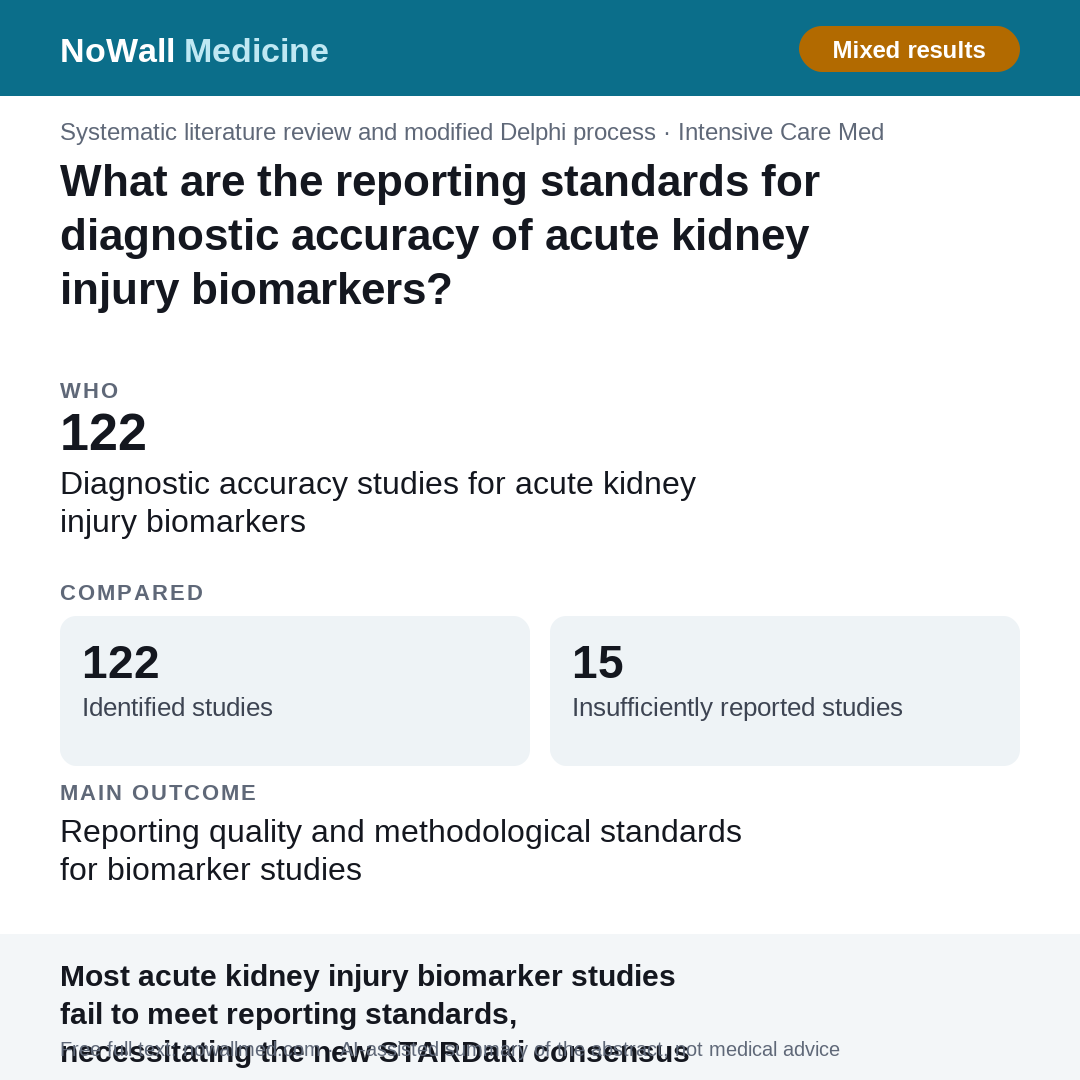
What are the reporting standards for diagnostic accuracy of acute kidney injury biomarkers?
Who
122
Diagnostic accuracy studies for acute kidney injury biomarkers
Compared
122Identified studies
15Insufficiently reported studies
Main outcome
Reporting quality and methodological standards for biomarker studies
Bottom line: Most acute kidney injury biomarker studies fail to meet reporting standards, necessitating the new STARDaki consensus criteria.
Limitation: Low compliance with the STARD checklist prevented meta-analysis.
Intensive Care Med · 2026-07-28Download image

Clinical question: What are the reporting standards for diagnostic accuracy of acute kidney injury biomarkers?

Why it matters: Existing studies on biomarkers for acute kidney injury are heterogeneous and contradictory, making it difficult to determine their true diagnostic performance.

Key points

Headline and key points written with AI from the paper’s abstract, with every number checked against it. Read the paper before relying on them.
Read the full paper free at PubMed Central ↗

Topics

Acute Kidney Injury; Humans; Biomarkers; Consensus; Checklist; Delphi Technique

DOI: 10.1007/s00134-026-08549-5 · PubMed: 42517928

Spotted a mistake? Suggest a correction

More in Critical Care

Meta-analysisCrit Care · Nov 19, 2026 · Critical Care

Corticosteroids in sepsis have conflicting mortality conclusions in reviews

Discordant evidence on corticosteroids in sepsis: a meta-research study

ResearchPediatricResuscitation · Nov 17, 2026 · Critical Care

Eighty-nine percent of infants survived 28 days after chest compressions at birth in 2024

Survival after neonatal chest compressions at birth: Temporal trends and prognostic factors in a population-based cohort, Queensland, Australia

ResearchResuscitation · Nov 17, 2026 · Critical Care

Bystanders attaching AEDs had highest 30-day survival rate of 28 percent

Survival after out of hospital cardiac arrest in relation to AED usage in a multi response system including AED equipped drones

ResearchResuscitation · Nov 17, 2026 · Critical Care

Foreign body airway obstruction caused 1.1% of out-of-hospital cardiac arrests

Out-of-hospital cardiac arrests due to foreign body airway obstruction: A CanROC registry, retrospective cohort study

ResearchResuscitation · Nov 17, 2026 · Critical Care

Commercially available multimodal LLMs for EEG-based prognostication after cardiac arrest