Statistical fragility of outcomes in acellular dermal matrix literature: A systematic review of randomized controlled trials
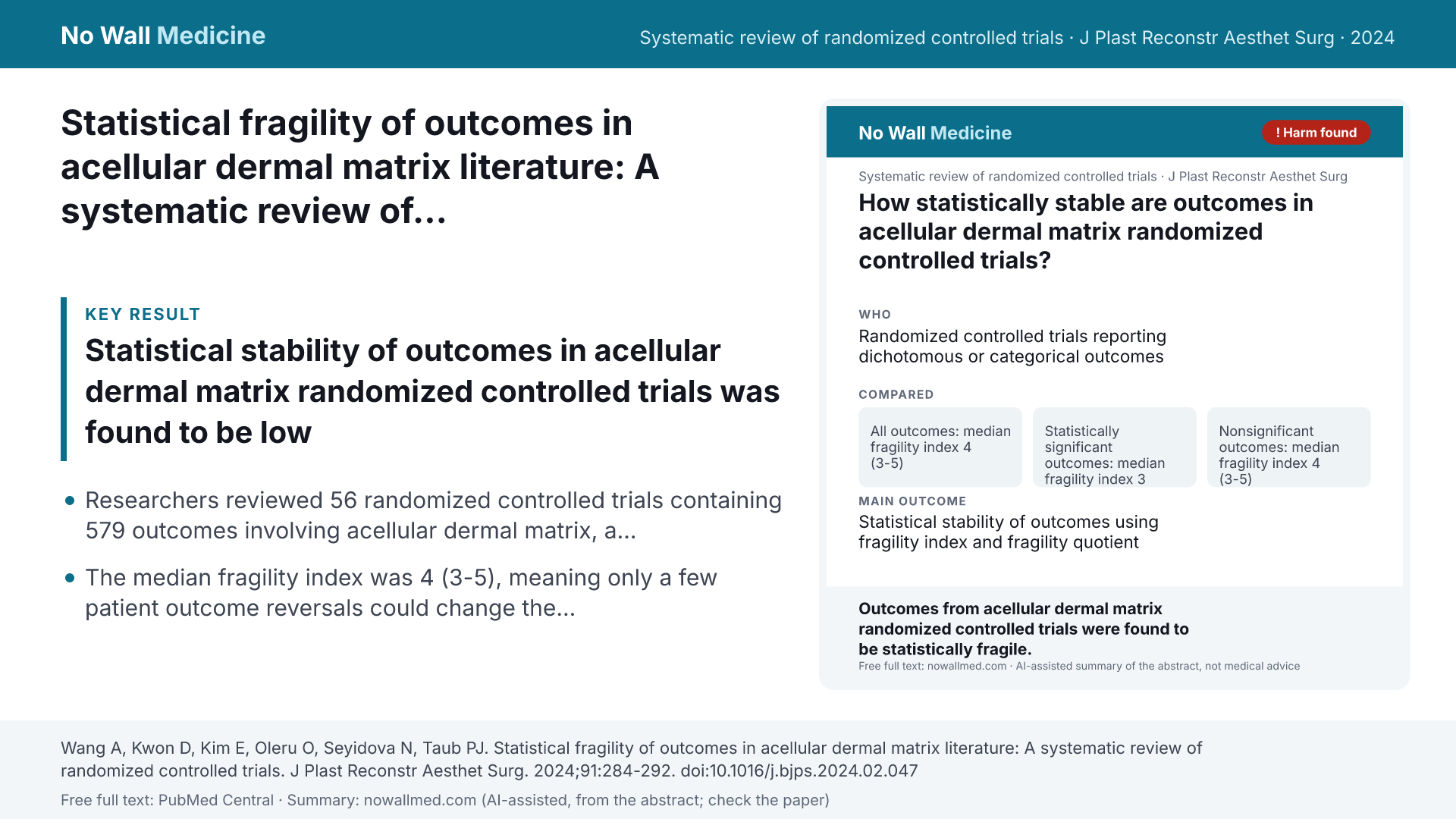
Key result: Statistical stability of outcomes in acellular dermal matrix randomized controlled trials was found to be low
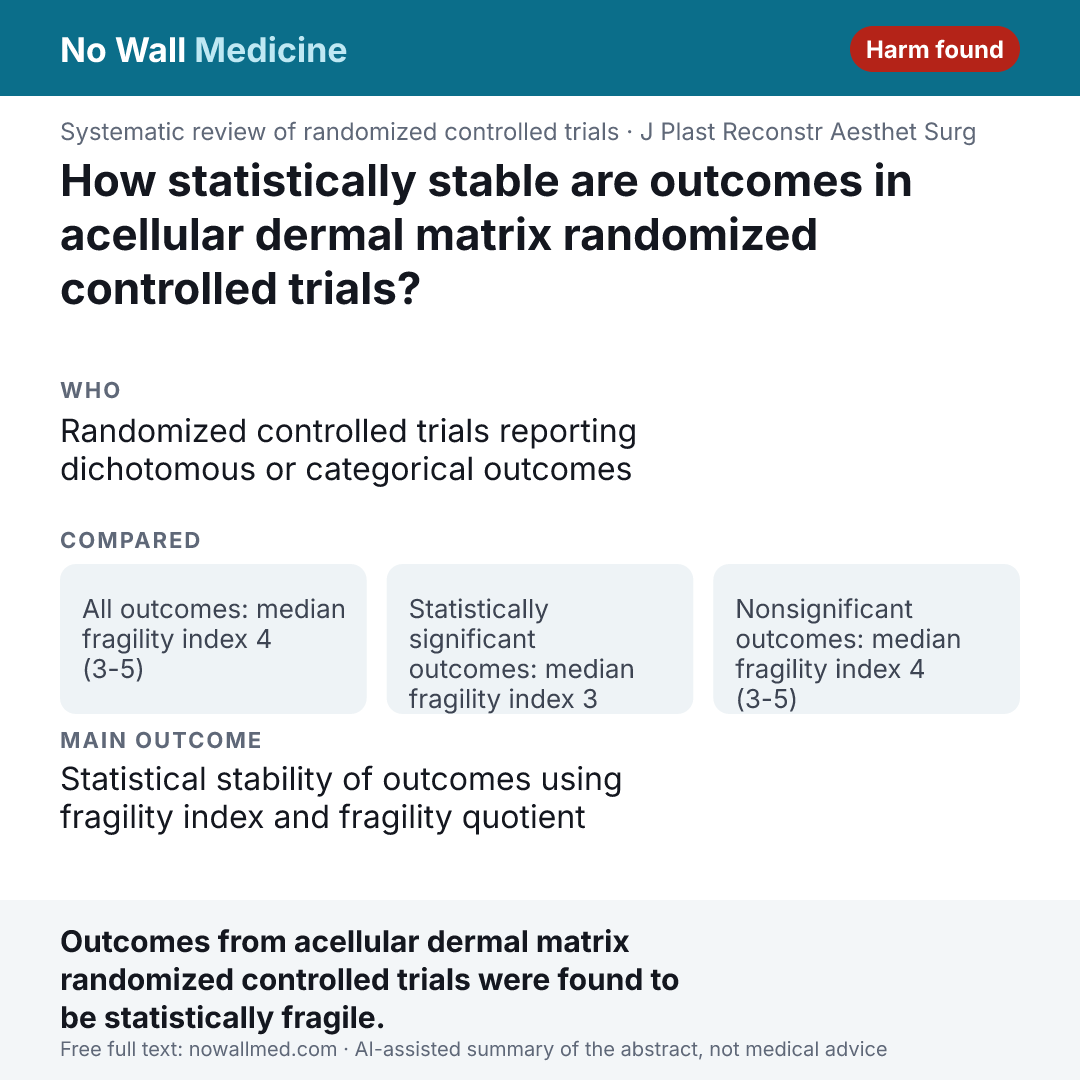
Systematic review of randomized controlled trialsHarm found
How statistically stable are outcomes in acellular dermal matrix randomized controlled trials?
Who
Randomized controlled trials reporting dichotomous or categorical outcomes
Compared
All outcomes: median fragility index 4 (3-5)
Statistically significant outcomes: median fragility index 3 (1-6)
Nonsignificant outcomes: median fragility index 4 (3-5)
Main outcome
Statistical stability of outcomes using fragility index and fragility quotient
Bottom line: Outcomes from acellular dermal matrix randomized controlled trials were found to be statistically fragile.
J Plast Reconstr Aesthet Surg · 2024-02-11 · Save PNG
Key points
- Researchers reviewed 56 randomized controlled trials containing 579 outcomes involving acellular dermal matrix, a tissue substitute used in reconstructive surgery.
- The median fragility index was 4 (3-5), meaning only a few patient outcome reversals could change the statistical significance of the results.
- In 26% of the outcomes, the number of patients lost to follow-up was equal to or greater than the fragility index.
Discussion prompts
- Would these patients look like yours? Who was left out?
- Is the main outcome one that matters to patients?
- Is the difference large enough to change what you do?
Cite: Wang A, Kwon D, Kim E, Oleru O, Seyidova N, Taub PJ. Statistical fragility of outcomes in acellular dermal matrix literature: A systematic review of randomized controlled trials. J Plast Reconstr Aesthet Surg. 2024;91:284-292. doi:10.1016/j.bjps.2024.02.047
Free full text: PubMed Central · Summary and visual abstract: nowallmed.com/a/statistical-fragility-of-outcomes-in-acellular-dermal-matrix-nmps0l/ (AI-assisted from the abstract; check the paper before relying on it).