Machine learning predicted epilepsy treatment outcomes with area under curve 0·82 to 0·94
Status, challenges, and future directions of machine learning in the management of epilepsy: a systematic review and meta-analysis
Systematic review and meta-analysisMixed results
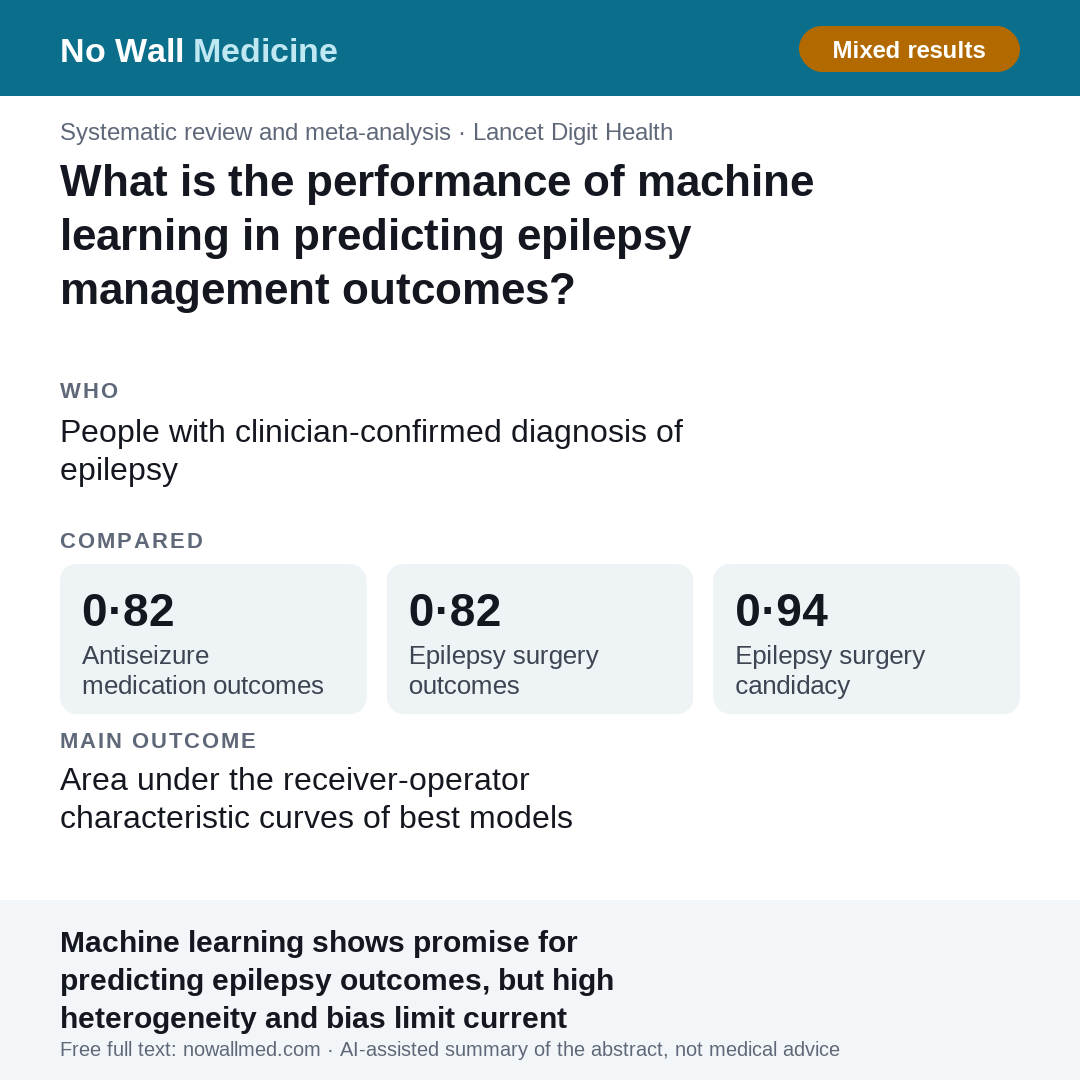
What is the performance of machine learning in predicting epilepsy management outcomes?
Who
People with clinician-confirmed diagnosis of epilepsy
Compared
0·82Antiseizure medication outcomes (95% CI 0·77-0·88)
0·82Epilepsy surgery outcomes (0·76-0·88)
0·94Epilepsy surgery candidacy (0·92-0·96)
Main outcome
Area under the receiver-operator characteristic curves of best models
Bottom line: Machine learning shows promise for predicting epilepsy outcomes, but high heterogeneity and bias limit current clinical applicability.
Limitation: High heterogeneity, high risk of bias, small sample sizes, and scarcity of external validation.
Funded by: Australian Government National Health and Medical Research Council
Lancet Digit Health · 2026-09-03Download image
Clinical question: What is the performance of machine learning in predicting epilepsy management outcomes?
Why it matters: Doctors have had limited tools to predict epilepsy treatment outcomes, leading to trial and error
Key points
- Researchers analyzed 135 studies on machine learning in epilepsy management, including 16,771 identified studies.
- The pooled area under curve was 0·82 for predicting antiseizure medication outcomes and 0·94 for epilepsy surgery candidacy.
- All included studies were rated high for overall risk of bias, with very high or high heterogeneity between studies.
Limitation the authors note: Studies had high heterogeneity and bias, particularly in small sample sizes and handling of missing data
Headline and key points written with AI from the paper’s abstract, with every number checked against it. Read the paper before relying on them.
Topics
Spotted a mistake? Suggest a correction