Triple therapy showed lower exacerbation risk than dual bronchodilator therapy in symptomatic COPD patients
Step up to triple therapy versus switch to dual bronchodilator therapy in patients with COPD on an inhaled corticosteroid/long-acting β2-agonist: post-hoc analyses of KRONOS
Post-hoc analysis of a randomized trialBenefit found
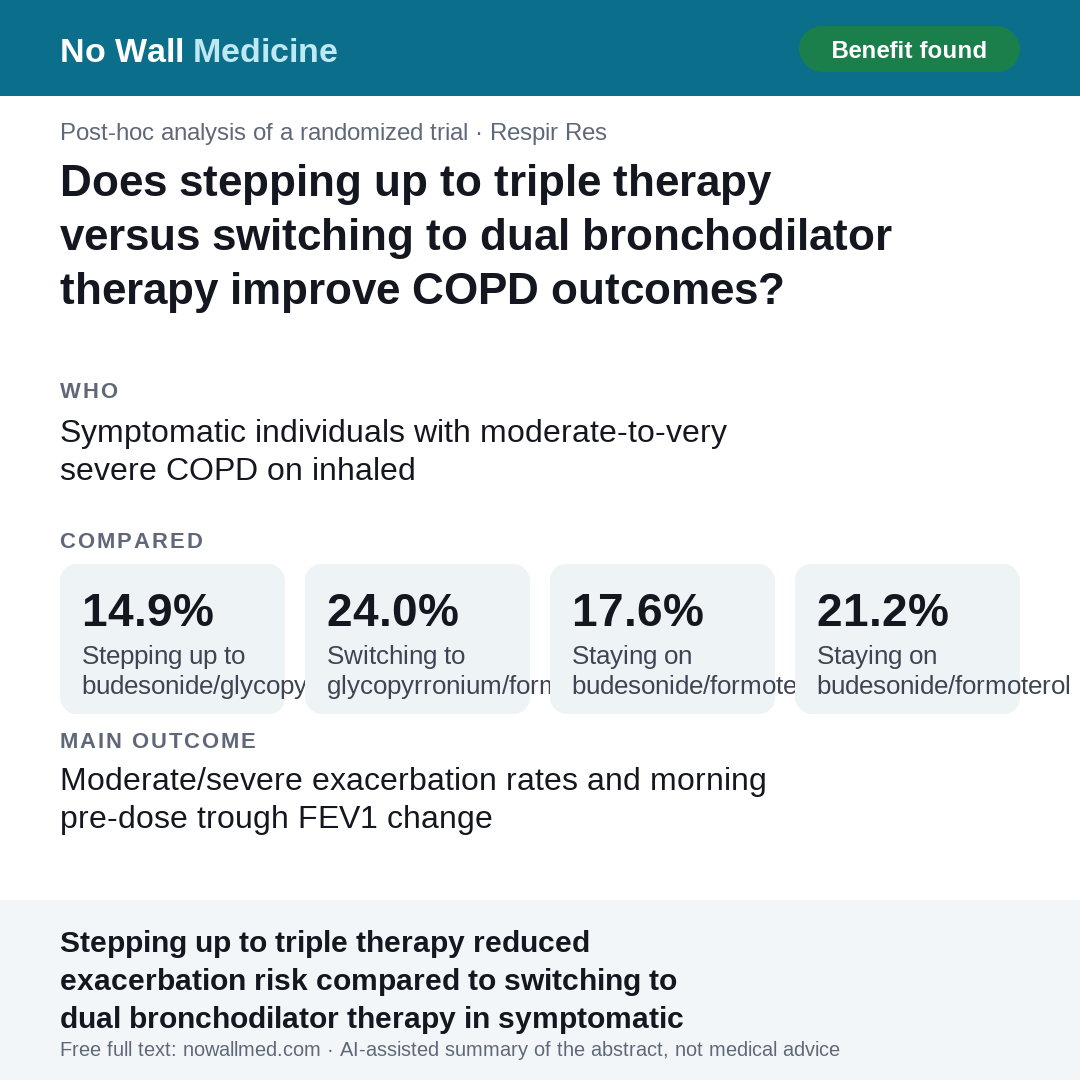
Does stepping up to triple therapy versus switching to dual bronchodilator therapy improve COPD outcomes?
Who
Symptomatic individuals with moderate-to-very severe COPD on inhaled corticosteroid/long-acting beta2-agonist
Compared
14.9%Stepping up to budesonide/glycopyrronium/formoterol
24.0%Switching to glycopyrronium/formoterol
17.6%Staying on budesonide/formoterol
21.2%Staying on budesonide/formoterol dry-powder
Main outcome
Moderate/severe exacerbation rates and morning pre-dose trough FEV1 change
Result: rate ratio 0.57 (95% CI 0.35 to 0.94)
Bottom line: Stepping up to triple therapy reduced exacerbation risk compared to switching to dual bronchodilator therapy in symptomatic COPD patients.
Limitation: This was a post-hoc analysis of the KRONOS trial.
Respir Res · 2025-05-08Download image
Clinical question: Does stepping up to triple therapy versus switching to dual bronchodilator therapy improve COPD outcomes?
Why it matters: It is unclear whether escalating to triple therapy or switching to dual bronchodilator therapy is better for exacerbation risk in symptomatic patients without a recent history of exacerbations.
Key points
- Symptomatic people with moderate-to-very severe chronic obstructive pulmonary disease were randomized to receive triple therapy, dual bronchodilator therapy, or stay on inhaled corticosteroid/long-acting beta-agonist therapy.
- Stepping up to triple therapy was associated with a lower rate of moderate or severe exacerbations compared to switching to dual bronchodilator therapy (rate ratio 0.57 [0.35, 0.94]).
- Triple therapy showed greater morning lung function improvement compared to staying on inhaled corticosteroid/long-acting beta-agonist therapy (106 [64, 148] mL versus BFF and 55 [12, 97] mL versus BUD/FORM).
Headline and key points written with AI from the paper’s abstract, with every number checked against it. Read the paper before relying on them.
Was this summary helpful?
Subject terms
Cite this article
Singh D, Bafadhel M, Arya N, Marshall J, Parikh H, Kisielewicz D. Step up to triple therapy versus switch to dual bronchodilator therapy in patients with COPD on an inhaled corticosteroid/long-acting β2-agonist: post-hoc analyses of KRONOS. Respir Res. 2025. doi:10.1186/s12931-025-03234-5
Spotted a mistake? Suggest a correction
Top studies every Monday
The week’s key trials and guidelines in your specialties, plus any topics you follow. By email, free.
Get the weekly digest