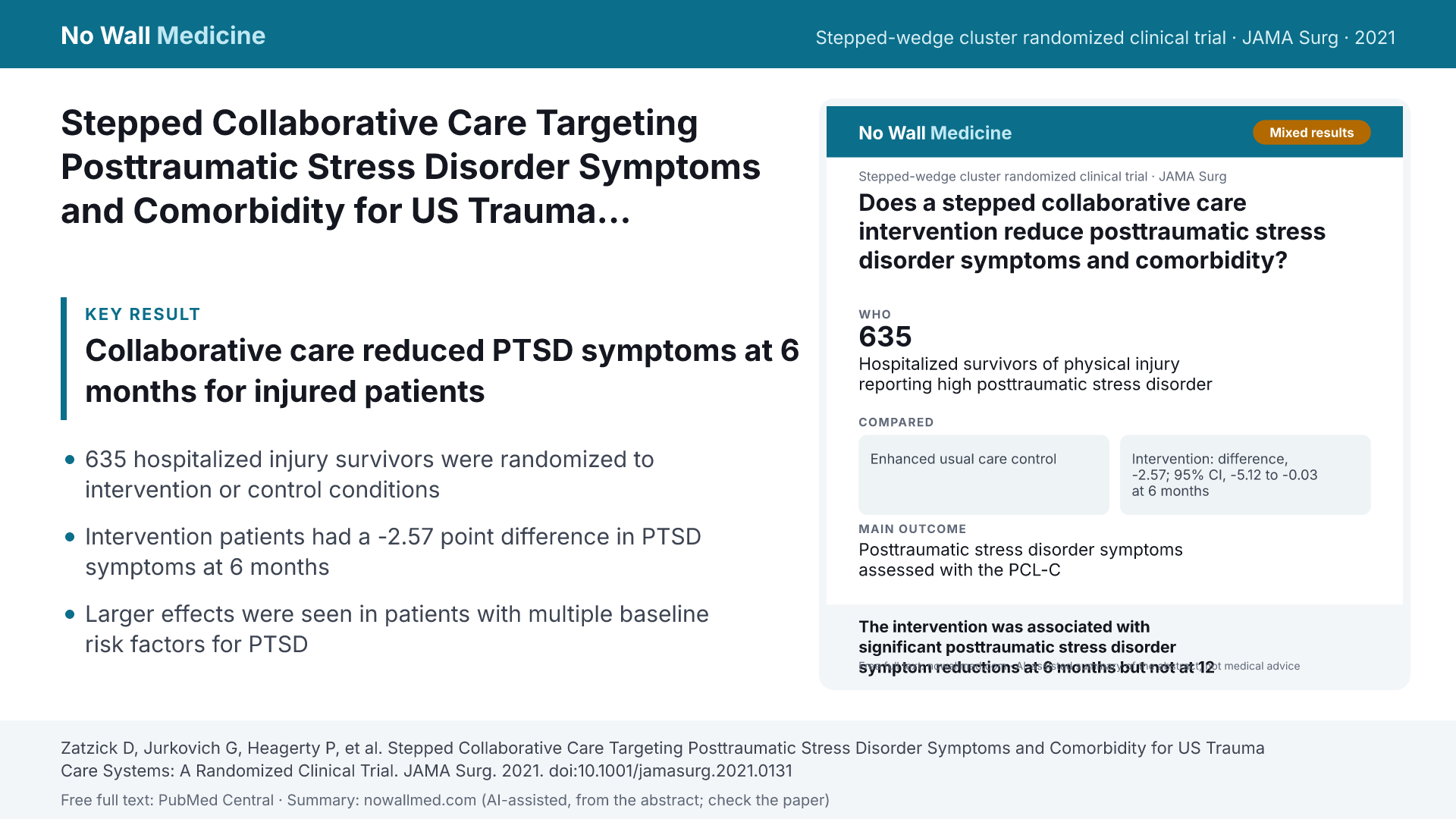
Stepped Collaborative Care Targeting Posttraumatic Stress Disorder Symptoms and Comorbidity for US Trauma Care Systems: A Randomized Clinical Trial
Key result: Collaborative care reduced PTSD symptoms at 6 months for injured patients
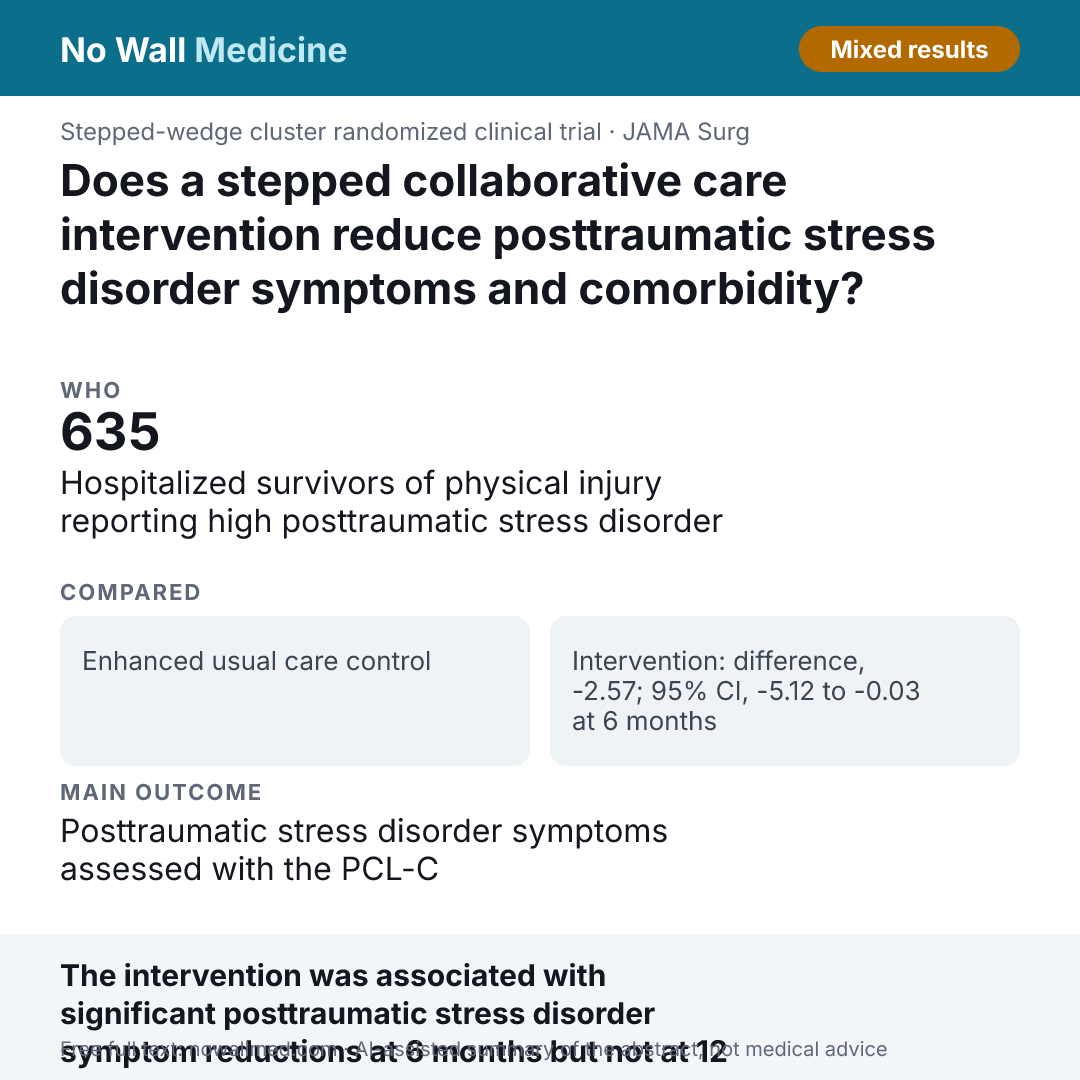
Stepped-wedge cluster randomized clinical trialMixed results
Does a stepped collaborative care intervention reduce posttraumatic stress disorder symptoms and comorbidity?
Who
635
Hospitalized survivors of physical injury reporting high posttraumatic stress disorder distress · 25 US level I trauma centers
Compared
Enhanced usual care control
Intervention: difference, -2.57; 95% CI, -5.12 to -0.03 at 6 months
Main outcome
Posttraumatic stress disorder symptoms assessed with the PCL-C
Result: difference, -2.57; 95% CI, -5.12 to -0.03 at 6 months
Bottom line: The intervention was associated with significant posttraumatic stress disorder symptom reductions at 6 months but not at 12 months.
JAMA Surg · 2021-03-11 · Save PNG
Key points
- 635 hospitalized injury survivors were randomized to intervention or control conditions.
- Intervention patients had a -2.57 point difference in PTSD symptoms at 6 months.
- Larger effects were seen in patients with multiple baseline risk factors for PTSD.
Discussion prompts
- Would these patients look like yours? Who was left out?
- Is the main outcome one that matters to patients?
- Is the difference large enough to change what you do?
Cite: Zatzick D, Jurkovich G, Heagerty P, et al. Stepped Collaborative Care Targeting Posttraumatic Stress Disorder Symptoms and Comorbidity for US Trauma Care Systems: A Randomized Clinical Trial. JAMA Surg. 2021. doi:10.1001/jamasurg.2021.0131
Free full text: PubMed Central · Summary and visual abstract: nowallmed.com/a/stepped-collaborative-care-targeting-posttraumatic-stress-disorder-ntph8b/ (AI-assisted from the abstract; check the paper before relying on it).