Peyton's four-step teaching approach showed no advantage over other stepwise methods for resuscitation skills
Stepwise approach to skills teaching in resuscitation: A systematic review
Systematic review of 17 studiesNo clear difference
Is Peyton's four-step approach more effective than alternative approaches for teaching resuscitation skills?
Who
2,906
Lay persons to health care professionals
Compared
Peyton's four-step approach
Alternative stepwise approaches
Main outcome
Skill acquisition or retention
Bottom line: Very low certainty evidence suggests Peyton's four-step approach was not more effective than alternative stepwise approaches.
Limitation: High methodological and clinical heterogeneity and very low certainty of evidence due to imprecision and inconsistency.
Resusc Plus · 2023-08-28Download image
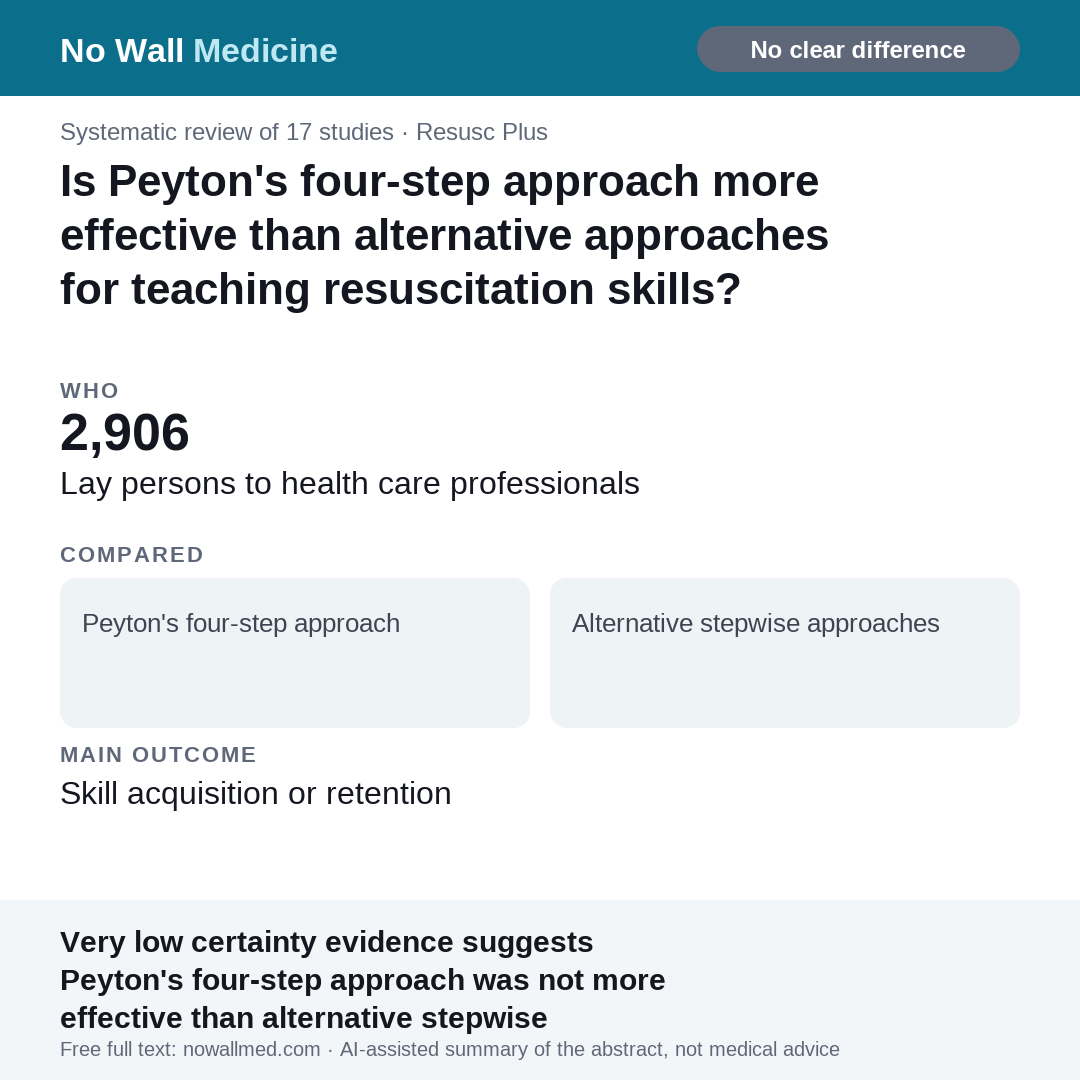
Clinical question: Is Peyton's four-step approach more effective than alternative approaches for teaching resuscitation skills?
Why it matters: It was unknown if Peyton's four-step approach for teaching resuscitation and first aid skills is more effective than other stepwise teaching methods.
Key points
- Researchers reviewed 17 studies involving 2,906 participants ranging from lay persons to healthcare professionals to compare different stepwise teaching methods.
- Out of 17 studies, 14 showed no difference in skill acquisition or retention when comparing Peyton's four-step approach to other stepwise methods.
- The certainty of evidence across all included studies was rated as very low due to imprecision and inconsistency.
Limitation the authors note: High methodological and clinical heterogeneity precluded a meta-analysis from being conducted.
Headline and key points written with AI from the paper’s abstract, with every number checked against it. Read the paper before relying on them.
Was this summary helpful?
Cite this article
Breckwoldt J, Cheng A, Lauridsen KG, Lockey A, Yeung J, Greif R. Stepwise approach to skills teaching in resuscitation: A systematic review. Resusc Plus. 2023. doi:10.1016/j.resplu.2023.100457
Spotted a mistake? Suggest a correction
Top studies every Monday
The week’s key trials and guidelines in your specialties, plus any topics you follow. By email, free.
Get the weekly digest