Stereotactic Body and Conventional Radiotherapy for Painful Bone Metastases: A Systematic Review and Meta-Analysis
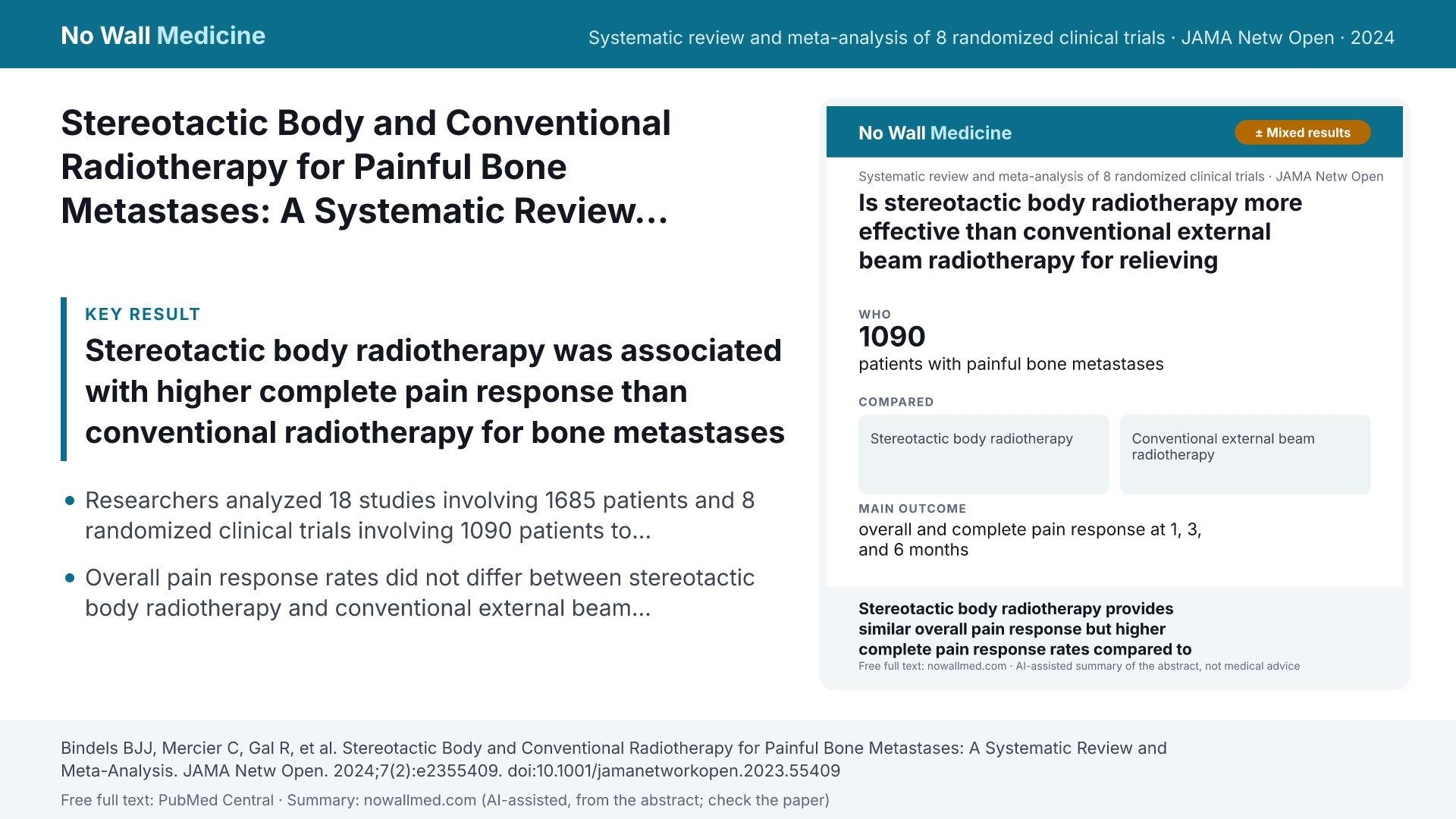
Key result: Stereotactic body radiotherapy was associated with higher complete pain response than conventional radiotherapy for bone metastases
Key points
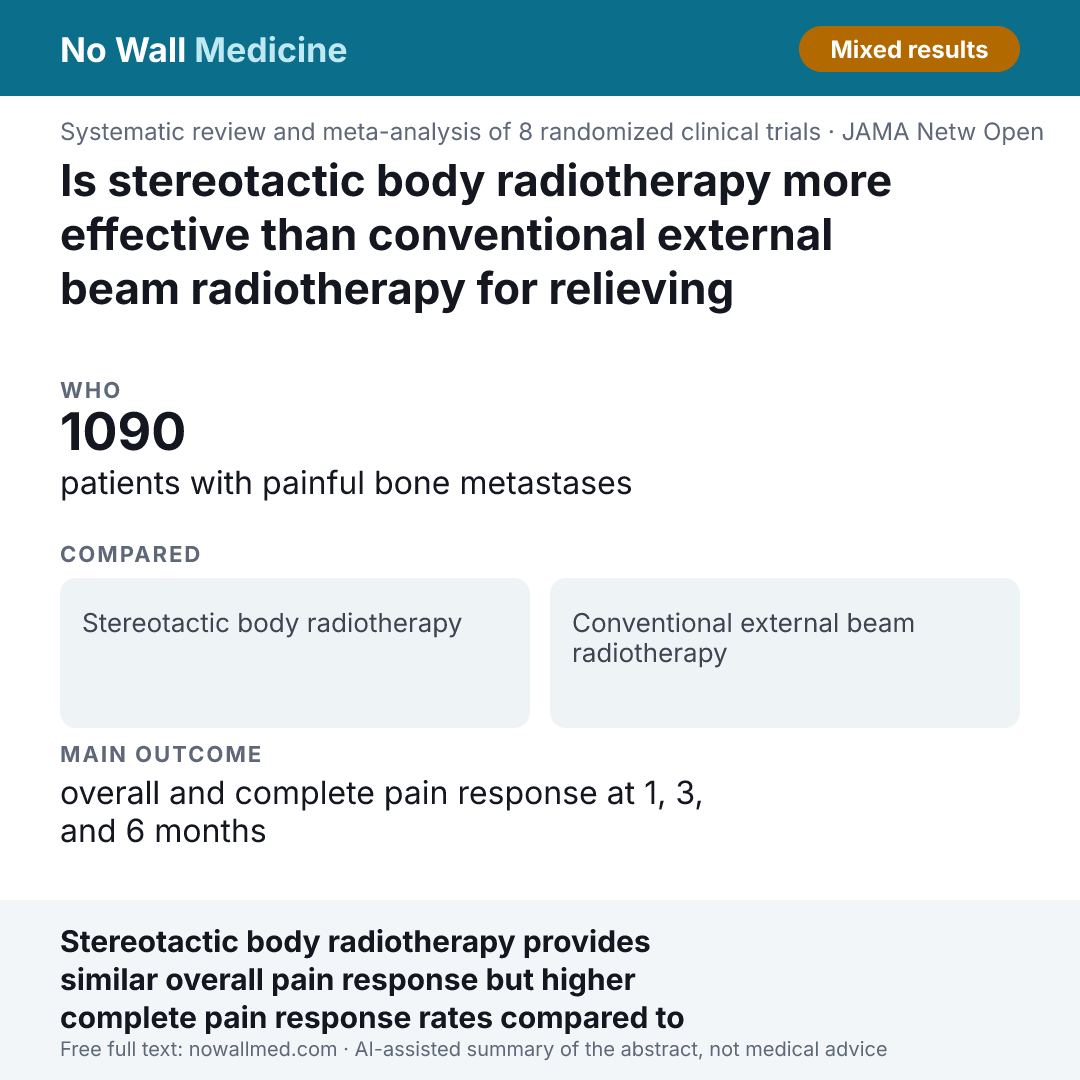
- Researchers analyzed 18 studies involving 1685 patients and 8 randomized clinical trials involving 1090 patients to compare two types of radiation therapy.
- Overall pain response rates did not differ between stereotactic body radiotherapy and conventional external beam radiotherapy at 1 (RR, 1.14; 95% CI, 0.99-1.30), 3 (RR, 1.19; 95% CI, 0.96-1.47), or 6 (RR, 1.22; 95% CI, 0.96-1.54) months.
- Stereotactic body radiotherapy was associated with a higher complete pain response at 1 (RR, 1.43; 95% CI, 1.02-2.01), 3 (RR, 1.80; 95% CI, 1.16-2.78), and 6 (RR, 2.47; 95% CI, 1.24-4.91) months.
Why it matters: The effectiveness of stereotactic body radiotherapy compared to conventional external beam radiotherapy for relieving metastatic bone pain has been a subject of debate with conflicting results.
Discussion prompts
- Would these patients look like yours? Who was left out?
- Is the main outcome one that matters to patients?
- Is the difference large enough to change what you do?
Cite: Bindels BJJ, Mercier C, Gal R, et al. Stereotactic Body and Conventional Radiotherapy for Painful Bone Metastases: A Systematic Review and Meta-Analysis. JAMA Netw Open. 2024;7(2):e2355409. doi:10.1001/jamanetworkopen.2023.55409
Free full text: PubMed Central · Summary and visual abstract: nowallmed.com/a/stereotactic-body-and-conventional-radiotherapy-for-painful-bone-1untfe0/ (AI-assisted from the abstract; check the paper before relying on it).