Intervention strategies were associated with higher rates of genetic testing for relatives of cancer patients
Strategies to improve implementation of cascade testing in hereditary cancer syndromes: a systematic review
Systematic reviewBenefit found
What intervention strategies improve implementation of cascade testing in hereditary cancer syndromes?
Who
At-risk relatives in hereditary cancer syndromes
Compared
68%Delivery arrangement interventions
Other EPOC taxonomy strategies
Main outcome
Rates of genetic testing uptake
Bottom line: Most interventions improve cascade testing uptake, but intervention descriptions and implementation outcome assessments are often suboptimal.
Limitation: Suboptimal quality of intervention descriptions and assessment of implementation outcomes.
NPJ Genom Med · 2024-04-03Download image
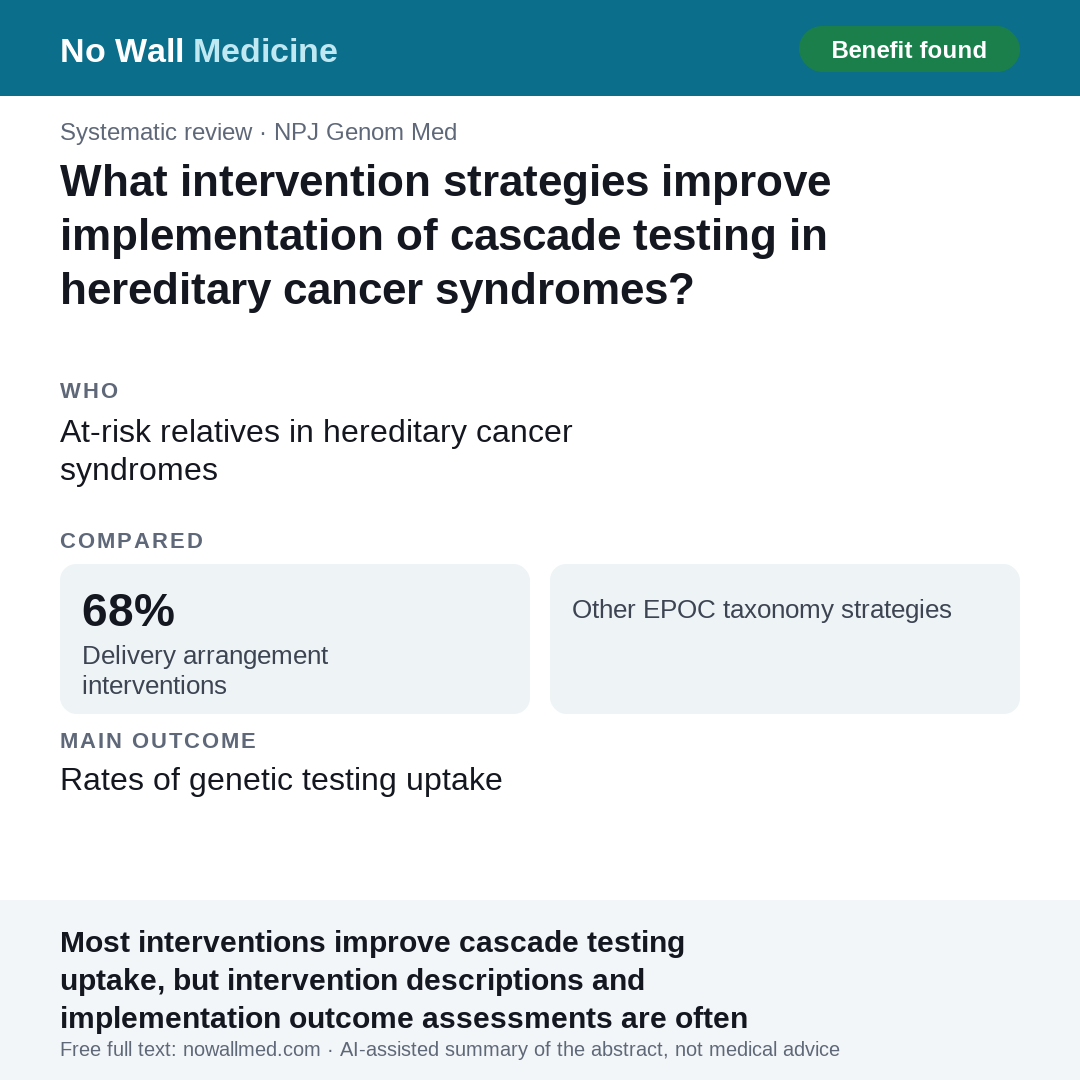
Clinical question: What intervention strategies improve implementation of cascade testing in hereditary cancer syndromes?
Why it matters: Current literature shows that rates of cascade testing for at-risk relatives are typically below 30%, and it is unclear which intervention strategies most effectively improve these rates.
Key points
- Researchers systematically reviewed existing literature on intervention strategies used to improve cascade testing, which is the process of testing at-risk relatives for familial genetic mutations.
- The highest uptake of cascade testing was associated with delivery arrangement strategies at 68%, though overall testing rates are typically below 30%.
- The average quality score for intervention descriptions was 7.3 out of 12, while only 3.7% of studies reported on cost, fidelity, or sustainability.
Headline and key points written with AI from the paper’s abstract, with every number checked against it. Read the paper before relying on them.
Was this summary helpful?
Cite this article
Chiang J, Chua Z, Chan JY, Sule AA, Loke WH, Lum E. Strategies to improve implementation of cascade testing in hereditary cancer syndromes: a systematic review. NPJ Genom Med. 2024. doi:10.1038/s41525-024-00412-0
Spotted a mistake? Suggest a correction
Top studies every Monday
The week’s key trials and guidelines in your specialties, plus any topics you follow. By email, free.
Get the weekly digest