Occlusion-first strategy shows better outcomes than ablation-first in combined atrial fibrillation procedures
Strategy Optimization for a Combined Procedure in Patients With Atrial Fibrillation: The COMBINATION Randomized Clinical Trial
Prospective, multicenter randomized clinical trialBenefit found
Does ablation-first or occlusion-first strategy improve outcomes in combined LAAO and catheter ablation?
Who
202
Patients with nonvalvular atrial fibrillation · 14 high-volume centers in China
Compared
71.1%Ablation-first
83.5%Occlusion-first
Main outcome
Composite of thromboembolic events, device-related thrombus, bleeding, and cardiovascular rehospitalization or death
Result: hazard ratio 0.53 (95% CI, 0.29-0.95)
Bottom line: The occlusion-first approach resulted in higher event-free survival and better long-term freedom from atrial tachyarrhythmia.
JAMA Netw Open · 2024-11-04Download image
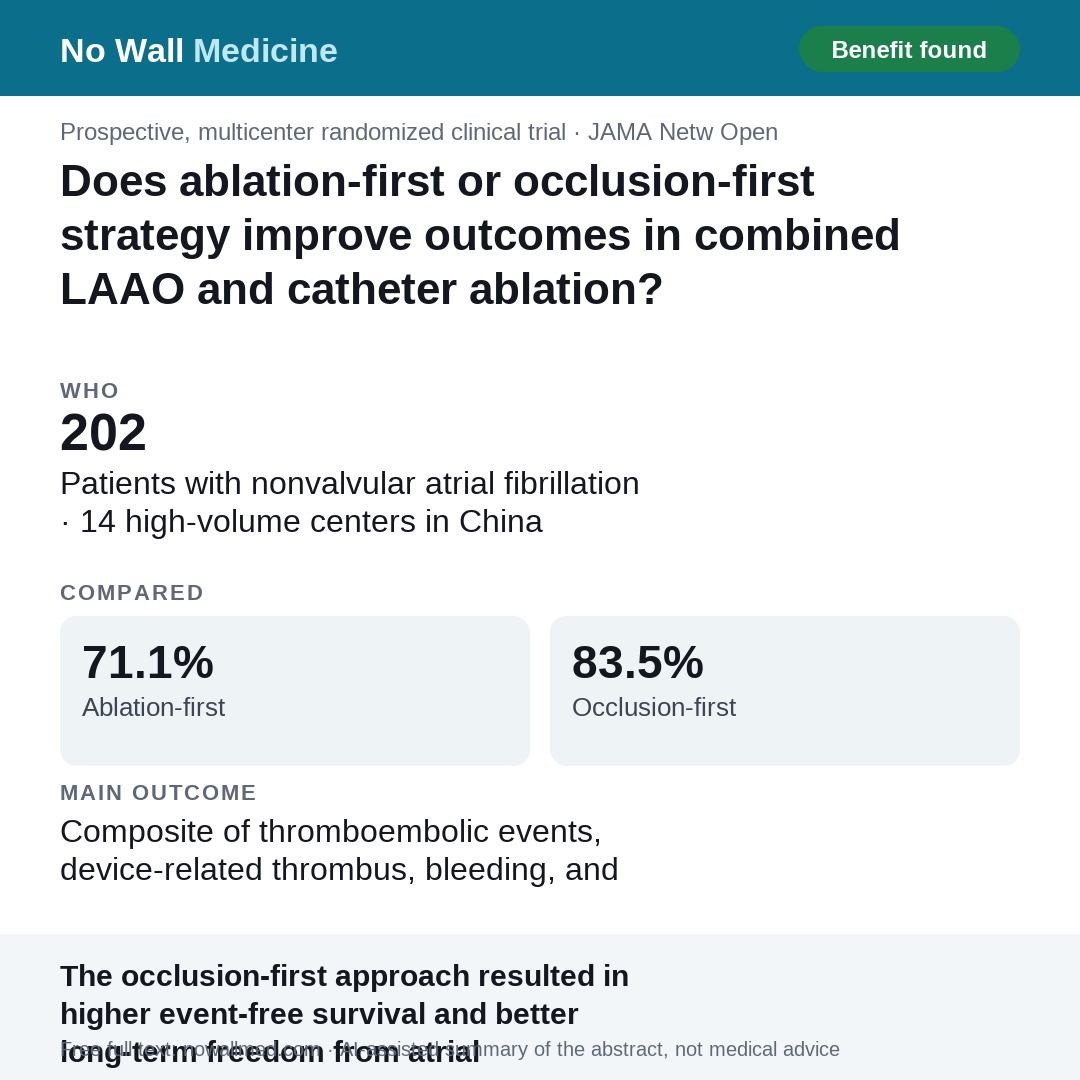
Clinical question: Does ablation-first or occlusion-first strategy improve outcomes in combined LAAO and catheter ablation?
Why it matters: The optimal sequence of performing catheter ablation and left atrial appendage occlusion during a single procedure for patients with atrial fibrillation is unknown.
Key points
- Researchers randomized 202 patients with nonvalvular atrial fibrillation to receive either catheter ablation or left atrial appendage occlusion first during a single procedure.
- The occlusion-first group had higher event-free survival for the primary composite endpoint of stroke, blood clots in the device, bleeding, or death compared to the ablation-first group (83.5% vs 71.1%).
- The occlusion-first group also had higher rates of long-term freedom from atrial fibrillation (77.3% vs 63.5%) and atrial tachyarrhythmia (70.1% vs 55.7%) than the ablation-first group.
Headline and key points written with AI from the paper’s abstract, with every number checked against it. Read the paper before relying on them.
Topics
Cite this article
Du X, Chu H, Yang B, Zhong J, Ruan Z, Chen Q. Strategy Optimization for a Combined Procedure in Patients With Atrial Fibrillation: The COMBINATION Randomized Clinical Trial. JAMA Netw Open. 2024. doi:10.1001/jamanetworkopen.2024.45084
Spotted a mistake? Suggest a correction
Top studies every Monday
The week’s key trials and guidelines in your specialties, plus any topics you follow. By email, free.
Get the weekly digest