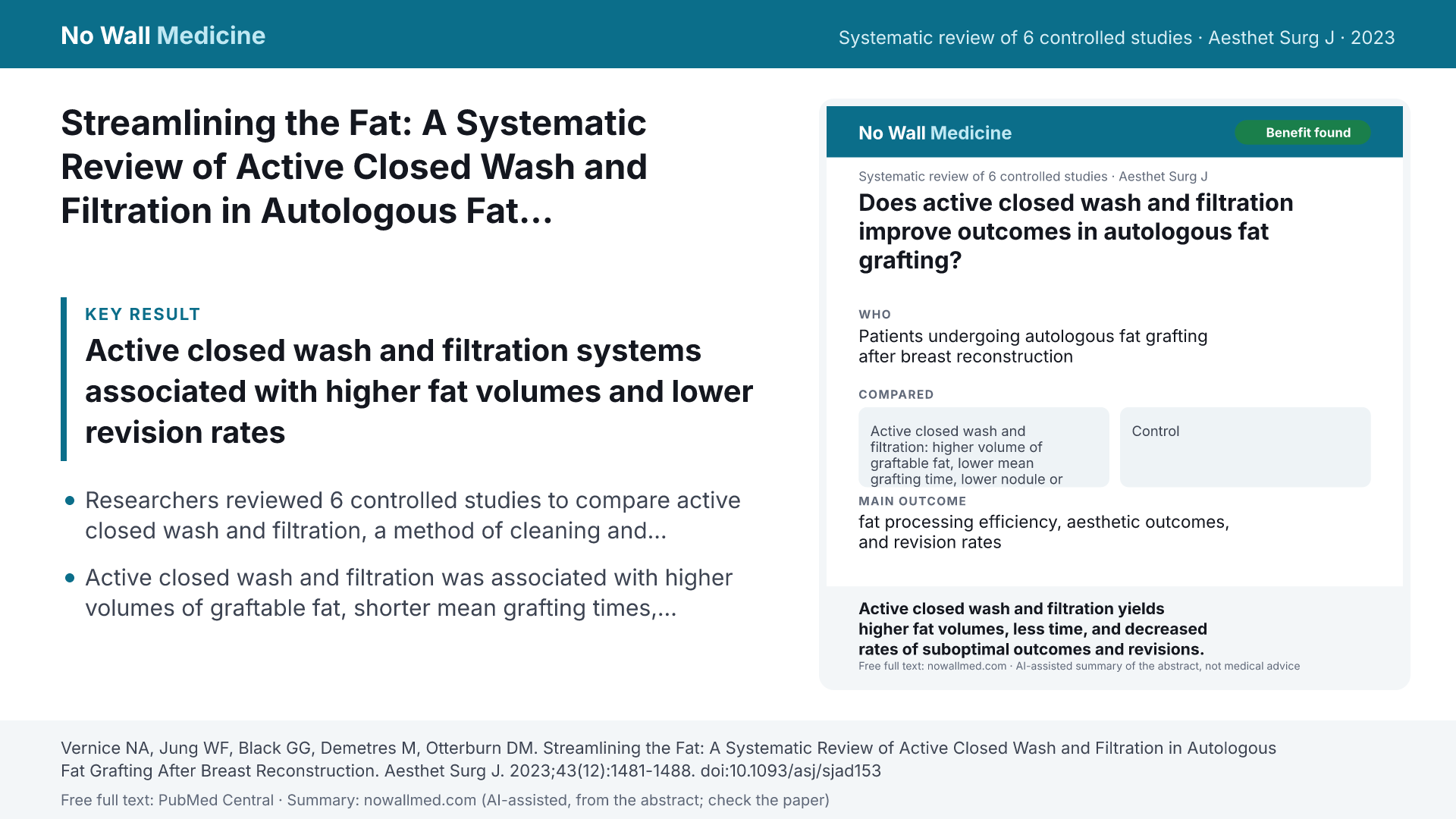
Active closed wash and filtration systems associated with higher fat volumes and lower revision rates
Streamlining the Fat: A Systematic Review of Active Closed Wash and Filtration in Autologous Fat Grafting After Breast Reconstruction
Systematic review of 6 controlled studiesBenefit found
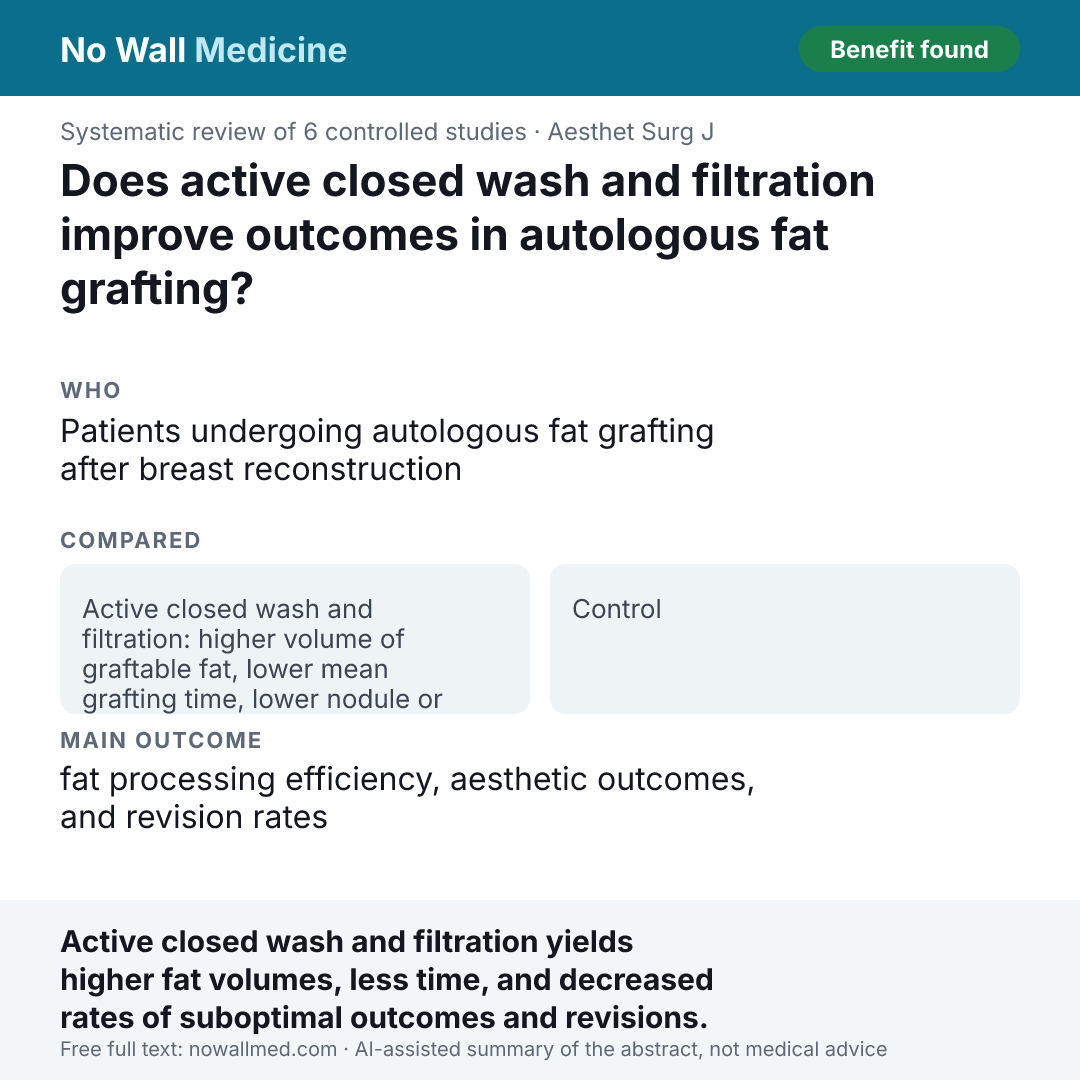
Does active closed wash and filtration improve outcomes in autologous fat grafting?
Who
Patients undergoing autologous fat grafting after breast reconstruction
Compared
Active closed wash and filtration: higher volume of graftable fat, lower mean grafting time, lower nodule or cyst formation, lower fat necrosis, lower revision rates
Control
Main outcome
fat processing efficiency, aesthetic outcomes, and revision rates
Bottom line: Active closed wash and filtration yields higher fat volumes, less time, and decreased rates of suboptimal outcomes and revisions.
Aesthet Surg J · 2023-05-21 · Save PNG
Clinical question: Does active closed wash and filtration improve outcomes in autologous fat grafting?
Why it matters: The optimal technique for processing fat during breast reconstruction remains unknown and outcomes are currently varied.
Key points
- Researchers reviewed 6 controlled studies to compare active closed wash and filtration, a method of cleaning and filtering fat, against other processing techniques in breast reconstruction.
- Active closed wash and filtration was associated with higher volumes of graftable fat, shorter mean grafting times, and lower rates of nodules, cysts, or fat necrosis.
- The use of active closed wash and filtration was associated with significantly lower revision rates compared to control methods in 3 studies.
Headline and key points written with AI from the paper’s abstract, with every number checked against it. Read the paper before relying on them.
Was this summary helpful?
Subject terms
Headline, design, result, key points, caveat and citation as plain text.
Cite this article
Vernice NA, Jung WF, Black GG, Demetres M, Otterburn DM. Streamlining the Fat: A Systematic Review of Active Closed Wash and Filtration in Autologous Fat Grafting After Breast Reconstruction. Aesthet Surg J. 2023;43(12):1481-1488. doi:10.1093/asj/sjad153
Spotted a mistake? Suggest a correction