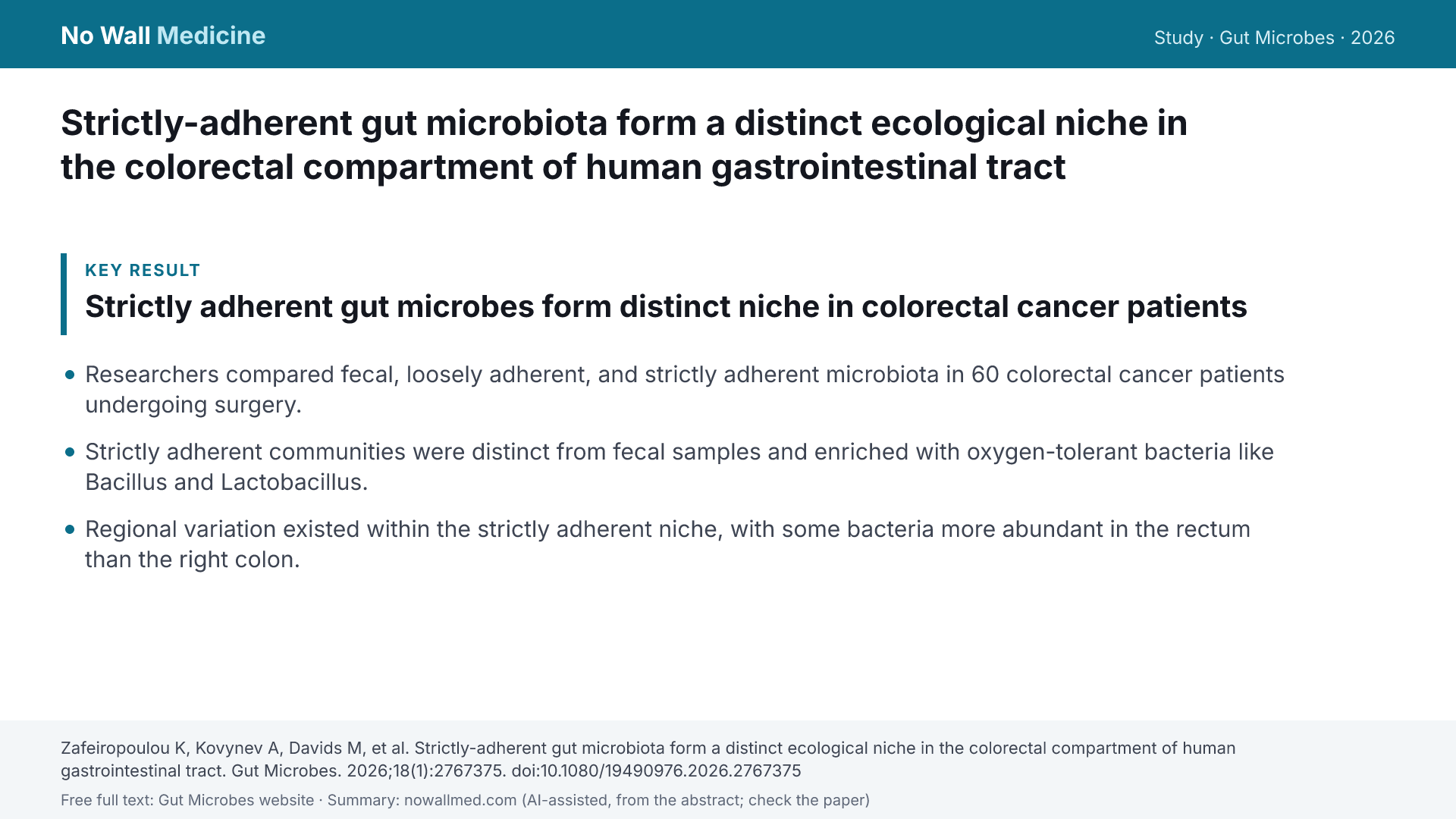
Strictly-adherent gut microbiota form a distinct ecological niche in the colorectal compartment of human gastrointestinal tract
Key result: Strictly adherent gut microbes form distinct niche in colorectal cancer patients
Key points
- Researchers compared fecal, loosely adherent, and strictly adherent microbiota in 60 colorectal cancer patients undergoing surgery.
- Strictly adherent communities were distinct from fecal samples and enriched with oxygen-tolerant bacteria like Bacillus and Lactobacillus.
- Regional variation existed within the strictly adherent niche, with some bacteria more abundant in the rectum than the right colon.
Why it matters: Applies to colorectal cancer patients; highlights that fecal samples may not capture the distinct microbial community close to the intestinal wall.
Discussion prompts
- Would these patients look like yours? Who was left out?
- Is the main outcome one that matters to patients?
- Is the difference large enough to change what you do?
Cite: Zafeiropoulou K, Kovynev A, Davids M, et al. Strictly-adherent gut microbiota form a distinct ecological niche in the colorectal compartment of human gastrointestinal tract. Gut Microbes. 2026;18(1):2767375. doi:10.1080/19490976.2026.2767375
Free full text: Gut Microbes website · Summary and visual abstract: nowallmed.com/a/strictly-adherent-gut-microbiota-form-a-distinct-ecological-niche-in-g8aafa/ (AI-assisted from the abstract; check the paper before relying on it).