Structured mobilization intervention did not increase maximal mobility scores for critically ill patients
Structured Mobilization for Critically Ill Patients: A Pragmatic Cluster-randomized Trial
Cluster-randomized trialBenefit found
Does mobilization improve recovery in critically ill patients
Who
848, 1069
Critically ill patients in ICUs · 12 ICUs
Compared
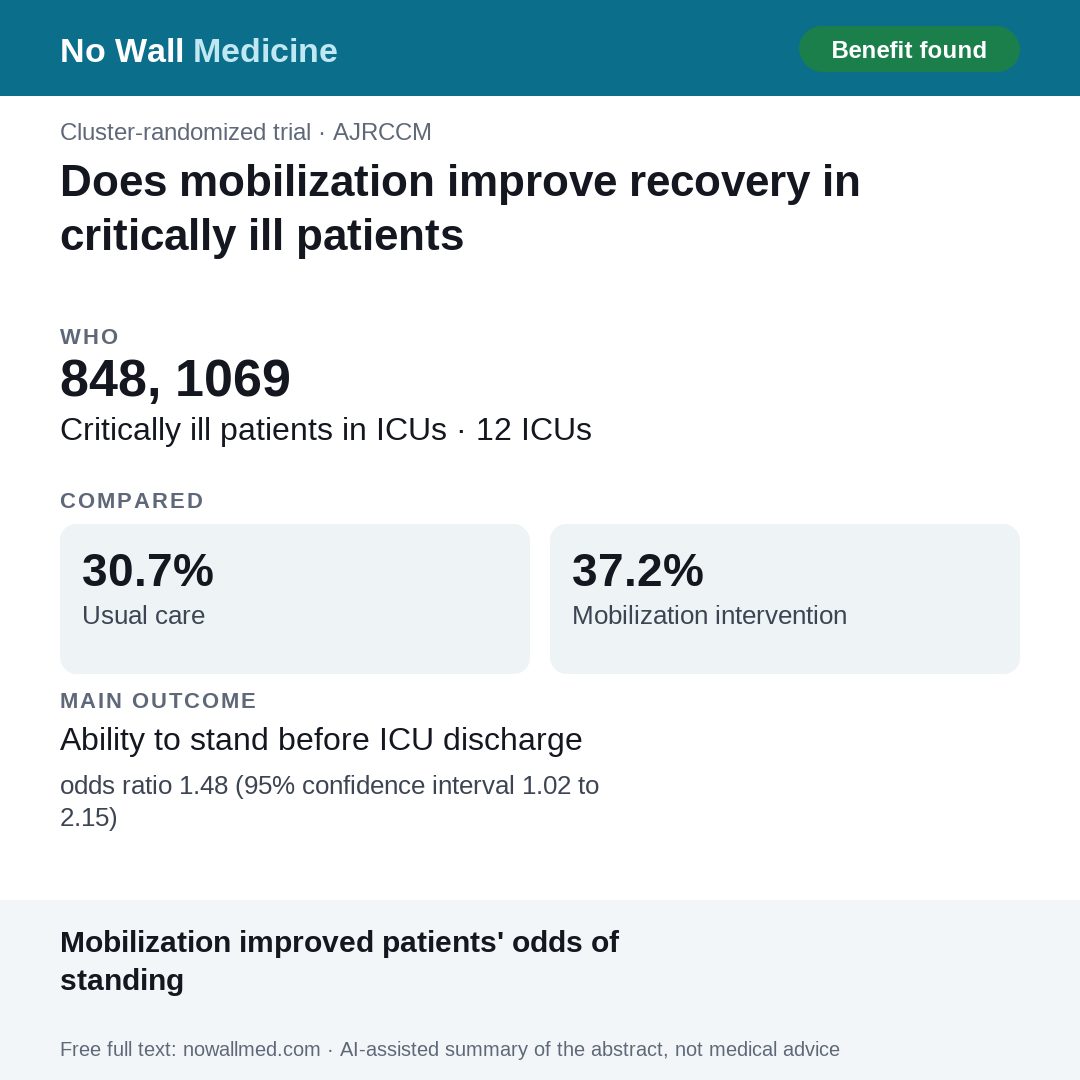
30.7%Usual care
37.2%Mobilization intervention
Main outcome
Ability to stand before ICU discharge
Result: odds ratio 1.48 (95% confidence interval 1.02 to 2.15)
Bottom line: Mobilization improved patients' odds of standing
AJRCCM · 2023-03-31Download image
Why it matters: The real-world effectiveness of low-cost, multifaceted mobilization interventions for critically ill patients is unknown.
In absolute numbers
Usual care: 30.7% · Mobilization intervention: 37.2% → a difference of 6.5 percentage points, so about 16 people would need the treatment for 1 more to benefit (number needed to treat) over the trial’s follow-up.
Worked out by us from the two group results above, not reported by the authors. Check the paper for the exact outcome and timing.
Key points
- Researchers conducted a trial across 12 intensive care units involving 848 patients receiving usual care and 1,069 patients receiving a multifaceted mobilization intervention.
- The intervention did not increase the primary outcome of maximal Intensive Care Mobility Scale scores, with an estimated mean difference of 0.16 (95% confidence interval, -0.31 to 0.63; P = 0.51).
- More patients in the intervention group (37.2%) achieved the ability to stand before discharge compared to the usual care group (30.7%) (odds ratio, 1.48; 95% confidence interval, 1.02 to 2.15; P = 0.04).
Headline and key points written with AI from the paper’s abstract, with every number checked against it. Read the paper before relying on them.
Was this summary helpful?
Subject terms
Cite this article
Schweickert WD, Jablonski J, Bayes B, Chowdhury M, Whitman C, Tian J. Structured Mobilization for Critically Ill Patients: A Pragmatic Cluster-randomized Trial. AJRCCM. 2023. doi:10.1164/rccm.202209-1763OC
Spotted a mistake? Suggest a correction
Top studies every Monday
The week’s key trials and guidelines in your specialties, plus any topics you follow. By email, free.
Get the weekly digest