Researchers plan to study if omega-3 supplementation protects against heat and ozone exposure
Study Protocol for a Randomized Controlled Trial Investigating Acute Cardiometabolic Responses to Heat-Ozone Coexposure and the Interventional Role of Omega-3 Eicosapentaenoic Acid: The HOEPA Study
Randomized, double-blind, placebo-controlled trialUnclear result
Does eicosapentaenoic acid supplementation mitigate acute cardiometabolic impairments from heat and ozone coexposure?
Who
48
Healthy adult participants
Compared
eicosapentaenoic acid (3 g/d)
corn oil placebo
Main outcome
activated partial thromboplastin time
Bottom line: This study protocol investigates if eicosapentaenoic acid mitigates cardiometabolic impacts from heat and ozone exposure.
J Am Heart Assoc · 2026-09-09Download image
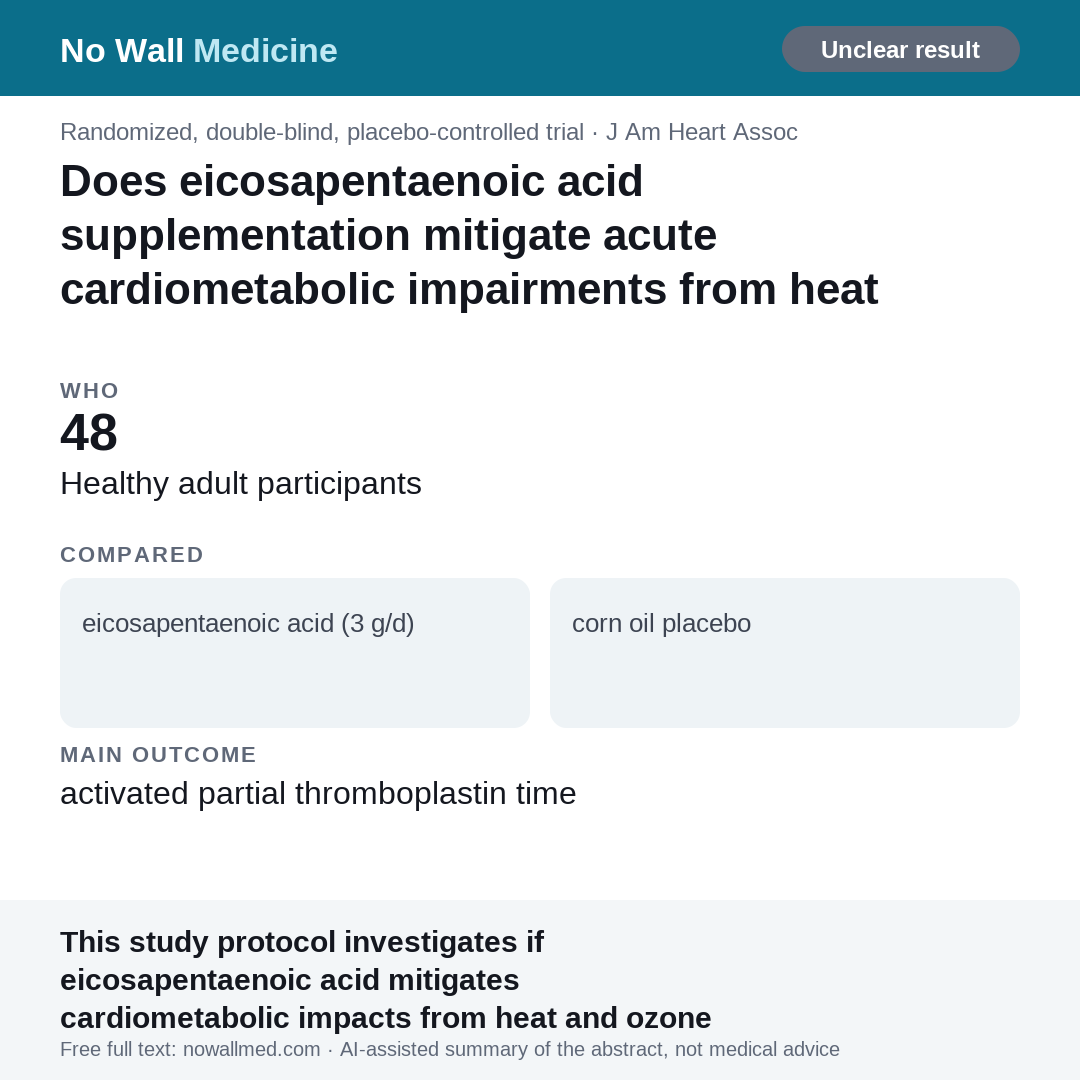
Clinical question: Does eicosapentaenoic acid supplementation mitigate acute cardiometabolic impairments from heat and ozone coexposure?
Why it matters: The combined effects of extreme heat and ozone exposure on cardiovascular and metabolic health, and how to mitigate these effects, are poorly understood.
Key points
- The study will involve 48 healthy adults assigned to receive either 3 g/d of eicosapentaenoic acid or a corn oil placebo for 4 weeks.
- Researchers will measure how these participants respond to ozone at 200 ppb and heat at 32 °C, focusing on blood clotting and vascular function.
- The primary outcome being measured is the activated partial thromboplastin time, which is a test used to evaluate how quickly blood clots.
Headline and key points written with AI from the paper’s abstract, with every number checked against it. Read the paper before relying on them.
Topics
Spotted a mistake? Suggest a correction
More in Cardiology
Clonal hematopoiesis mutations linked to higher atrial fibrillation risk in cancer populations
Association of Clonal Hematopoiesis Mutations With Incident Atrial Fibrillation: A Systematic Review and Meta-Analysis
Deep learning model detects aortic stenosis from finger-cuff pressure waveforms accurately
Aortic Valve Stenosis Screening Using Deep Learning on Noninvasive Arterial Pressure Waveforms
Spontaneous coronary artery dissection affects younger women more often than expected
Spontaneous coronary artery dissection: implications for women's health, clinical care, and future research
Early lipid-lowering strategies may reduce atherosclerotic cardiovascular disease risk
Lipid-Lowering Strategies in the Era of Early Atherosclerosis Detection: 2026 ACC Scientific Statement: A Report of the American College of Cardiology