Subcutaneous amivantamab with lazertinib showed similar efficacy and longer survival than intravenous administration
Subcutaneous Versus Intravenous Amivantamab, Both in Combination With Lazertinib, in Refractory Epidermal Growth Factor Receptor-Mutated Non-Small Cell Lung Cancer: Primary Results From the Phase III PALOMA-3 Study
Randomized Phase III trialBenefit found
Is subcutaneous amivantamab plus lazertinib noninferior to intravenous amivantamab plus lazertinib?
Who
418
Patients with epidermal growth factor receptor-mutated advanced non-small cell lung cancer
Compared
Subcutaneous amivantamab and lazertinib: median progression-free survival 6.1 months
Intravenous amivantamab and lazertinib: median progression-free survival 4.3 months
Main outcome
Overall survival
Result: hazard ratio 0.62 (95% CI 0.42 to 0.92)
Bottom line: Subcutaneous amivantamab with lazertinib showed noninferiority, improved convenience, fewer infusion-related reactions, and prolonged survival compared to intravenous administration.
J Clin Oncol · 2024-06-10Download image
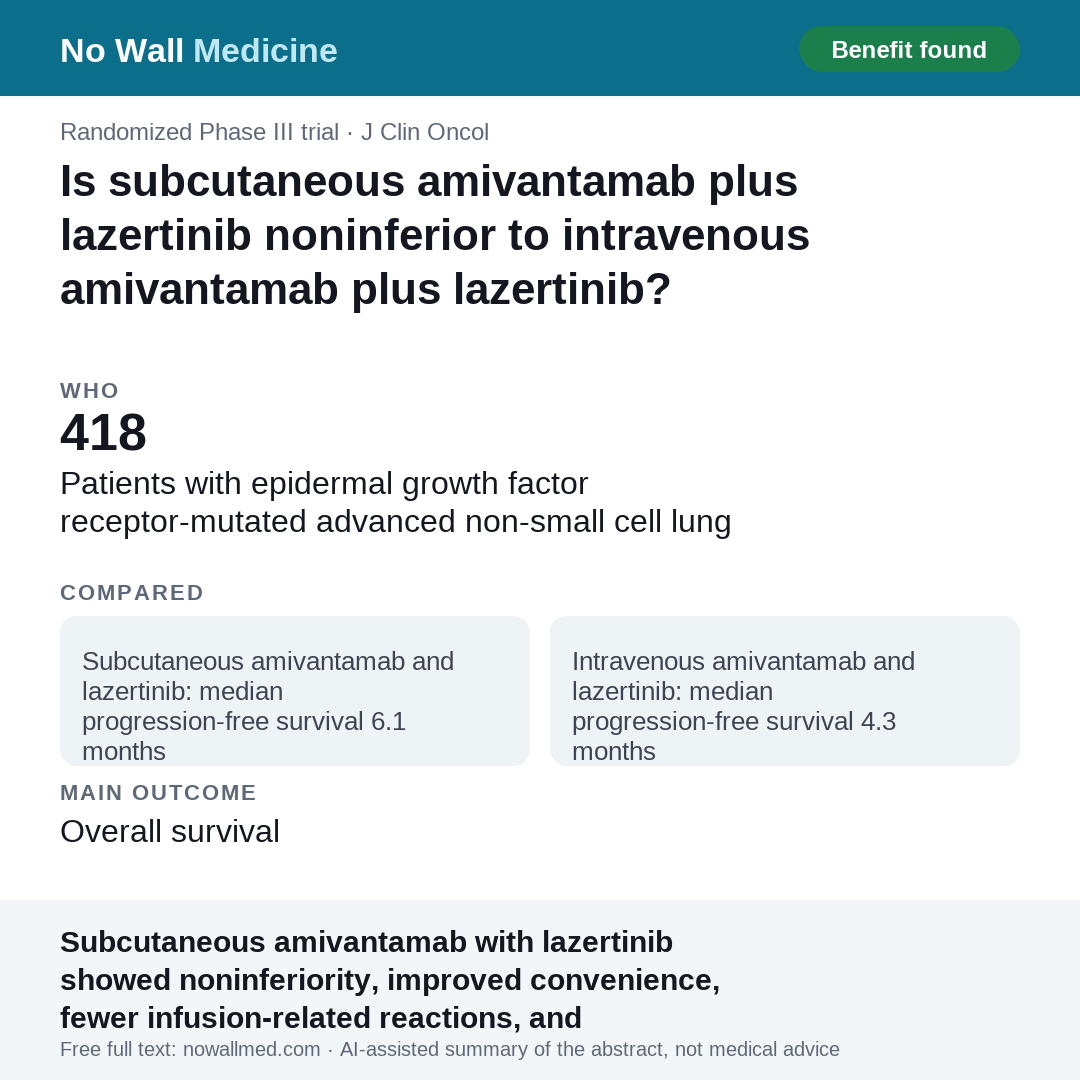
Clinical question: Is subcutaneous amivantamab plus lazertinib noninferior to intravenous amivantamab plus lazertinib?
Why it matters: It was unknown if a subcutaneous formulation of amivantamab could maintain efficacy and improve tolerability compared to the intravenous version in patients with advanced lung cancer.
Key points
- Researchers studied 418 patients with advanced non-small cell lung cancer who progressed after osimertinib and platinum-based chemotherapy.
- The subcutaneous group had a 30% objective response rate and 6.1 months median progression-free survival compared to 33% and 4.3 months in the intravenous group.
- Infusion-related reactions occurred in 13% of the subcutaneous group versus 66% in the intravenous group, and median administration time was 4.8 minutes versus 5 hours.
Headline and key points written with AI from the paper’s abstract, with every number checked against it. Read the paper before relying on them.
Was this summary helpful?
Subject terms
Cite this article
Leighl NB, Akamatsu H, Lim SM, Cheng Y, Minchom AR, Marmarelis ME. Subcutaneous Versus Intravenous Amivantamab, Both in Combination With Lazertinib, in Refractory Epidermal Growth Factor Receptor-Mutated Non-Small Cell Lung Cancer: Primary Results From the Phase III PALOMA-3 Study. J Clin Oncol. 2024. doi:10.1200/JCO.24.01001
Spotted a mistake? Suggest a correction
Top studies every Monday
The week’s key trials and guidelines in your specialties, plus any topics you follow. By email, free.
Get the weekly digest