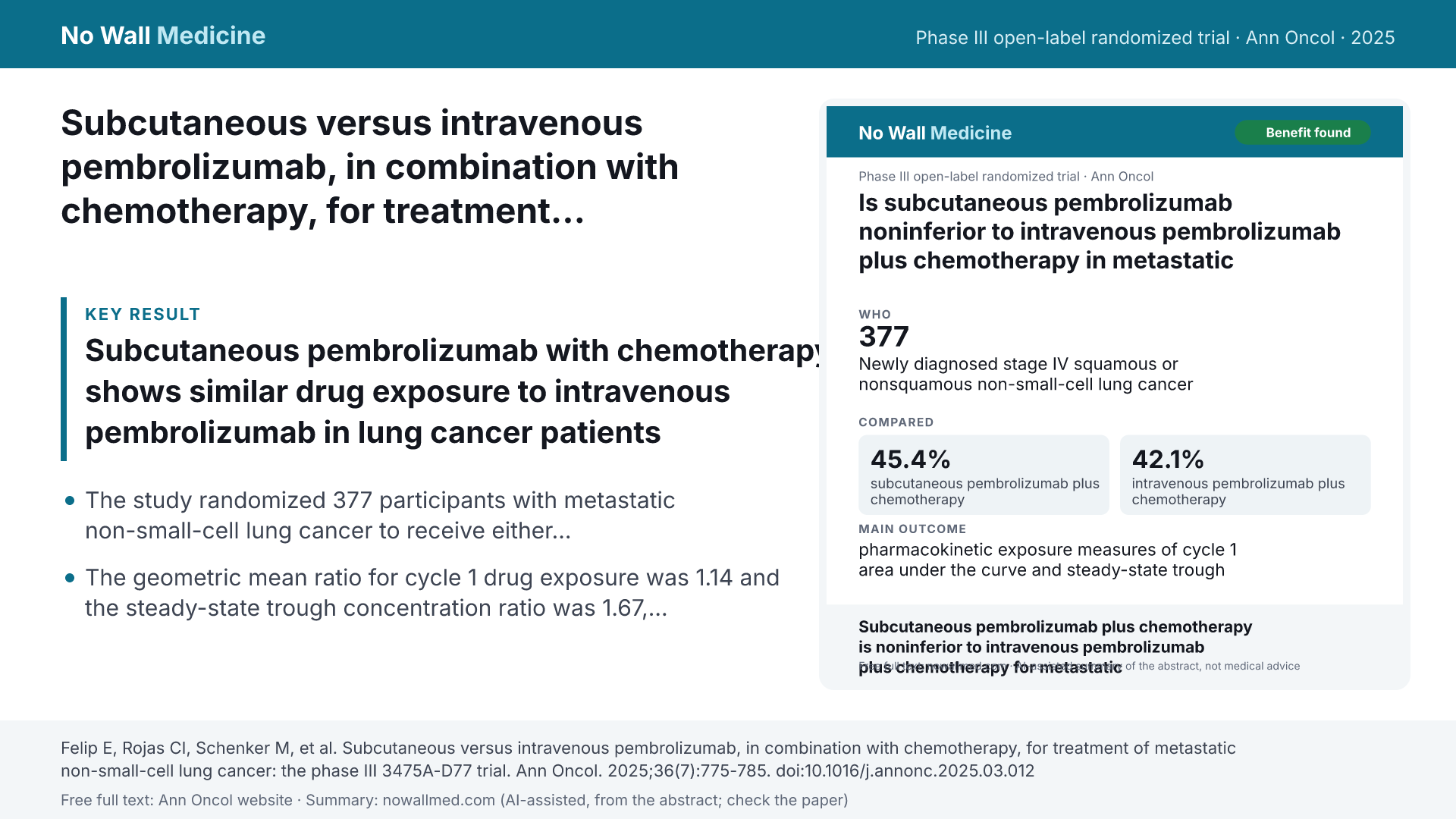
Subcutaneous pembrolizumab with chemotherapy shows similar drug exposure to intravenous pembrolizumab in lung cancer patients
Subcutaneous versus intravenous pembrolizumab, in combination with chemotherapy, for treatment of metastatic non-small-cell lung cancer: the phase III 3475A-D77 trial
Phase III open-label randomized trialBenefit found
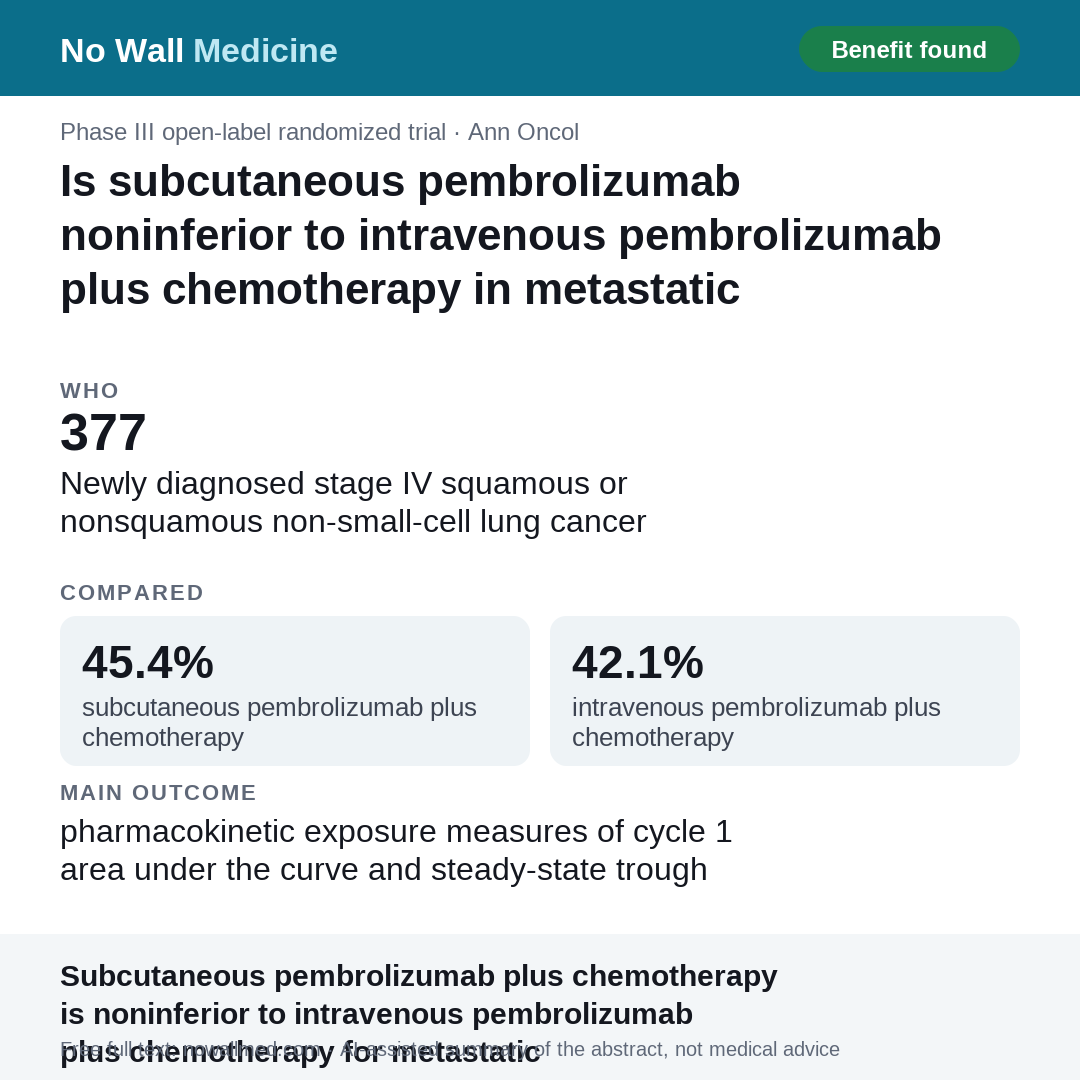
Is subcutaneous pembrolizumab noninferior to intravenous pembrolizumab plus chemotherapy in metastatic non-small-cell lung cancer?
Who
377
Newly diagnosed stage IV squamous or nonsquamous non-small-cell lung cancer patients
Compared
45.4%subcutaneous pembrolizumab plus chemotherapy
42.1%intravenous pembrolizumab plus chemotherapy
Main outcome
pharmacokinetic exposure measures of cycle 1 area under the curve and steady-state trough concentration
Result: GMR for cycle 1 AUC0-6 weeks 1.14 (96% CI 1.06-1.22)
Bottom line: Subcutaneous pembrolizumab plus chemotherapy is noninferior to intravenous pembrolizumab plus chemotherapy for metastatic non-small-cell lung cancer.
Ann Oncol · 2025-03-27Download image
Clinical question: Is subcutaneous pembrolizumab noninferior to intravenous pembrolizumab plus chemotherapy in metastatic non-small-cell lung cancer?
Why it matters: It was unknown if subcutaneous administration of pembrolizumab provides similar drug exposure and efficacy compared to the standard intravenous method for metastatic non-small-cell lung cancer.
Key points
- The study randomized 377 participants with metastatic non-small-cell lung cancer to receive either subcutaneous pembrolizumab or intravenous pembrolizumab combined with chemotherapy.
- The geometric mean ratio for cycle 1 drug exposure was 1.14 and the steady-state trough concentration ratio was 1.67, meeting the noninferiority criteria.
- Objective response rates were 45.4% for the subcutaneous group and 42.1% for the intravenous group, while safety profiles were consistent between both arms.
Headline and key points written with AI from the paper’s abstract, with every number checked against it. Read the paper before relying on them.
Was this summary helpful?
Subject terms
Cite this article
Felip E, Rojas CI, Schenker M, et al. Subcutaneous versus intravenous pembrolizumab, in combination with chemotherapy, for treatment of metastatic non-small-cell lung cancer: the phase III 3475A-D77 trial. Ann Oncol. 2025. doi:10.1016/j.annonc.2025.03.012
Spotted a mistake? Suggest a correction