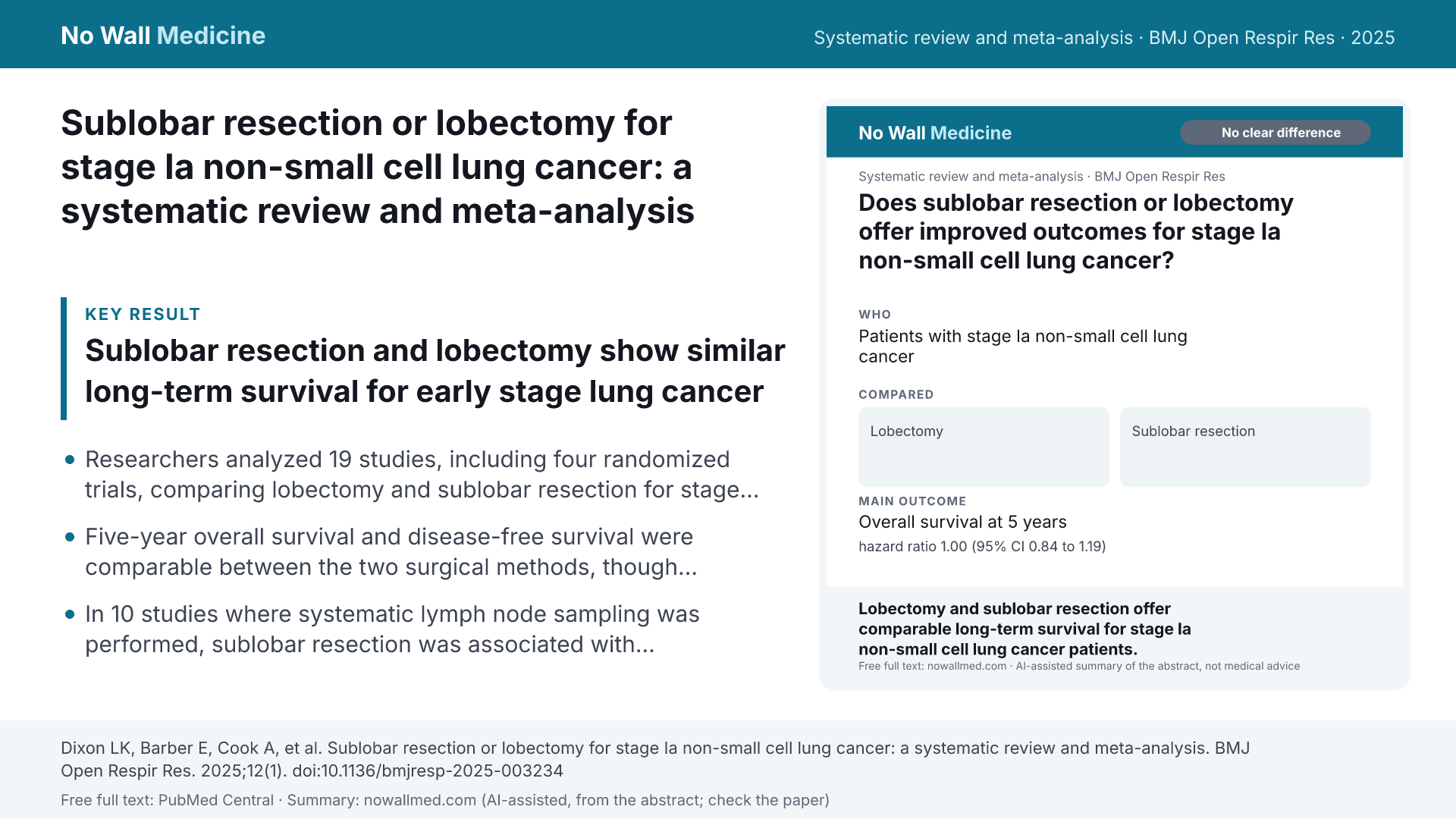
Sublobar resection and lobectomy show similar long-term survival for early stage lung cancer
Sublobar resection or lobectomy for stage Ia non-small cell lung cancer: a systematic review and meta-analysis
Systematic review and meta-analysisNo clear difference
Does sublobar resection or lobectomy offer improved outcomes for stage Ia non-small cell lung cancer?
Who
Patients with stage Ia non-small cell lung cancer
Compared
Lobectomy
Sublobar resection
Main outcome
Overall survival at 5 years
Result: hazard ratio 1.00 (95% CI 0.84 to 1.19)
Bottom line: Lobectomy and sublobar resection offer comparable long-term survival for stage Ia non-small cell lung cancer patients.
BMJ Open Respir Res · 2025-10-31Download image
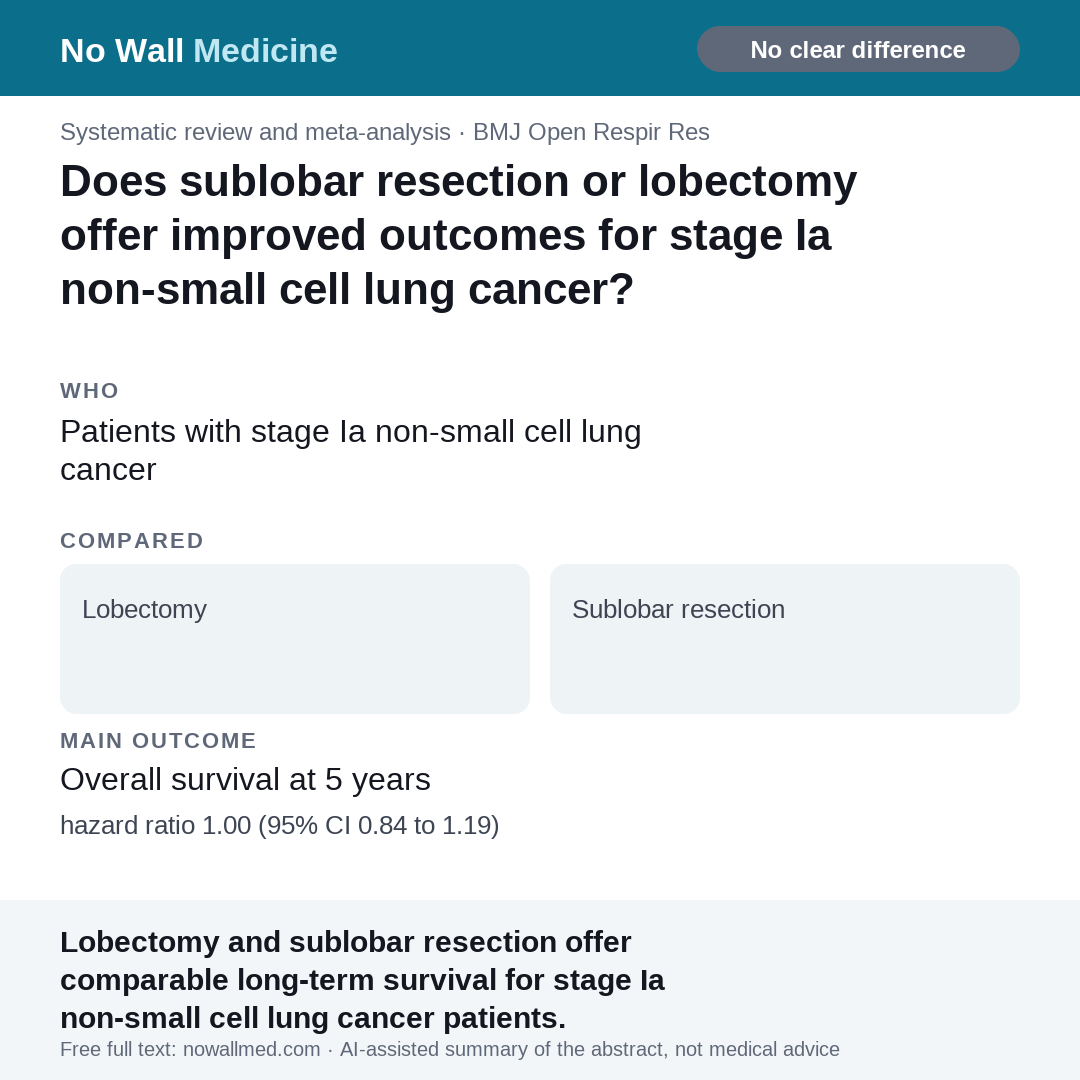
Clinical question: Does sublobar resection or lobectomy offer improved outcomes for stage Ia non-small cell lung cancer?
Why it matters: Clinicians need to determine if removing a smaller portion of the lung is as effective as a full lobe removal for stage Ia non-small cell lung cancer.
Key points
- Researchers analyzed 19 studies, including four randomized trials, comparing lobectomy and sublobar resection for stage Ia non-small cell lung cancer.
- Five-year overall survival and disease-free survival were comparable between the two surgical methods, though sublobar resection was associated with higher local recurrence (OR=1.86; 95% CI 1.07 to 3.25).
- In 10 studies where systematic lymph node sampling was performed, sublobar resection was associated with improved overall survival (HR=0.81; 95% CI 0.69 to 0.965).
Headline and key points written with AI from the paper’s abstract, with every number checked against it. Read the paper before relying on them.
Was this summary helpful?
Abstract
Background
This systematic review and meta-analysis synthesises evidence from both randomised trials and observational studies to determine whether lobectomy or sublobar resection offers improved outcomes for patients with stage Ia non-small cell lung cancer (NSCLC). Methods
Studies (up to June 2025) comparing lobectomy and sublobar resection (segmentectomy or wedge) for clinical stage Ia NSCLC (<2 cm) were included in the random-effects meta-analyses. Risk of bias was assessed using Risk of Bias 2 for randomised trials or Risk of Bias in Non-randomised Studies of Interventions-I for observational studies. Results
19 studies, including four randomised trials, were included. Overall survival at 5 years was comparable between lobectomy and sublobar resection (HR=1.00; 95% CI 0.84 to 1.19; I²=26%), as was disease-free survival (HR=1.05; 95% CI 0.90 to 1.23; I²=0%). Sublobar resection was associated with significantly higher local recurrence (OR=1.86; 95% CI 1.07 to 3.25; I²=73%). No differences were observed in 10-year survival (OR=0.99; 95% CI 0.27 to 3.59; I²=86%) or postoperative change in forced expiratory volume in 1 s (mean difference=-4.70; 95% CI -11.15 to 1.76; I²=99%). In 10 studies that mandated systematic hilar and mediastinal lymph node sampling, sublobar resection was associated with improved overall survival compared with lobectomy (HR=0.81; 95% CI 0.69 to 0.965; I²=0%). Conclusion
Lobectomy and sublobar resection offer comparable long-term survival for patients with stage Ia NSCLC. While sublobar resection is associated with higher local recurrence rates, subgroup analysis suggests that when intraoperative systematic hilar and mediastinal lymph node sampling is performed, sublobar resection may offer a survival advantage.
Abstract reproduced under the article’s CC BY NC licence.
Subject terms
Cite this article
Dixon LK, Barber E, Cook A, Boudour J, Conibear J, West D. Sublobar resection or lobectomy for stage Ia non-small cell lung cancer: a systematic review and meta-analysis. BMJ Open Respir Res. 2025. doi:10.1136/bmjresp-2025-003234
Spotted a mistake? Suggest a correction
Top studies every Monday
The week’s key trials and guidelines in your specialties, plus any topics you follow. By email, free.
Get the weekly digest