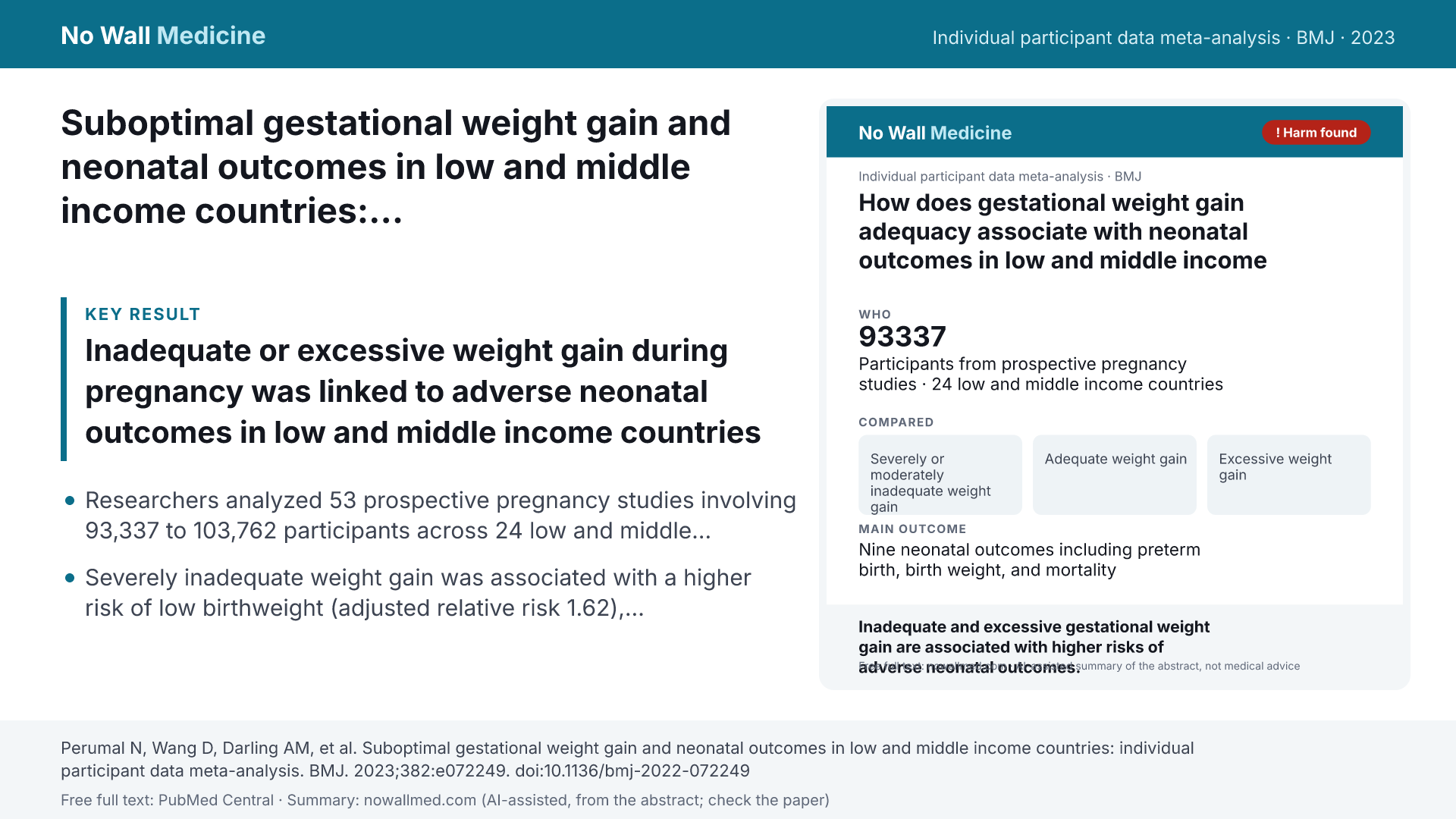
Inadequate or excessive weight gain during pregnancy was linked to adverse neonatal outcomes in low and middle income countries
Suboptimal gestational weight gain and neonatal outcomes in low and middle income countries: individual participant data meta-analysis
Individual participant data meta-analysisHarm found
How does gestational weight gain adequacy associate with neonatal outcomes in low and middle income countries?
Who
93337
Participants from prospective pregnancy studies · 24 low and middle income countries
Compared
Severely or moderately inadequate weight gain
Adequate weight gain
Excessive weight gain
Main outcome
Nine neonatal outcomes including preterm birth, birth weight, and mortality
Bottom line: Inadequate and excessive gestational weight gain are associated with higher risks of adverse neonatal outcomes.
Limitation: Further research is needed to assess optimal weight gain ranges for low and middle income countries.
BMJ · 2023-09-21Download image
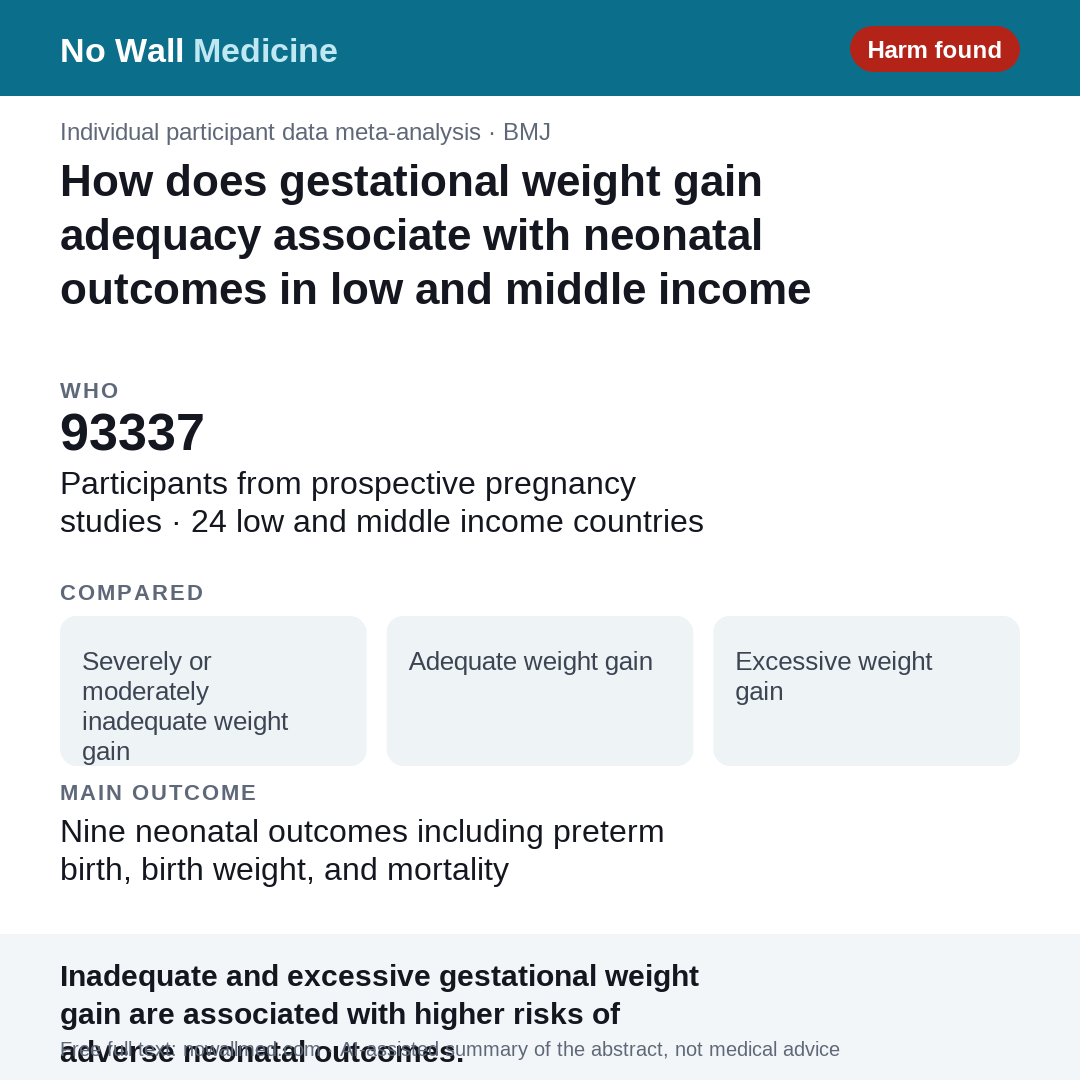
Clinical question: How does gestational weight gain adequacy associate with neonatal outcomes in low and middle income countries?
Why it matters: Current weight gain guidelines are derived from data in high income settings and may not be appropriate for low and middle income countries.
Key points
- Researchers analyzed 53 prospective pregnancy studies involving 93,337 to 103,762 participants across 24 low and middle income countries.
- Severely inadequate weight gain was associated with a higher risk of low birthweight (adjusted relative risk 1.62), small for gestational age (1.44), and microcephaly (1.57).
- Excessive weight gain was associated with a higher risk of preterm birth (1.22), large for gestational age (1.44), and macrosomia (1.52).
Headline and key points written with AI from the paper’s abstract, with every number checked against it. Read the paper before relying on them.
Was this summary helpful?
Abstract
Objective
To estimate the associations between gestational weight gain (GWG) during pregnancy and neonatal outcomes in low and middle income countries. Design
Individual participant data meta-analysis. Setting
Prospective pregnancy studies from 24 low and middle income countries. Main outcome measures
Nine neonatal outcomes related to timing (preterm birth) and anthropometry (weight, length, and head circumference) at birth, stillbirths, and neonatal death. Analysis methods
A systematic search was conducted in PubMed, Embase, and Web of Science which identified 53 prospective pregnancy studies published after the year 2000 with data on GWG, timing and anthropometry at birth, and neonatal mortality. GWG adequacy was defined as the ratio of the observed maternal weight gain over the recommended weight gain based on the Institute of Medicine body mass index specific guidelines, which are derived from data in high income settings, and the INTERGROWTH-21st GWG standards. Study specific estimates, adjusted for confounders, were generated and then pooled using random effects meta-analysis models. Maternal age and body mass index before pregnancy were examined as potential modifiers of the associations between GWG adequacy and neonatal outcomes. Results
Overall, 55% of participants had severely inadequate (<70%) or moderately inadequate (70% to <90%) GWG, 22% had adequate GWG (90-125%), and 23% had excessive GWG (≥125%). Severely inadequate GWG was associated with a higher risk of low birthweight (adjusted relative risk 1.62, 95% confidence interval 1.51 to 1.72; 48 studies, 93 337 participants; τ2=0.006), small for gestational age (1.44, 1.36 to 1.54; 51 studies, 93 191 participants; τ2=0.016), short for gestational age (1.47, 1.29 to 1.69; 40 studies, 83 827 participants; τ2=0.074), and microcephaly (1.57, 1.31 to 1.88; 31 studies, 80 046 participants; τ2=0.145) compared with adequate GWG. Excessive GWG was associated with a higher risk of preterm birth (1.22, 1.13 to 1.31; 48 studies, 103 762 participants; τ2=0.008), large for gestational age (1.44, 1.33 to 1.57; 47 studies, 90 044 participants; τ2=0.009), and macrosomia (1.52, 1.33 to 1.73; 29 studies, 68 138 participants; τ2=0) compared with adequate GWG. The direction and magnitude of the associations between GWG adequacy and several neonatal outcomes were modified by maternal age and body mass index before pregnancy. Conclusions
Inadequate and excessive GWG are associated with a higher risk of adverse neonatal outcomes across settings. Interventions to promote optimal GWG during pregnancy are likely to reduce the burden of adverse neonatal outcomes, however further research is needed to assess optimal ranges of GWG based on data from low and middle income countries.
Abstract reproduced under the article’s CC BY licence.
Subject terms
Cite this article
Perumal N, Wang D, Darling AM, et al. Suboptimal gestational weight gain and neonatal outcomes in low and middle income countries: individual participant data meta-analysis. BMJ. 2023;382:e072249. doi:10.1136/bmj-2022-072249
Spotted a mistake? Suggest a correction