Subtype prevalence and treatment implication in adolescents and adults with mild-to-moderate asthma: Systematic review and meta-analysis
Systematic review and meta-analysisMixed results
What is the prevalence of asthma subtypes and their response to inhaled corticosteroids?
Who
3,533
Adolescents and adults with mild-to-moderate asthma
Compared
40.39%Noneosinophilic asthma (95% CI 27.54, 53.93)
Eosinophilic asthma: significant improvements in asthma symptoms
Main outcome
Prevalence of asthma subtypes and response to inhaled corticosteroid therapy
Bottom line: Noneosinophilic asthma is prevalent in mild-to-moderate asthma and shows a poor response to inhaled corticosteroid therapy.
Limitation: very low certainty of evidence for noneosinophilic asthma prevalence
JACI Glob · 2024-11-04Download image
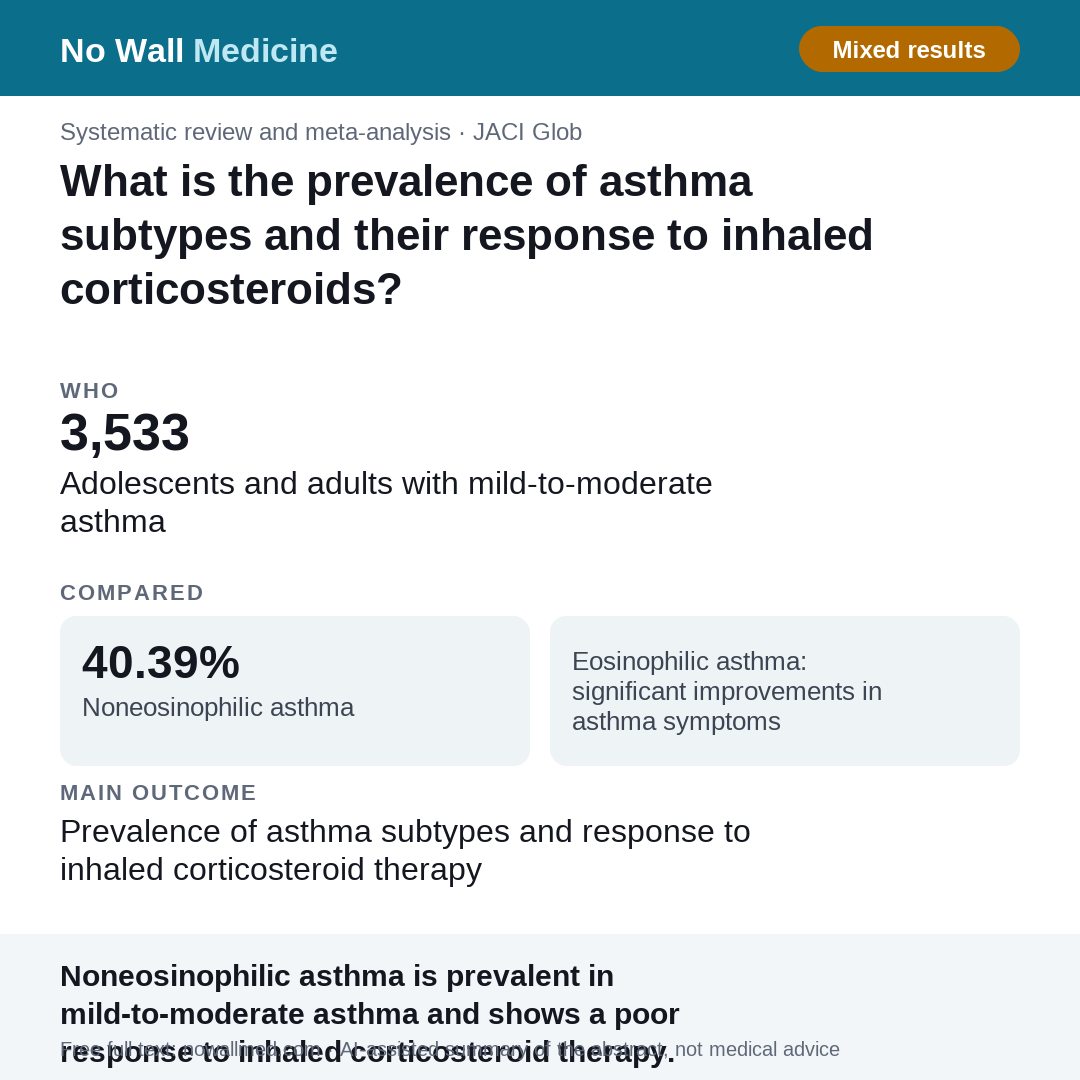
Clinical question: What is the prevalence of asthma subtypes and their response to inhaled corticosteroids?
Abstract
Background
Inhaled corticosteroid (ICS)-containing regimens are the mainstay for treating asthma despite usually being ineffective in noneosinophilic asthma (NEA). Data on the prevalence of NEA versus eosinophilic asthma (EA) in mild-to-moderate asthma are limited. Objective
We performed a systematic review of the prevalence of mild-to-moderate asthma in adolescents and adults using sputum inflammatory cell analysis and their responses to ICS. Methods
We searched electronic databases (PubMed, Scopus, EMBASE, Cochrane) for studies in adolescents and adults with mild-to-moderate asthma. The primary outcome was the prevalence of asthma subtypes based on sputum inflammatory cell analysis, categorized into EA and NEA. The secondary outcome involved comparing asthma outcomes between different subtypes after ICS therapy. Certainty of evidence was reported for each pooled analysis. Results
Eighteen studies involving 3,533 adolescents and adults with mild-to-moderate asthma were reviewed. The pooled prevalence (95% confidence interval) of NEA was estimated at 40.39% (27.54, 53.93) in patients with ICS naive with very low certainty of evidence. On reevaluating sputum cytology, the disease of approximately 20% to 30% of patients initially diagnosed as NEA transitioned to the EA subtype. EA patients showed significant improvements in asthma symptoms after ICS therapy: forced expiratory volume in 1 second (standardized mean difference, 0.79; 95% confidence interval, 0.30, 1.27), and airway hyperresponsiveness (standardized mean difference, 1.34; 95% confidence interval, 0.29, 2.40). NEA patients exhibited limited response. Conclusion
A high proportion of adolescents and adults with mild-to-moderate asthma were identified with NEA subtype disease, which exhibited a poor response to ICS. A thorough diagnostic evaluation before initiating treatment should be integrated into clinical practice.Registered in PROSPERO (CRD42023484334).
Cite this article
Wongsa C, Wongyikul P, Chokevittaya P, Nititammaluk A, Soe KK, Phinyo P. Subtype prevalence and treatment implication in adolescents and adults with mild-to-moderate asthma: Systematic review and meta-analysis. JACI Glob. 2024. doi:10.1016/j.jacig.2024.100366
Spotted a mistake? Suggest a correction
Top studies every Monday
The week’s key trials and guidelines in your specialties, plus any topics you follow. By email, free.
Get the weekly digest