Sunscreens with the New MCE Filter Cover the Whole UV Spectrum: Improved UVA1 Photoprotection In Vitro and in a Randomized Controlled Trial
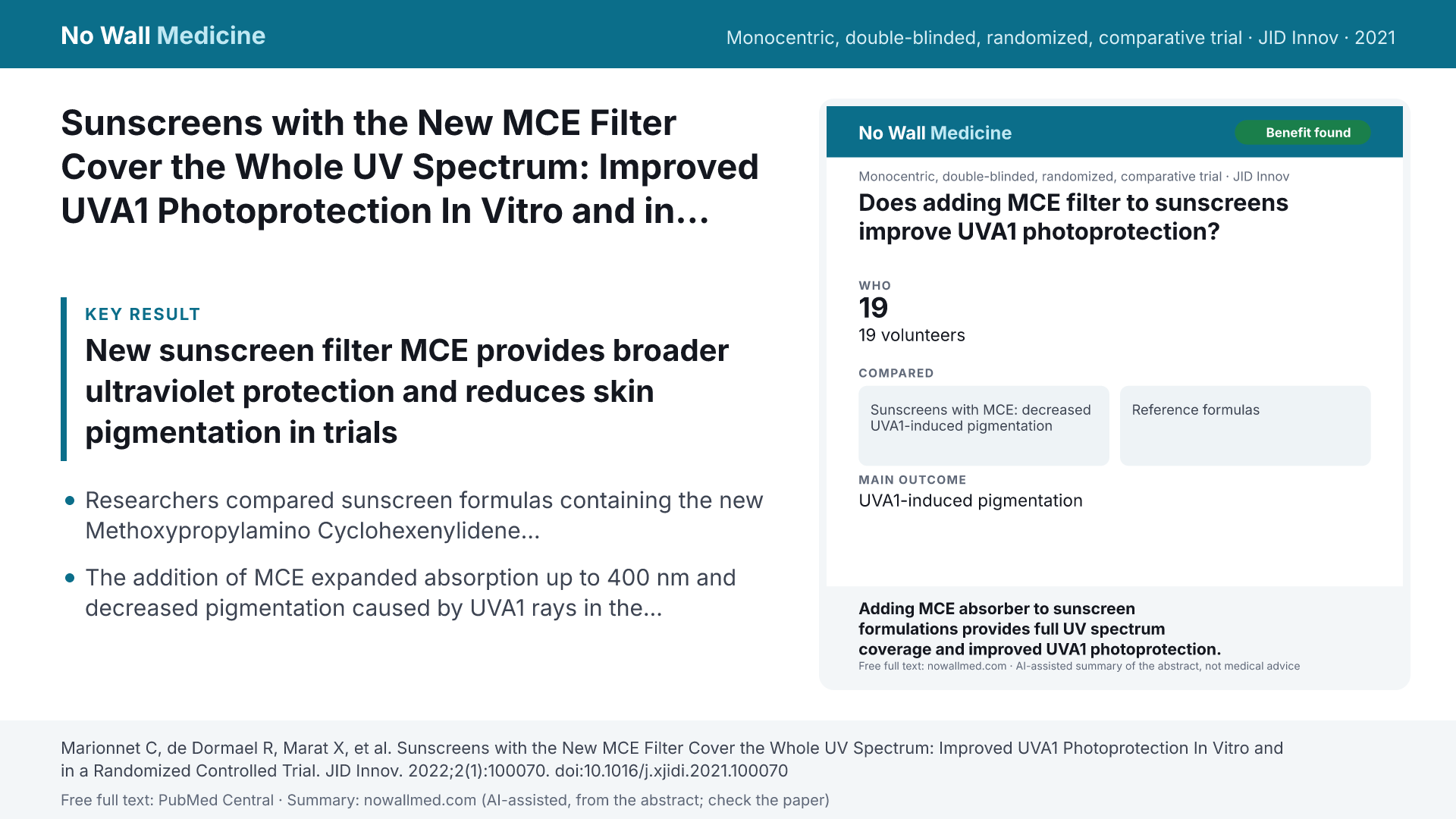
Key result: New sunscreen filter MCE provides broader ultraviolet protection and reduces skin pigmentation in trials
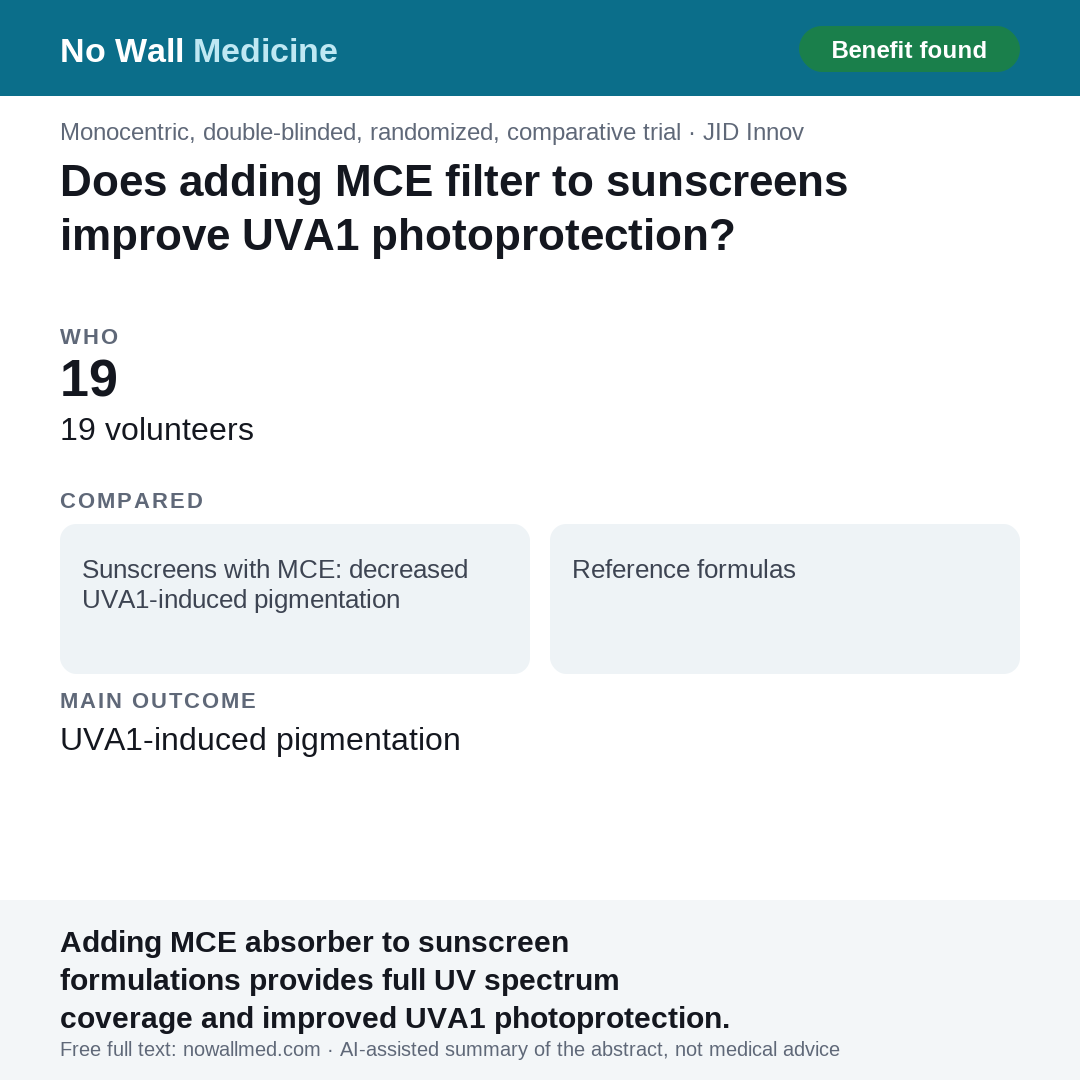
Monocentric, double-blinded, randomized, comparative trialBenefit found
Does adding MCE filter to sunscreens improve UVA1 photoprotection?
Who
19
19 volunteers
Compared
Sunscreens with MCE: decreased UVA1-induced pigmentation
Reference formulas
Main outcome
UVA1-induced pigmentation
Bottom line: Adding MCE absorber to sunscreen formulations provides full UV spectrum coverage and improved UVA1 photoprotection.
JID Innov · 2021-11-25Download image
Key points
- Researchers compared sunscreen formulas containing the new Methoxypropylamino Cyclohexenylidene Ethoxyethylcyanoacetate (MCE) filter against reference formulas using a skin model and 19 human volunteers.
- The addition of MCE expanded absorption up to 400 nm and decreased pigmentation caused by UVA1 rays in the clinical trial.
- MCE was associated with reduced dermal and epidermal alterations at cellular, biochemical, and molecular levels in a three-dimensional skin model.
Why it matters: Current sunscreen formulas lack sufficient absorption in the 370-400 nm wavelength range of UVA1 rays.
Discussion prompts
- Would these patients look like yours? Who was left out?
- Is the main outcome one that matters to patients?
- Is the difference large enough to change what you do?
Cite: Marionnet C, de Dormael R, Marat X, et al. Sunscreens with the New MCE Filter Cover the Whole UV Spectrum: Improved UVA1 Photoprotection In Vitro and in a Randomized Controlled Trial. JID Innov. 2021. doi:10.1016/j.xjidi.2021.100070
Free full text: PubMed Central · Summary and visual abstract: nowallmed.com/a/sunscreens-with-the-new-mce-filter-cover-the-whole-uv-spectrum-e96dw2/ (AI-assisted from the abstract; check the paper before relying on it).