Ropivacaine nerve blocks reduced opioid use after cardiac surgery compared to a placebo
Superficial parasternal intercostal plane block with ropivacaine versus placebo for opioid exposure after cardiac surgery (EPOCH CardioLink-10): a multicentre, double-blind, randomised trial
Multicentre, double-blind, randomised, placebo-controlled trialBenefit found
Does superficial parasternal intercostal plane block with ropivacaine reduce opioid consumption after cardiac surgery?
Who
318
Adults undergoing cardiac surgery via median sternotomy · Pan-Canadian multicentre sites
Compared
Ropivacaine: -20.7 MMEs
Placebo
Main outcome
Cumulative opioid consumption over 72 hours in morphine milligram equivalents
Result: least-squares mean difference -20.7 MMEs (95% CI -39.0 to -2.3)
Bottom line: Bilateral superficial parasternal intercostal plane blockade with ropivacaine reduced cumulative opioid consumption after cardiac surgery.
Limitation: There was no pre-specified analysis of adverse events.
Funded by: Canadian Institutes of Health Research and others
Lancet Reg Health Am · 2026-05-28Download image
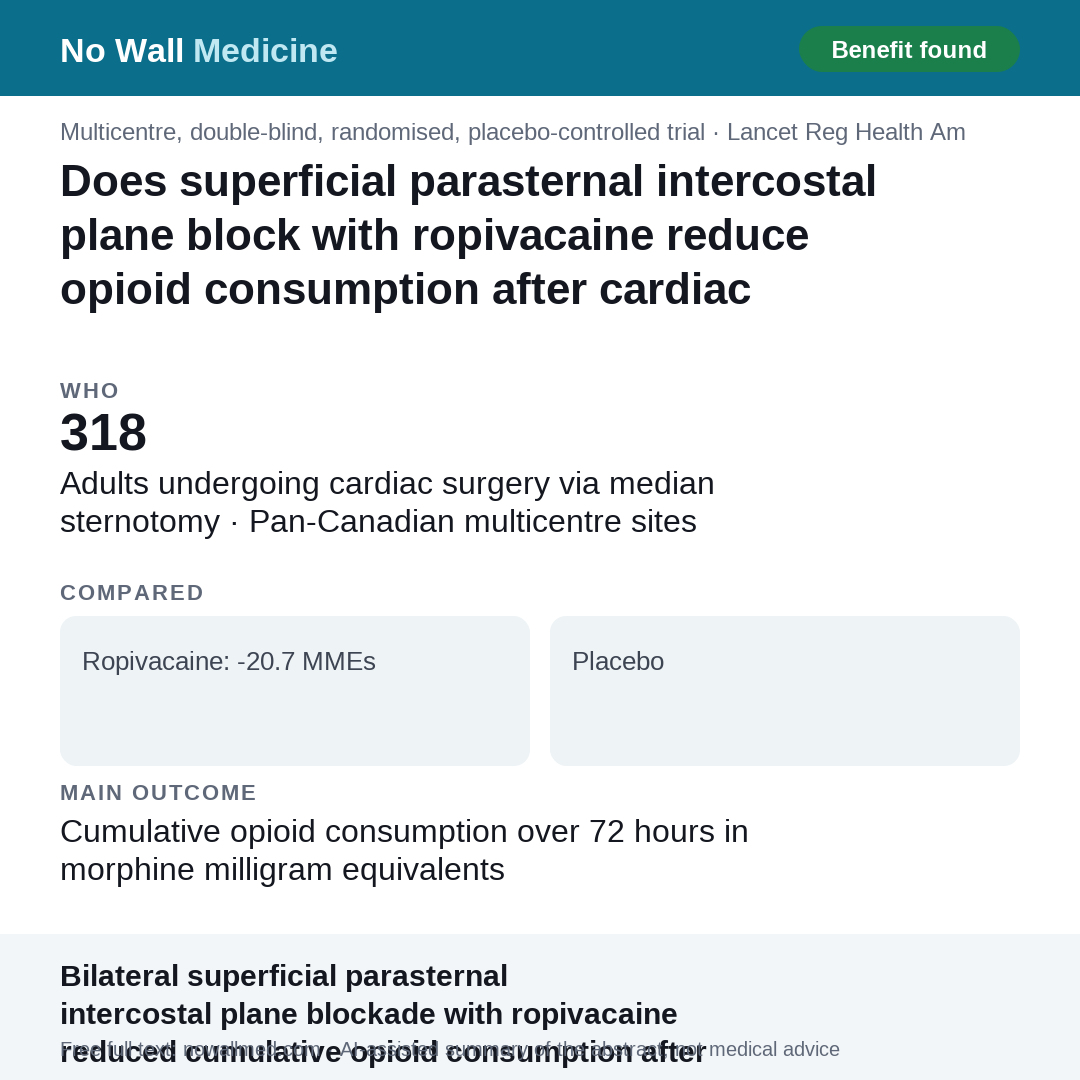
Clinical question: Does superficial parasternal intercostal plane block with ropivacaine reduce opioid consumption after cardiac surgery?
Why it matters: Robust randomized evidence is lacking to support specific opioid-sparing analgesic approaches in cardiac surgery.
Key points
- Researchers studied 318 adults undergoing heart surgery through a midline chest incision and compared a nerve block using ropivacaine to a placebo.
- Over 72 hours, the ropivacaine group had a lower cumulative opioid consumption with a least-squares mean difference of -20.7 morphine milligram equivalents.
- Pain scores and other secondary outcomes, such as rates of delirium, were similar between the two groups.
Headline and key points written with AI from the paper’s abstract, with every number checked against it. Read the paper before relying on them.
Cite this article
Alli A, Mazer CD, Dennis F, Teoh H, Chin K, Quan A. Superficial parasternal intercostal plane block with ropivacaine versus placebo for opioid exposure after cardiac surgery (EPOCH CardioLink-10): a multicentre, double-blind, randomised trial. Lancet Reg Health Am. 2026. doi:10.1016/j.lana.2026.101508
Spotted a mistake? Suggest a correction