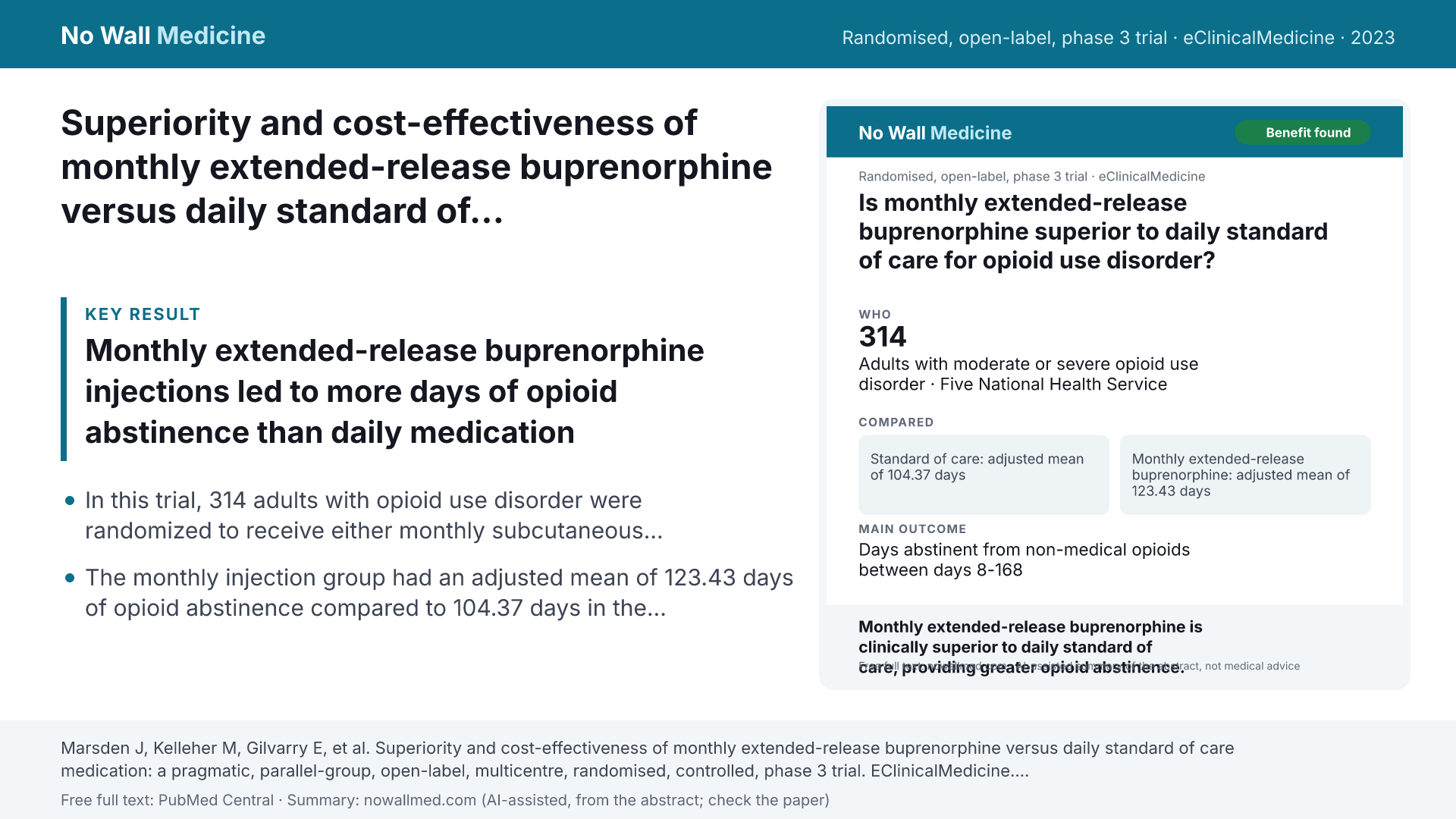
Monthly extended-release buprenorphine injections led to more days of opioid abstinence than daily medication
Superiority and cost-effectiveness of monthly extended-release buprenorphine versus daily standard of care medication: a pragmatic, parallel-group, open-label, multicentre, randomised, controlled, phase 3 trial
Randomised, open-label, phase 3 trialBenefit found
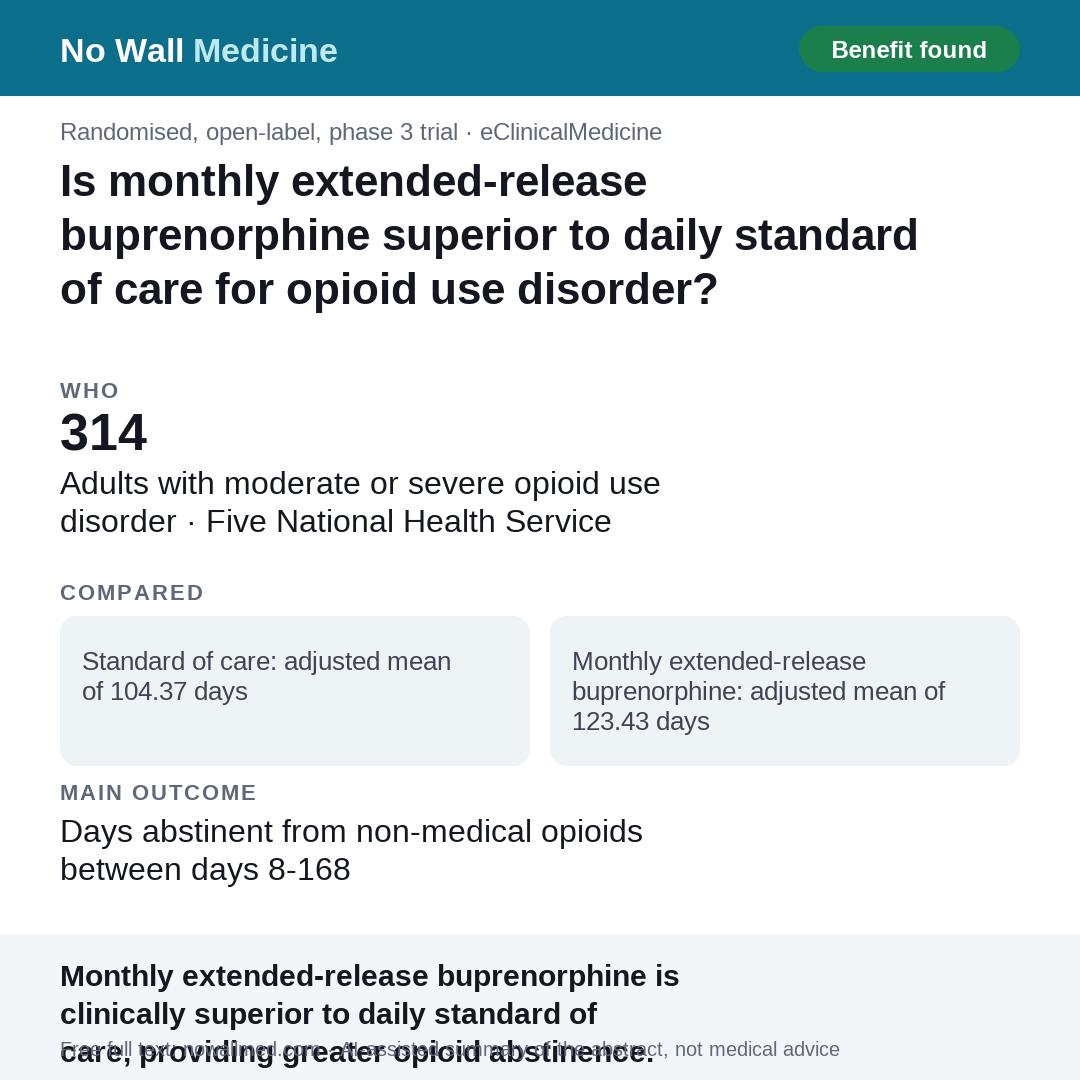
Is monthly extended-release buprenorphine superior to daily standard of care for opioid use disorder?
Who
314
Adults with moderate or severe opioid use disorder · Five National Health Service clinics in England and Scotland
Compared
Standard of care: adjusted mean of 104.37 days
Monthly extended-release buprenorphine: adjusted mean of 123.43 days
Main outcome
Days abstinent from non-medical opioids between days 8-168
Result: adjusted incident rate ratio 1.18 (95% CI 1.05-1.33)
Bottom line: Monthly extended-release buprenorphine is clinically superior to daily standard of care, providing greater opioid abstinence.
Limitation: Further trials are needed to evaluate long-term clinical and health economic outcomes.
Funded by: Indivior
eClinicalMedicine · 2023-11-17Download image
Clinical question: Is monthly extended-release buprenorphine superior to daily standard of care for opioid use disorder?
Why it matters: It was unknown if monthly extended-release buprenorphine injections were more effective than the daily standard-of-care medications for treating opioid use disorder.
Key points
- In this trial, 314 adults with opioid use disorder were randomized to receive either monthly subcutaneous buprenorphine injections or daily standard-of-care medication for 24 weeks.
- The monthly injection group had an adjusted mean of 123.43 days of opioid abstinence compared to 104.37 days in the daily medication group.
- Adverse events occurred in 81.0% of the injection group and 42.9% of the daily medication group, with the most common being mild-to-moderate pain from the injection.
Headline and key points written with AI from the paper’s abstract, with every number checked against it. Read the paper before relying on them.
Was this summary helpful?
Cite this article
Marsden J, Kelleher M, Gilvarry E, et al. Superiority and cost-effectiveness of monthly extended-release buprenorphine versus daily standard of care medication: a pragmatic, parallel-group, open-label, multicentre, randomised, controlled, phase 3 trial. eClinicalMedicine. 2023. doi:10.1016/j.eclinm.2023.102311
Spotted a mistake? Suggest a correction