Protocol for trial testing fortified energy-protein supplements during pregnancy and lactation in Nepal
Supplementation with fortified balanced energy-protein during pregnancy and lactation and its effects on birth outcomes and infant growth in southern Nepal: protocol of a 2×2 factorial randomised trial
2x2 factorial, household randomised, unblinded, efficacy trialUnclear result
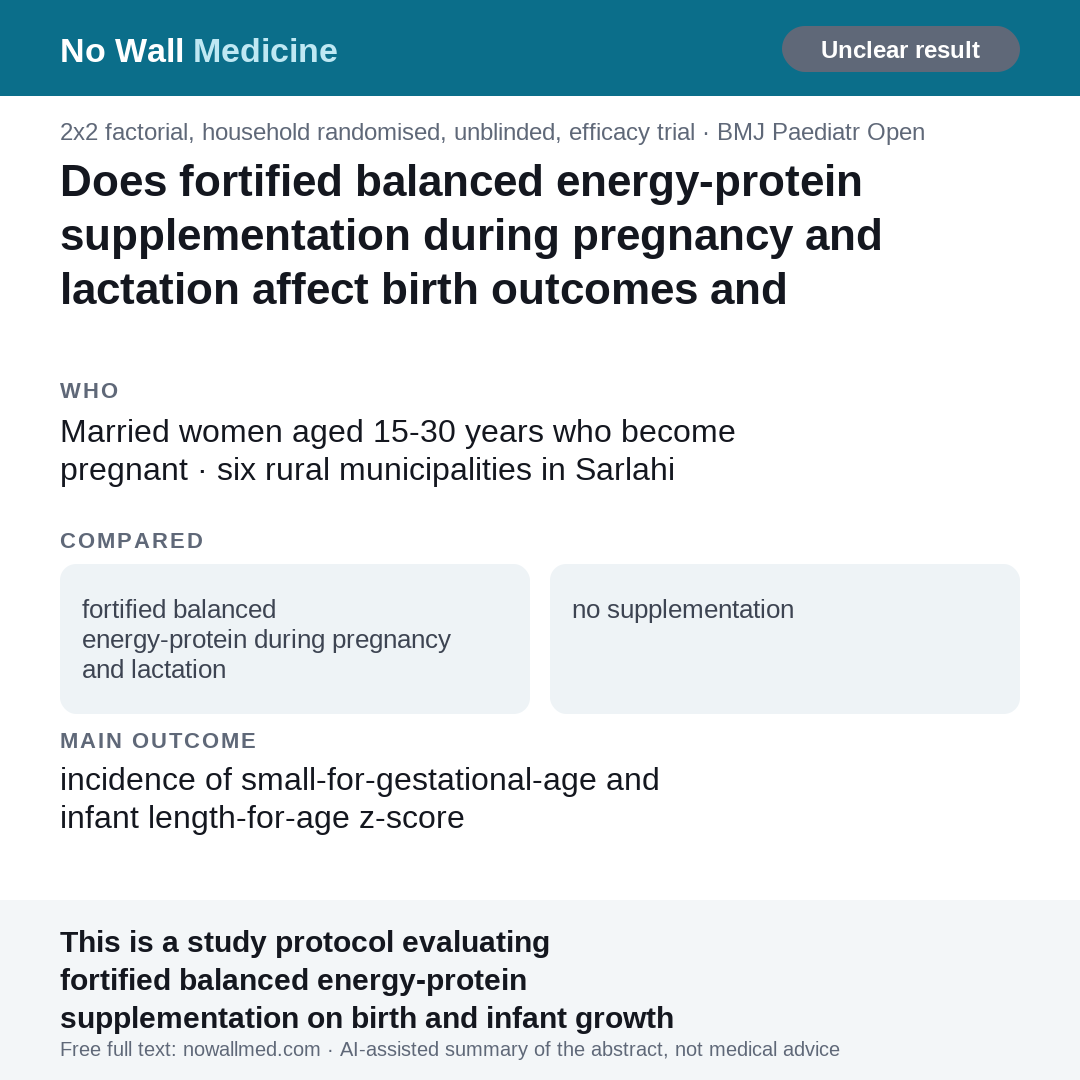
Does fortified balanced energy-protein supplementation during pregnancy and lactation affect birth outcomes and infant growth?
Who
Married women aged 15-30 years who become pregnant · six rural municipalities in Sarlahi District, Nepal
Compared
fortified balanced energy-protein during pregnancy and lactation
no supplementation
Main outcome
incidence of small-for-gestational-age and infant length-for-age z-score
Bottom line: This is a study protocol evaluating fortified balanced energy-protein supplementation on birth and infant growth outcomes.
BMJ Paediatr Open · 2023-11-06Download image
Clinical question: Does fortified balanced energy-protein supplementation during pregnancy and lactation affect birth outcomes and infant growth?
Why it matters: It is unknown how the format and composition of balanced energy-protein supplements during lactation affect infant growth and birth outcomes.
Key points
- The Maternal Infant Nutrition Trial (MINT) will involve married women aged 15-30 years in rural Nepal who are randomly assigned to receive or not receive fortified balanced energy-protein supplements.
- Researchers will measure the incidence of small-for-gestational-age, which is a birth weight below the expected range, and infant length-for-age at 6 months of age.
- The study uses a 2x2 factorial design to evaluate the impact of supplements during both pregnancy and the first 6 months after birth.
Headline and key points written with AI from the paper’s abstract, with every number checked against it. Read the paper before relying on them.
Was this summary helpful?
Abstract
Introduction
Many women in low and middle-income countries enter pregnancy with low nutritional reserves with increased risk of fetal growth restriction and poor birth outcomes, including small-for-gestational-age (SGA) and preterm birth. Balanced energy-protein (BEP) supplements have shown reductions in risk of stillbirth and SGA, yet variations in intervention format and composition and limited evidence on the impact of BEP during lactation on growth outcomes warrant further study. This paper describes the protocol of the Maternal Infant Nutrition Trial (MINT) Study, which aims to evaluate the impact of a fortified BEP supplement during pregnancy and lactation on birth outcomes and infant growth in rural Nepal. Methods and analysis
MINT is a 2×2 factorial, household randomised, unblinded, efficacy trial conducted in a subarea of Sarlahi District, Nepal. The study area covers six rural municipalities with about 27 000 households and a population of approximately 100 000. Married women (15-30 years) who become pregnant are eligible for participation in the trial and are randomly assigned at enrolment to supplementation with fortified BEP or not and at birth to fortified BEP supplementation or not until 6 months post partum. The primary pregnancy outcome is incidence of SGA, using the INTERGROWTH-21st standard, among live born infants with birth weight measured within 72 hours of delivery. The primary infant growth outcome is mean length-for-age z-score at 6 months using the WHO international growth reference. Ethics and dissemination
The study was approved by the Institutional Review Board (IRB) at Johns Hopkins Bloomberg School of Public Health, Baltimore, USA (IRB00009714), the Committee on Human Research IRB at The George Washington University, Washington, DC, USA (081739), and the Ethical Review Board of the Nepal Health Research Council, Kathmandu, Nepal (174/2018). Trial registration number
NCT03668977.
Abstract reproduced under the article’s CC BY licence.
Subject terms
Cite this article
Erchick DJ, Lama TP, Khatry SK, Katz J, Mullany LC, Zavala E. Supplementation with fortified balanced energy-protein during pregnancy and lactation and its effects on birth outcomes and infant growth in southern Nepal: protocol of a 2×2 factorial randomised trial. BMJ Paediatr Open. 2023. doi:10.1136/bmjpo-2023-002229
Spotted a mistake? Suggest a correction
Top studies every Monday
The week’s key trials and guidelines in your specialties, plus any topics you follow. By email, free.
Get the weekly digest