Systematic review identifies two main visualization strategies to support clinical reasoning and decision-making
Supporting clinical reasoning through visual summarization and presentation of patient data: a systematic review
Systematic reviewUnclear result
How are electronic health record data summarized and visualized to support clinical reasoning?
Who
112
Individual patient electronic health record data
Compared
Timeline-based presentations
Snapshot-based approaches
Main outcome
Data-information-visualization flows for clinical reasoning tasks
Bottom line: Visualization strategies like timelines and snapshots can support clinical reasoning through specific data-information-visualization flows.
J Am Med Inform Assoc · 2025-07-01Download image
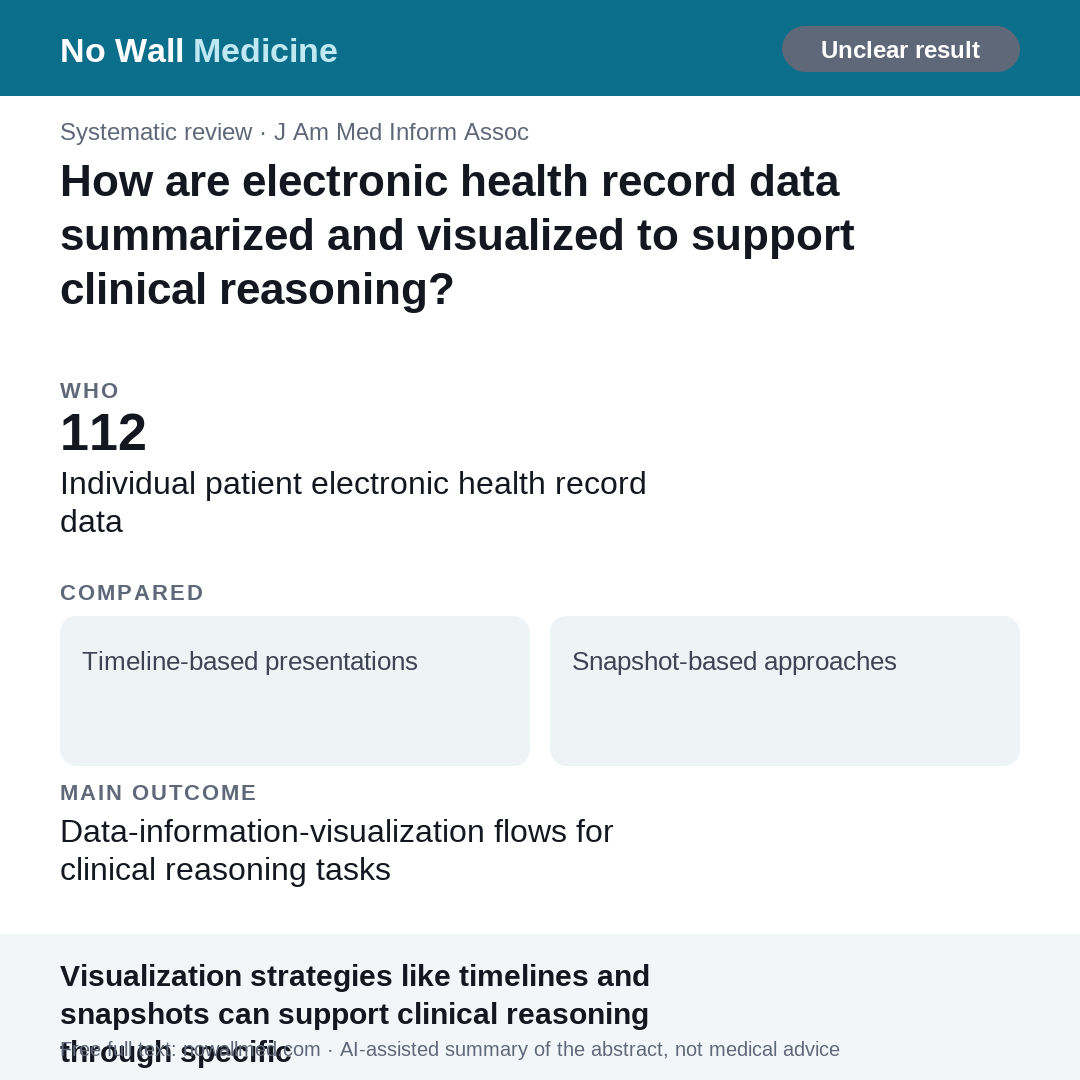
Clinical question: How are electronic health record data summarized and visualized to support clinical reasoning?
Key points
- Researchers reviewed 112 studies involving electronic health record data, visualization, and clinical decision-support tools.
- The review identified two primary strategies: timeline-based presentations for tracking trends and snapshot-based approaches for rapid status overviews.
- Of the included studies, 70 (62.5%) conducted detailed usability evaluations while 42 (37.5%) did not report any evaluations.
Headline and key points written with AI from the paper’s abstract, with every number checked against it. Read the paper before relying on them.
Topics
Cite this article
Fan H, Hardi A, Yen PY. Supporting clinical reasoning through visual summarization and presentation of patient data: a systematic review. J Am Med Inform Assoc. 2025. doi:10.1093/jamia/ocaf103
Spotted a mistake? Suggest a correction