Intersectoral care management did not change functionality or institutionalization for people with cognitive impairment
Supporting older people with cognitive impairment during and after hospital stays with intersectoral care management (intersec-CM)-results of a randomised clinical trial
Longitudinal multisite randomised controlled trialMixed results
Does intersectoral care management improve outcomes for people with cognitive impairment during hospital transition?
Who
401
Community-dwelling people with cognitive impairment, age 70+ · Three hospitals in two primary care regions in Germany
Compared
Care as usual
Intersectoral care management
Main outcome
Hospital admission, functionality, and institutionalisation
Bottom line: Intersectoral care management improved quality of life and mental health, despite no significant impact on functionality or institutionalisation.
Age Ageing · 2025-02-06Download image
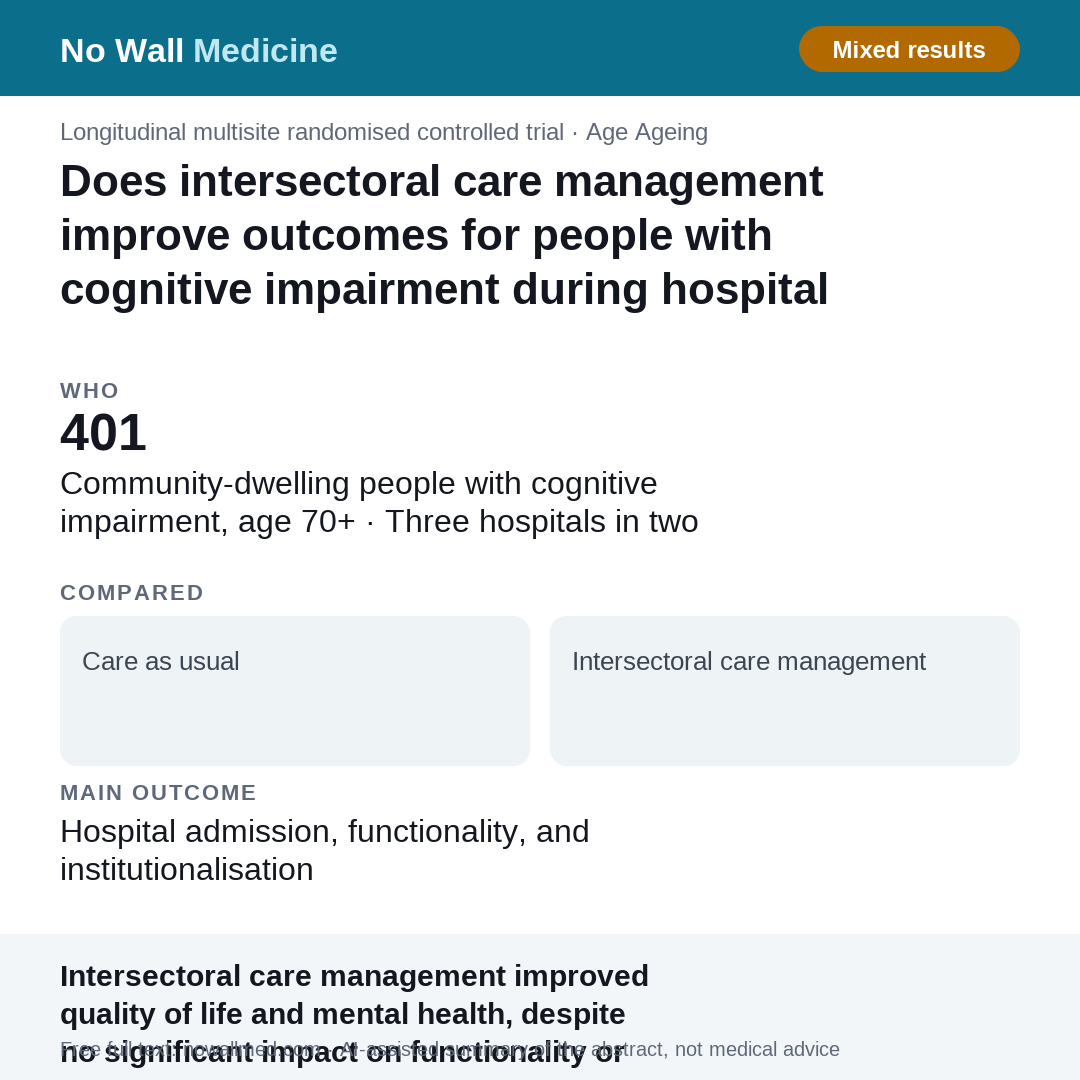
Clinical question: Does intersectoral care management improve outcomes for people with cognitive impairment during hospital transition?
Why it matters: The transition from hospital to primary care is a risk factor for negative health outcomes in people with cognitive impairment.
Key points
- Researchers studied 401 community-dwelling people aged 70 and older with cognitive impairment, comparing standard care to intersectoral care management.
- The intervention showed no statistically significant effect on hospital admission or activities of daily living at 3 months, nor on institutionalization or activities of daily living at 12 months.
- The intervention was associated with significantly fewer hospital readmissions at 12 months and improved health-related quality of life at both 3 and 12 months.
Headline and key points written with AI from the paper’s abstract, with every number checked against it. Read the paper before relying on them.
Was this summary helpful?
Subject terms
Cite this article
Boekholt M, Nikelski A, Schumacher-Schoenert F, Kracht F, Vollmar HC, Hoffmann W. Supporting older people with cognitive impairment during and after hospital stays with intersectoral care management (intersec-CM)-results of a randomised clinical trial. Age Ageing. 2025. doi:10.1093/ageing/afaf011
Spotted a mistake? Suggest a correction
Top studies every Monday
The week’s key trials and guidelines in your specialties, plus any topics you follow. By email, free.
Get the weekly digest