Surgeon Use of Shared Decision-making for Older Adults Considering Major Surgery: A Secondary Analysis of a Randomized Clinical Trial
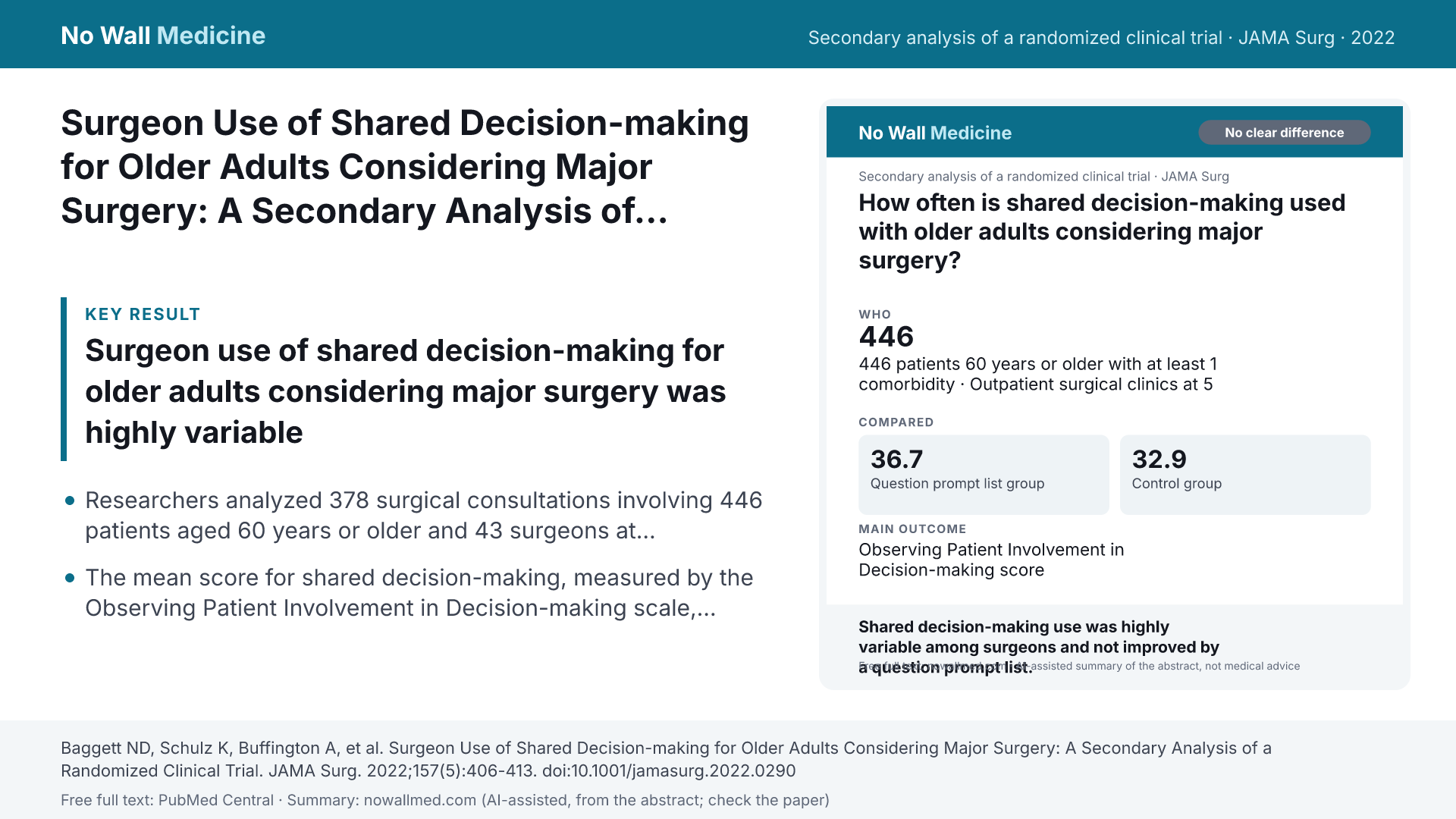
Key result: Surgeon use of shared decision-making for older adults considering major surgery was highly variable
Secondary analysis of a randomized clinical trialNo clear difference
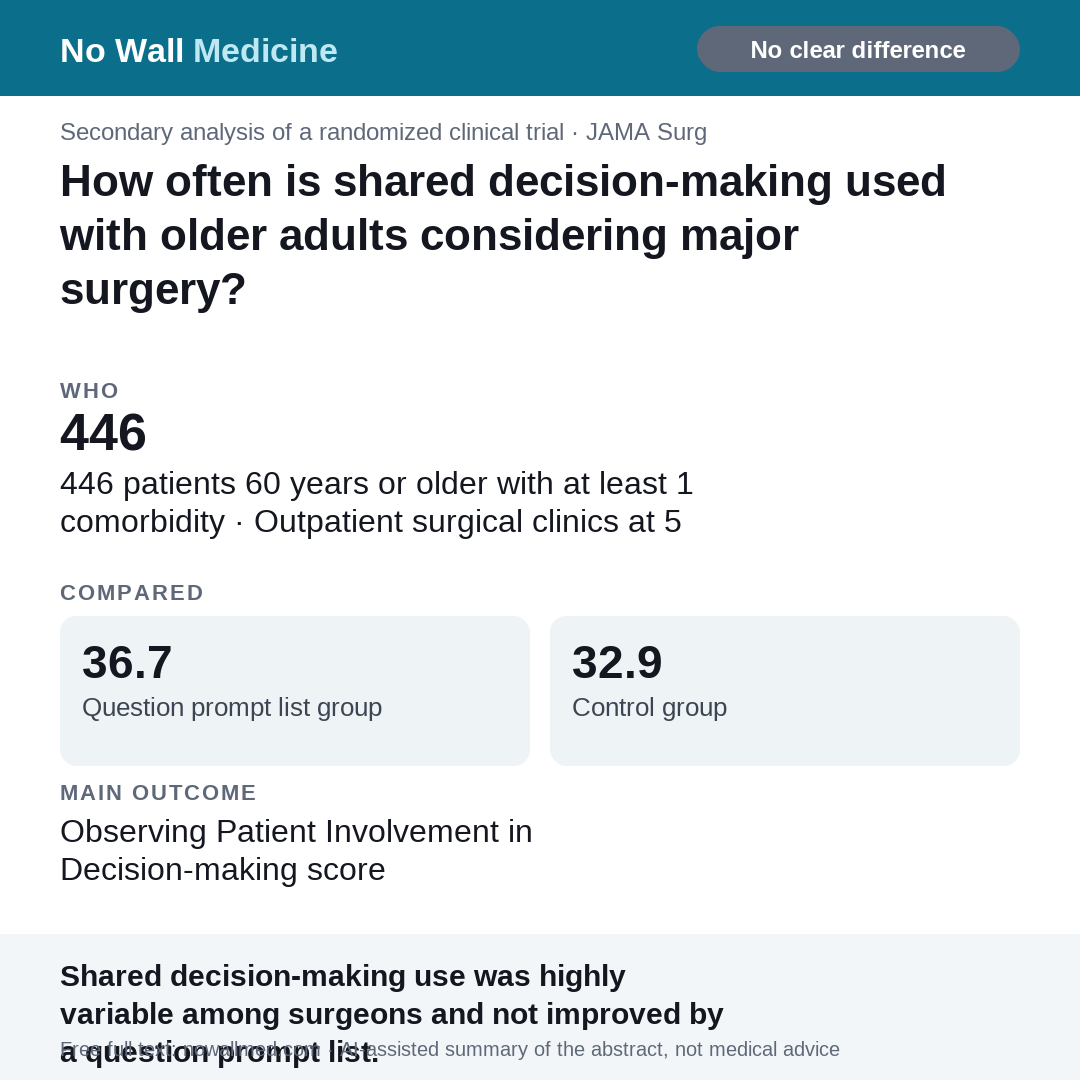
How often is shared decision-making used with older adults considering major surgery?
Who
446
446 patients 60 years or older with at least 1 comorbidity · Outpatient surgical clinics at 5 academic centers
Compared
36.7Question prompt list group (21.2)
32.9Control group (19.9)
Main outcome
Observing Patient Involvement in Decision-making score
Result: 3.80 (95% CI, -0.30 to 8.00)
Bottom line: Shared decision-making use was highly variable among surgeons and not improved by a question prompt list.
JAMA Surg · 2022-03-24Download image
Key points
- Researchers analyzed 378 surgical consultations involving 446 patients aged 60 years or older and 43 surgeons at five academic centers.
- The mean score for shared decision-making, measured by the Observing Patient Involvement in Decision-making scale, was 34.7 (20.6) and was not affected by the use of a question prompt list.
- Shared decision-making was associated with surgeons appearing reluctant to operate and with longer conversation lengths.
Discussion prompts
- Would these patients look like yours? Who was left out?
- Is the main outcome one that matters to patients?
- Is the difference large enough to change what you do?
Cite: Baggett ND, Schulz K, Buffington A, et al. Surgeon Use of Shared Decision-making for Older Adults Considering Major Surgery: A Secondary Analysis of a Randomized Clinical Trial. JAMA Surg. 2022. doi:10.1001/jamasurg.2022.0290
Free full text: PubMed Central · Summary and visual abstract: nowallmed.com/a/surgeon-use-of-shared-decision-making-for-older-adults-considering-14g6ht8/ (AI-assisted from the abstract; check the paper before relying on it).