Surgical Approaches to Orbital Fractures: A Practical and Systematic Review
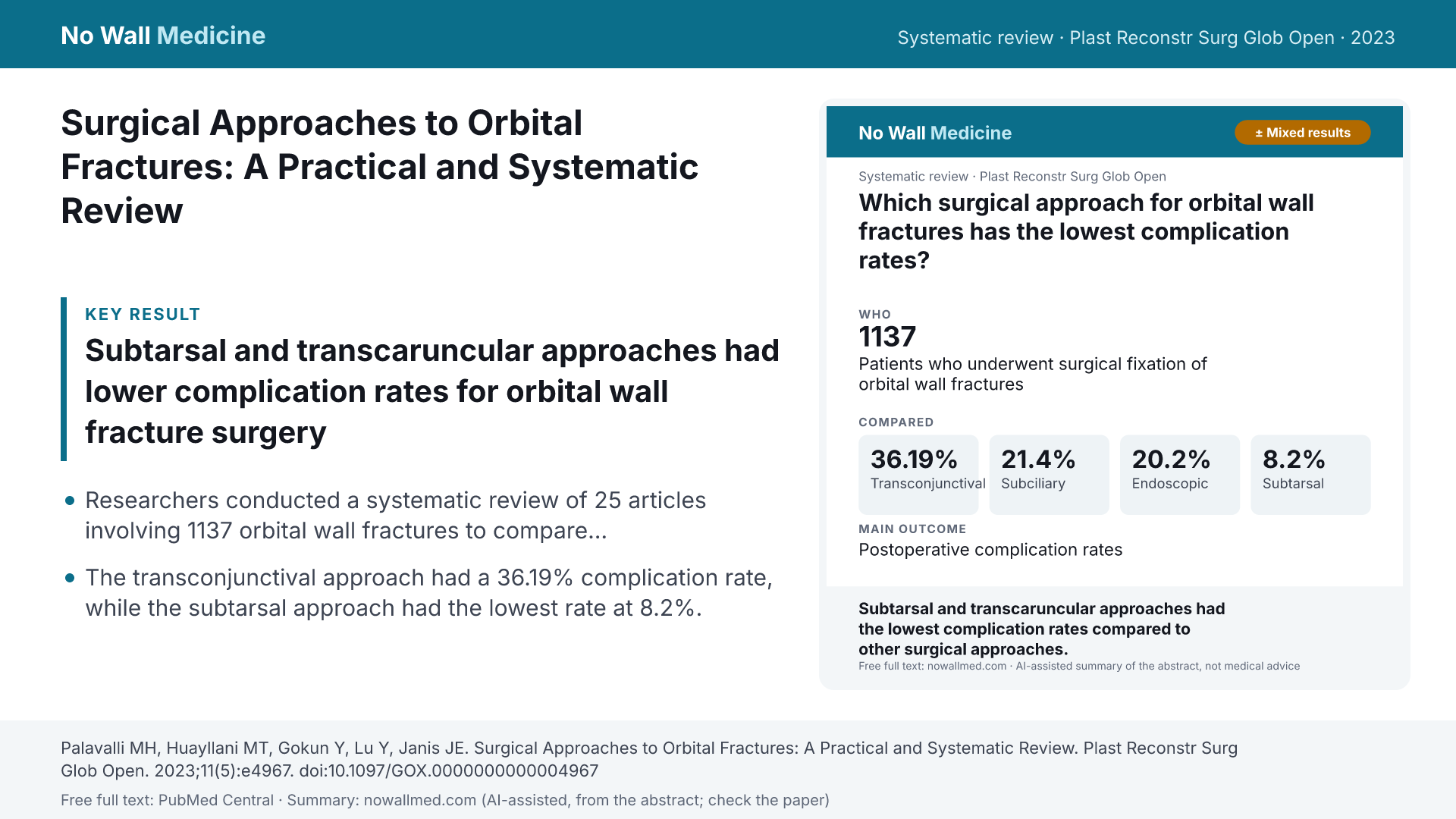
Key result: Subtarsal and transcaruncular approaches had lower complication rates for orbital wall fracture surgery
Systematic reviewMixed results
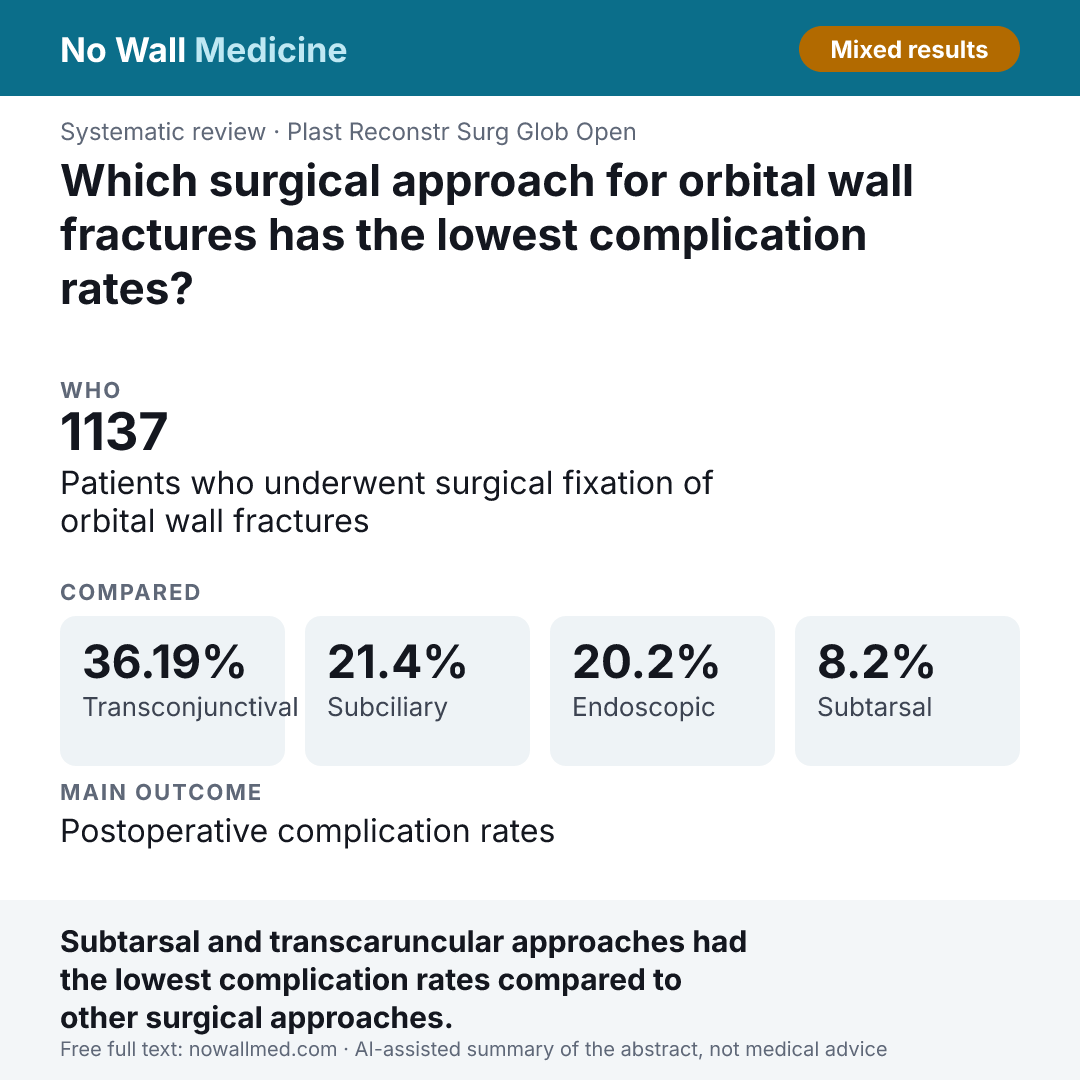
Which surgical approach for orbital wall fractures has the lowest complication rates?
Who
1137
Patients who underwent surgical fixation of orbital wall fractures
Compared
36.19%Transconjunctival
21.4%Subciliary
20.2%Endoscopic
8.2%Subtarsal
Main outcome
Postoperative complication rates
Bottom line: Subtarsal and transcaruncular approaches had the lowest complication rates compared to other surgical approaches.
Plast Reconstr Surg Glob Open · 2023-05-15 · Save PNG
Key points
- Researchers conducted a systematic review of 25 articles involving 1137 orbital wall fractures to compare different surgical methods.
- The transconjunctival approach had a 36.19% complication rate, while the subtarsal approach had the lowest rate at 8.2%.
- The most frequent methods used were endoscopic at 33.3% and transconjunctival at 32.8%.
Discussion prompts
- Would these patients look like yours? Who was left out?
- Is the main outcome one that matters to patients?
- Is the difference large enough to change what you do?
Cite: Palavalli MH, Huayllani MT, Gokun Y, Lu Y, Janis JE. Surgical Approaches to Orbital Fractures: A Practical and Systematic Review. Plast Reconstr Surg Glob Open. 2023;11(5):e4967. doi:10.1097/GOX.0000000000004967
Free full text: PubMed Central · Summary and visual abstract: nowallmed.com/a/surgical-approaches-to-orbital-fractures-a-practical-and-systematic-1qt5314/ (AI-assisted from the abstract; check the paper before relying on it).