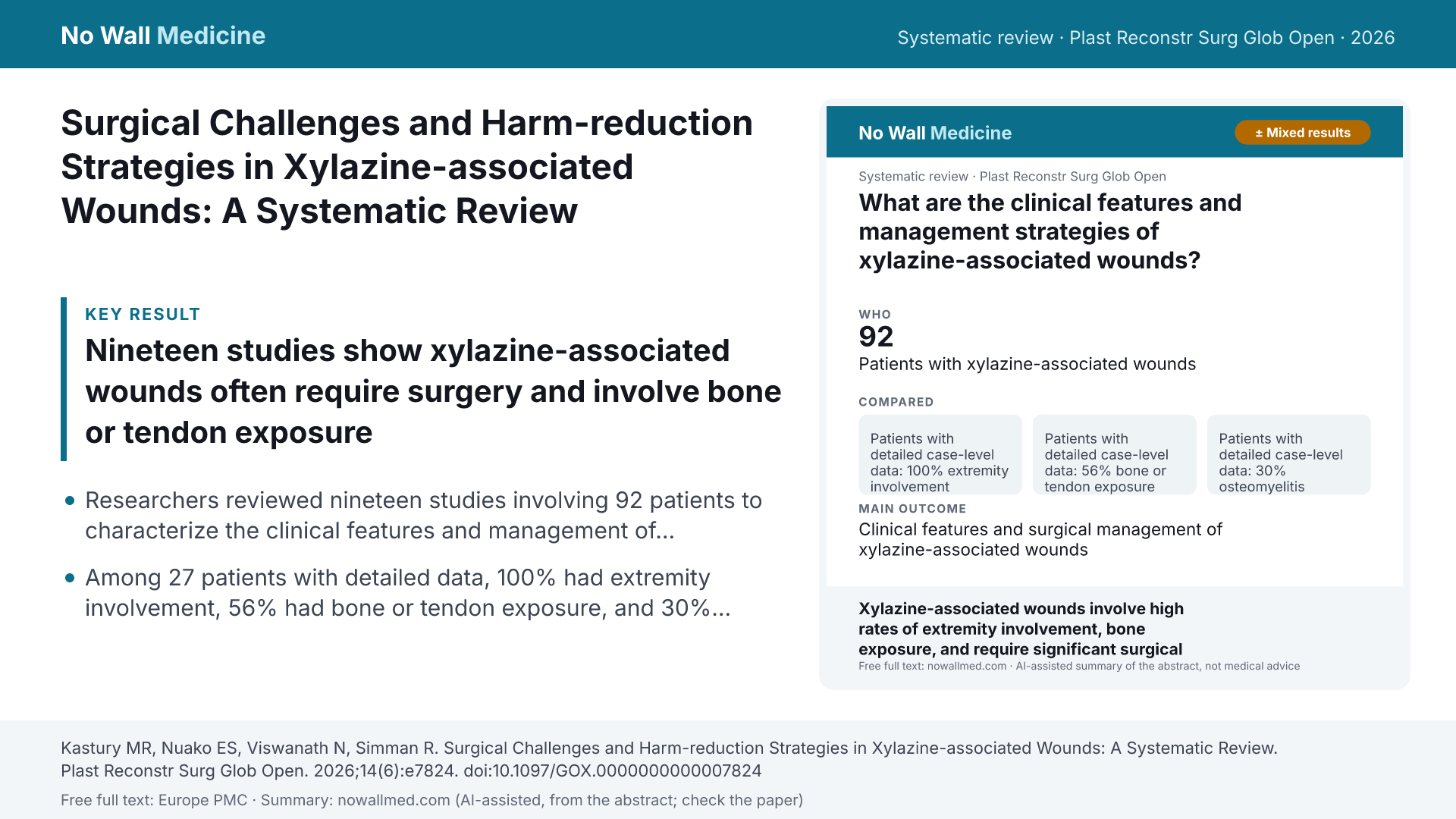
Nineteen studies show xylazine-associated wounds often require surgery and involve bone or tendon exposure
Surgical Challenges and Harm-reduction Strategies in Xylazine-associated Wounds: A Systematic Review
Systematic reviewMixed results
What are the clinical features and management strategies of xylazine-associated wounds?
Who
92
Patients with xylazine-associated wounds
Compared
Patients with detailed case-level data: 100% extremity involvement
Patients with detailed case-level data: 56% bone or tendon exposure
Patients with detailed case-level data: 30% osteomyelitis
Main outcome
Clinical features and surgical management of xylazine-associated wounds
Bottom line: Xylazine-associated wounds involve high rates of extremity involvement, bone exposure, and require significant surgical management.
Plast Reconstr Surg Glob Open · 2026-06-16 · Save PNG
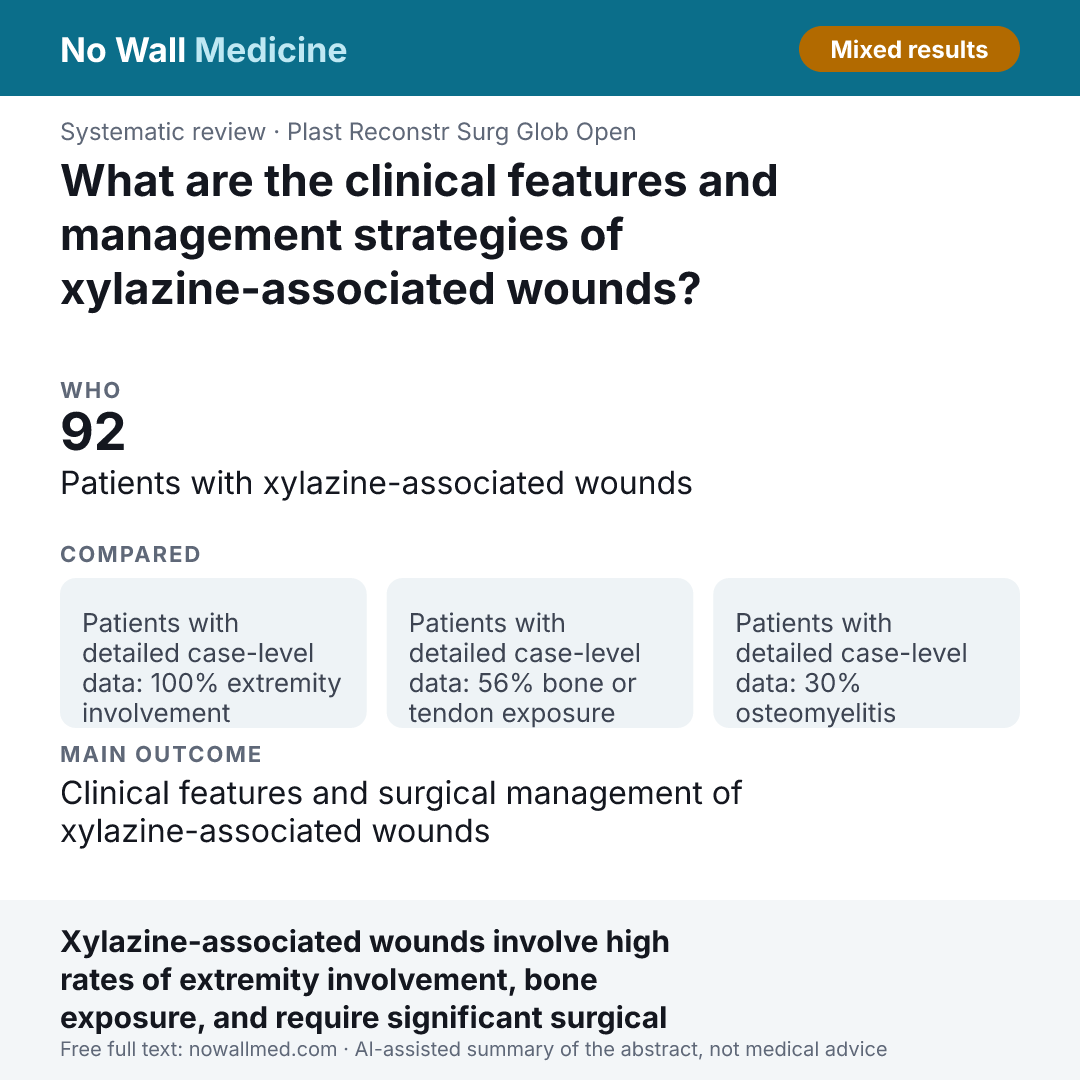
Clinical question: What are the clinical features and management strategies of xylazine-associated wounds?
Why it matters: Xylazine is a veterinary sedative used as an adulterant in illicit opioids that is linked to severe, progressive necrotic wounds.
Key points
- Researchers reviewed nineteen studies involving 92 patients to characterize the clinical features and management of wounds caused by the veterinary sedative xylazine.
- Among 27 patients with detailed data, 100% had extremity involvement, 56% had bone or tendon exposure, and 30% had osteomyelitis, which is a bone infection.
- Surgical management was used in 78% of patients, including skin grafting in 41%, free flap reconstruction in 11%, and amputation in 26%.
Headline and key points written with AI from the paper’s abstract, with every number checked against it. Read the paper before relying on them.
Was this summary helpful?
Abstract
Background
Xylazine, a veterinary sedative not approved for human use, has emerged as a dangerous adulterant in the illicit opioid supply and is now linked to severe, progressive necrotic wounds. These lesions often occur at noninjection sites, exhibit atypical healing patterns, and are commonly complicated by infection, osteomyelitis, and delayed presentation. This study characterizes the clinical features, management strategies, and outcomes of xylazine-associated wounds to inform triage and harm-reduction efforts. Methods
A systematic review was conducted in accordance with preferred reporting items for systematic reviews and meta-analyses guidelines and registered with PROSPERO (CRD420251000303). Searches of PubMed, Embase, and Web of Science were completed through April 2025. Nineteen studies comprising 92 patients were included. Descriptive statistics and Fisher exact tests were used to evaluate associations between clinical variables. Results
Among 27 patients with detailed case-level data, all had extremity involvement (100%), with bone or tendon exposure in 56% and osteomyelitis in 30%. Surgical management occurred in 78% of patients, including grafting (41%), free flap reconstruction (11%), and amputation (26%). Algorithm-guided care, documented in 56%, was significantly associated with both bone or tendon exposure (P = 0.007) and amputation (P = 0.008). At the study level, algorithm use was more common in studies that described bone or tendon exposure (P = 0.048). Conclusions
Xylazine-associated wounds are a distinct and increasingly prevalent condition. These findings support early surgical triage and structured, harm-reduction care models to improve outcomes for medically and socially vulnerable patients.
Abstract reproduced under the article’s CC BY-NC-ND licence.
Headline, design, result, key points, caveat and citation as plain text.
Cite this article
Kastury MR, Nuako ES, Viswanath N, Simman R. Surgical Challenges and Harm-reduction Strategies in Xylazine-associated Wounds: A Systematic Review. Plast Reconstr Surg Glob Open. 2026;14(6):e7824. doi:10.1097/GOX.0000000000007824
Spotted a mistake? Suggest a correction