Surgery for brain bleeding is associated with better outcomes and lower mortality than medical treatment
Surgical interventions for spontaneous supratentorial intracerebral haemorrhage: a systematic review and network meta-analysis
Systematic review and network meta-analysisBenefit found
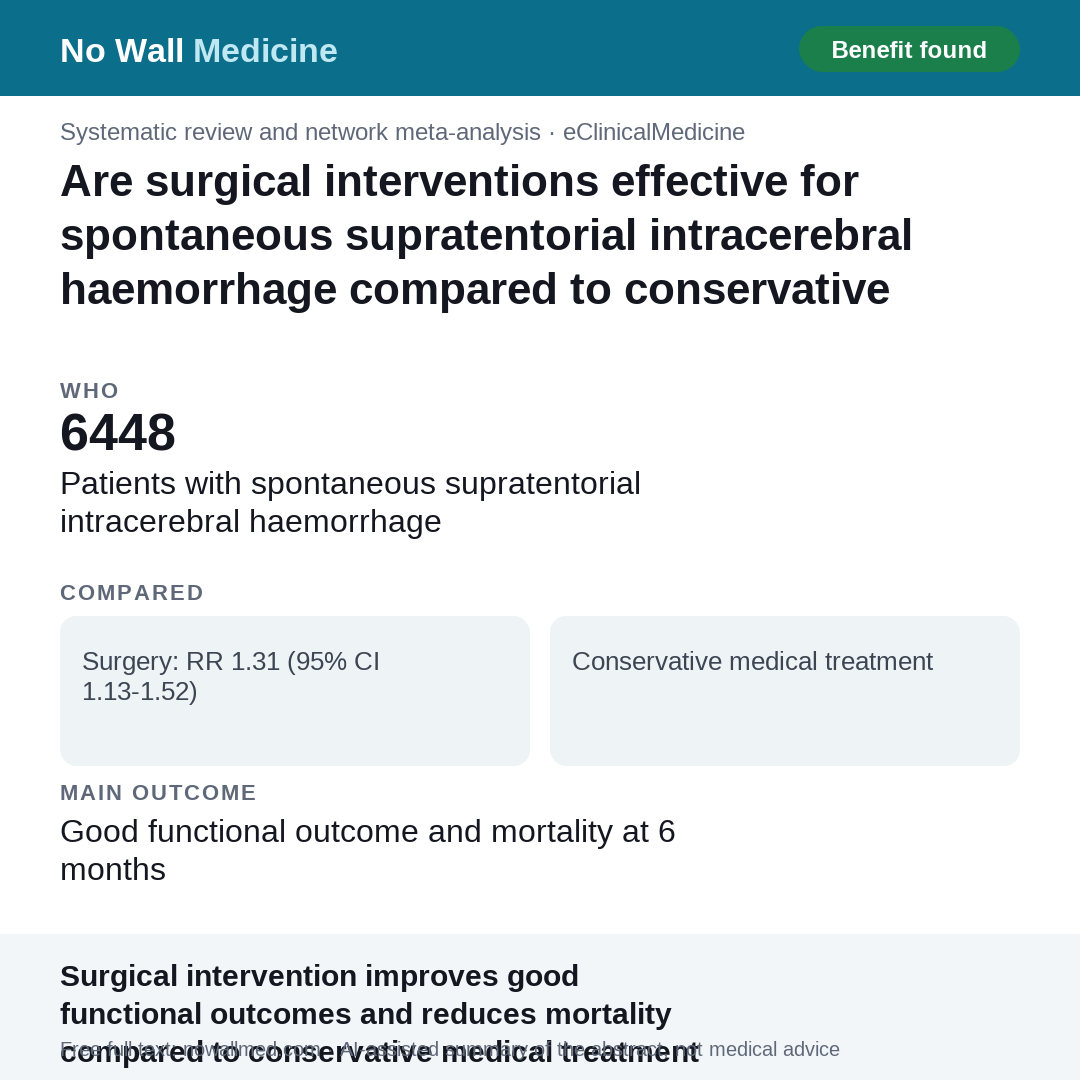
Are surgical interventions effective for spontaneous supratentorial intracerebral haemorrhage compared to conservative medical treatment?
Who
6448
Patients with spontaneous supratentorial intracerebral haemorrhage
Compared
Surgery: RR 1.31 (95% CI 1.13-1.52)
Conservative medical treatment
Main outcome
Good functional outcome and mortality at 6 months
Result: risk ratio 1.31 (95% CI 1.13-1.52) for good functional outcome
Bottom line: Surgical intervention improves good functional outcomes and reduces mortality compared to conservative medical treatment for spontaneous supratentorial intracerebral haemorrhage.
Funded by: National Natural Science Foundation of China and others
eClinicalMedicine · 2024-12-07Download image
Clinical question: Are surgical interventions effective for spontaneous supratentorial intracerebral haemorrhage compared to conservative medical treatment?
Why it matters: The comparative benefits of different surgical procedures and their superiority over conservative medical treatment for treating brain bleeding remain unclear.
Key points
- Researchers analyzed 31 randomized controlled trials involving 6448 patients with spontaneous supratentorial intracerebral hemorrhage, which is bleeding in the upper part of the brain.
- Compared to conservative medical treatment, surgery was associated with a 9.1% higher risk difference for good functional outcome and a 5.1% lower risk difference for mortality.
- Endoscopic surgery and minimally invasive puncture surgery were associated with improved functional outcomes, while endoscopic surgery and conventional craniotomy were associated with reduced mortality at 6 months.
Headline and key points written with AI from the paper’s abstract, with every number checked against it. Read the paper before relying on them.
Was this summary helpful?
Cite this article
Huan J, Yao M, Ma Y, Mei F, Liu Y, Ma L. Surgical interventions for spontaneous supratentorial intracerebral haemorrhage: a systematic review and network meta-analysis. eClinicalMedicine. 2024. doi:10.1016/j.eclinm.2024.102999
Spotted a mistake? Suggest a correction
Top studies every Monday
The week’s key trials and guidelines in your specialties, plus any topics you follow. By email, free.
Get the weekly digest