Surgical methods of total thyroidectomy for differentiated thyroid cancer: a systematic review and Bayesian network meta-analysis
Systematic review and Bayesian network meta-analysisMixed results
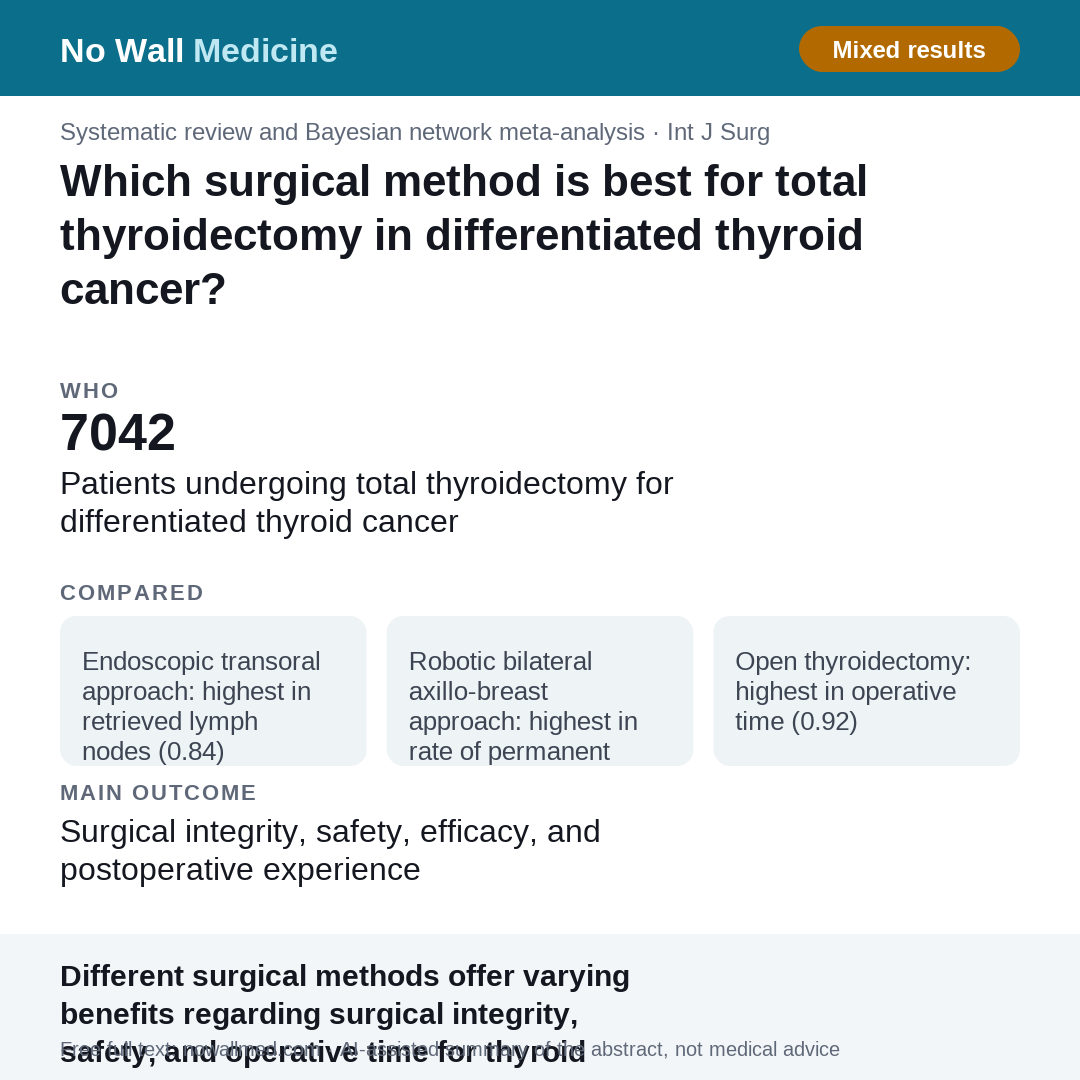
Which surgical method is best for total thyroidectomy in differentiated thyroid cancer?
Who
7042
Patients undergoing total thyroidectomy for differentiated thyroid cancer
Compared
Endoscopic transoral approach: highest in retrieved lymph nodes (0.84)
Robotic bilateral axillo-breast approach: highest in rate of permanent recurrent laryngeal nerve palsy (0.94)
Open thyroidectomy: highest in operative time (0.92)
Main outcome
Surgical integrity, safety, efficacy, and postoperative experience
Bottom line: Different surgical methods offer varying benefits regarding surgical integrity, safety, and operative time for thyroid cancer patients.
Int J Surg · 2024-01-01Download image
Clinical question: Which surgical method is best for total thyroidectomy in differentiated thyroid cancer?
Abstract
Background
Emerging remote-access surgical methods are utilized to treat differentiated thyroid cancer. The study aimed to compare the surgical integrity, safety, efficacy, and postoperative experience of patients among common surgical methods. Methods
The PubMed, Medline, Cochrane Library, Web of Science, and EMBASE databases were searched from their inception until March 2023. Pairwise meta-analysis and Bayesian network meta-analysis were performed. The surface under the cumulative ranking curve (SUCRA) was used to illuminate the probability that each method would be the best for each outcome. Results
Thirty-two studies comprising 7042 patients were included. Robotic bilateral axillo-breast approach (RBABA) and robotic gasless transaxillary approach (RGAA) retrieved fewer lymph nodes (LNs) than open thyroidectomy (OT). RBABA showed a significantly lower permanent recurrent laryngeal nerve (RLN) palsy rate than OT. According to SUCRA values, endoscopic transoral approach (EOA) ranked the highest in retrieved LNs (0.84), the proportion of stimulated serum thyroglobulin less than 1.0 ng/ml (0.77), and the pain score (0.77). Endoscopic bilateral areola approach (EBAA) ranked the highest in the transient RLN palsy rate (0.72). The endoscopic gasless transaxillary approach (EGAA) ranked the highest in the transient hypoparathyroidism rate (0.78). RBABA ranked the highest in the rate of permanent RLN palsy (0.94) and hypoparathyroidism (0.77). OT ranked the highest in operative time (0.92). Conclusions
Each surgical method of total thyroidectomy has benefits and limitations. EOA performed the best in maintaining surgical integrality and reducing the pain score, while taking a long operative time. Generally, RBABA showed the best advantage in protecting parathyroid glands and RLN but with the longest operative time. OT had the best advantage in operative time. Therefore, OT and EOA are ideal methods for patients with a higher risk of central LN metastasis. RBABA and EOA may not be suitable for elderly patients or those with high anesthesia risk.
Subject terms
Cite this article
Yuan Y, Pan B, Tang E, Mo H, Zhu J, Yi Z. Surgical methods of total thyroidectomy for differentiated thyroid cancer: a systematic review and Bayesian network meta-analysis. Int J Surg. 2024. doi:10.1097/JS9.0000000000000819
Spotted a mistake? Suggest a correction
Top studies every Monday
The week’s key trials and guidelines in your specialties, plus any topics you follow. By email, free.
Get the weekly digest