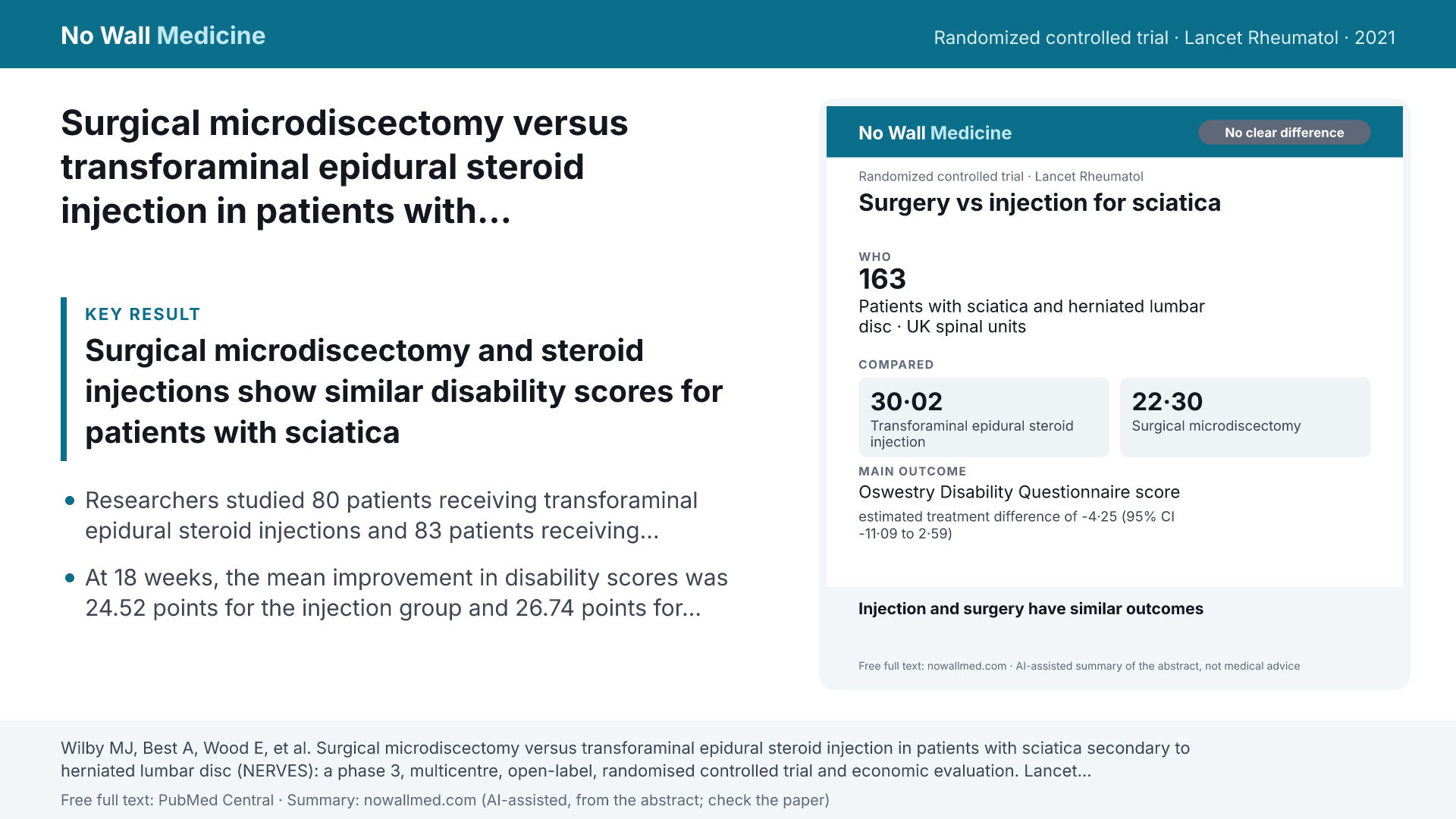
Surgical microdiscectomy and steroid injections show similar disability scores for patients with sciatica
Surgical microdiscectomy versus transforaminal epidural steroid injection in patients with sciatica secondary to herniated lumbar disc (NERVES): a phase 3, multicentre, open-label, randomised controlled trial and economic evaluation
Randomized controlled trialNo clear difference
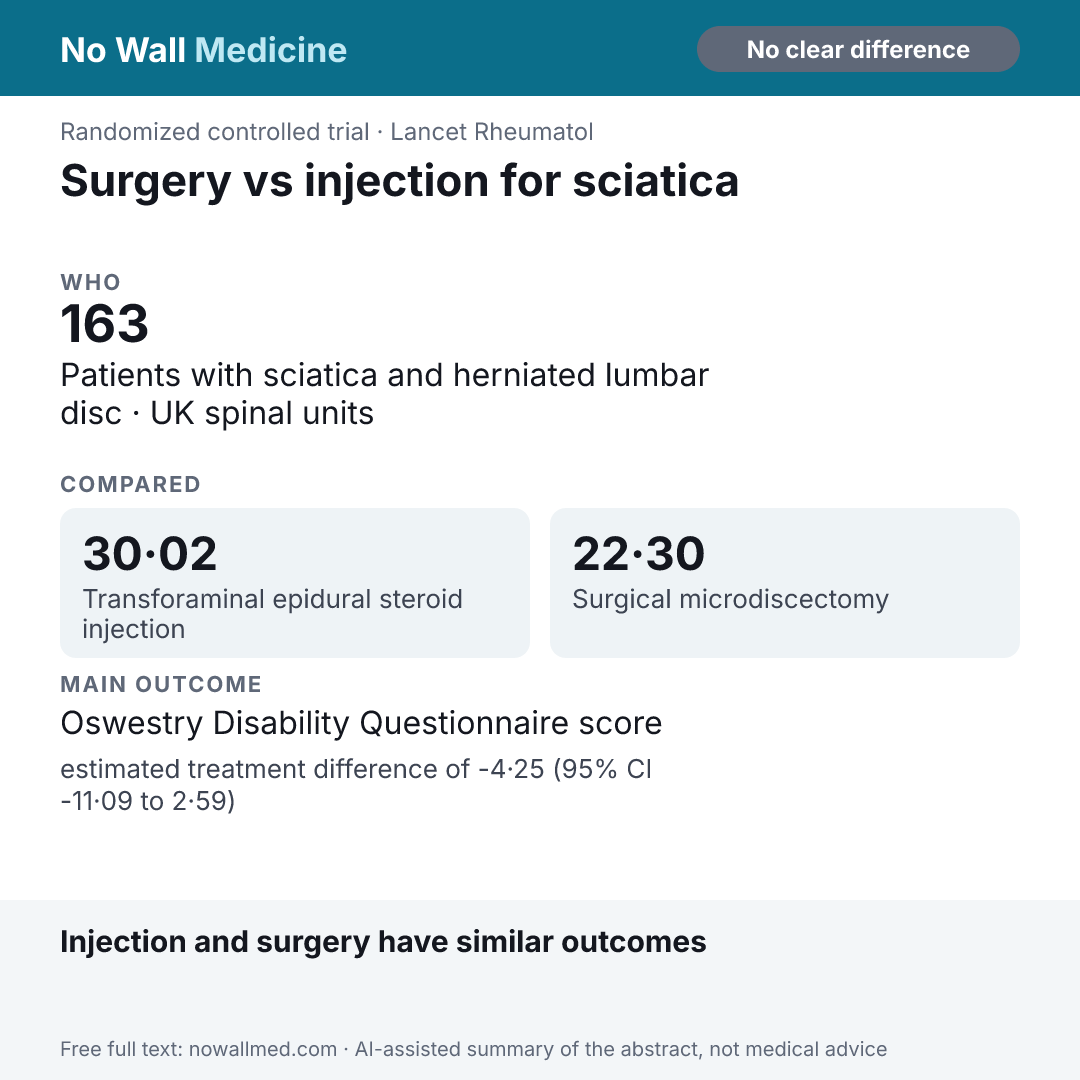
Surgery vs injection for sciatica
Who
163
Patients with sciatica and herniated lumbar disc · UK spinal units
Compared
30·02Transforaminal epidural steroid injection (SD 24·38)
22·30Surgical microdiscectomy (19·83)
Main outcome
Oswestry Disability Questionnaire score
Result: estimated treatment difference of -4·25 (95% CI -11·09 to 2·59)
Bottom line: Injection and surgery have similar outcomes
Funded by: National Institute for Health Research
Lancet Rheumatol · 2021-03-18 · Save PNG
Why it matters: It is controversial whether non-surgical treatments like transforaminal epidural steroid injections are as effective or cost-effective as surgical microdiscectomy for managing radicular pain.
Key points
- Researchers studied 80 patients receiving transforaminal epidural steroid injections and 83 patients receiving surgical microdiscectomy for sciatica caused by a herniated lumbar disc.
- At 18 weeks, the mean improvement in disability scores was 24.52 points for the injection group and 26.74 points for the surgery group, showing no statistically significant difference.
- Four serious adverse events were associated with surgery, while none were associated with the steroid injections.
Headline and key points written with AI from the paper’s abstract, with every number checked against it. Read the paper before relying on them.
Was this summary helpful?
Abstract
Background
The optimal invasive treatment for sciatica secondary to herniated lumbar disc remains controversial, with a paucity of evidence for use of non-surgical treatments such as transforaminal epidural steroid injection (TFESI) over surgical microdiscectomy. We aimed to investigate the clinical and cost-effectiveness of these options for management of radicular pain secondary to herniated lumbar disc. Methods
We did a pragmatic, multicentre, phase 3, open-label, randomised controlled trial at 11 spinal units across the UK. Eligible patients were aged 16-65 years, had MRI-confirmed non-emergency sciatica secondary to herniated lumbar disc with symptom duration between 6 weeks and 12 months, and had leg pain that was not responsive to non-invasive management. Participants were randomly assigned (1:1) to receive either TFESI or surgical microdiscectomy by an online randomisation system that was stratified by centre with random permuted blocks. The primary outcome was Oswestry Disability Questionnaire (ODQ) score at 18 weeks. All randomly assigned participants who completed a valid ODQ at baseline and at 18 weeks were included in the analysis. Safety analysis included all treated participants. Cost-effectiveness was estimated from the EuroQol-5D-5L, Hospital Episode Statistics, medication usage, and self-reported resource-use data. This trial was registered with ISRCTN, number ISRCTN04820368, and EudraCT, number 2014-002751-25. Findings
Between March 6, 2015, and Dec 21, 2017, 163 (15%) of 1055 screened patients were enrolled, with 80 participants (49%) randomly assigned to the TFESI group and 83 participants (51%) to the surgery group. At week 18, ODQ scores were 30·02 (SD 24·38) for 63 assessed patients in the TFESI group and 22·30 (19·83) for 61 assessed patients in the surgery group. Mean improvement was 24·52 points (18·89) for the TFESI group and 26·74 points (21·35) for the surgery group, with an estimated treatment difference of -4·25 (95% CI -11·09 to 2·59; p=0·22). There were four serious adverse events in four participants associated with surgery, and none with TFESI. Compared with TFESI, surgery had an incremental cost-effectiveness ratio of £38 737 per quality-adjusted life-year gained, and a 0·17 probability of being cost-effective at a willingness-to-pay threshold of £20 000 per quality-adjusted life-year. Interpretation
For patients with sciatica secondary to herniated lumbar disc, with symptom duration of up to 12 months, TFESI should be considered as a first invasive treatment option. Surgery is unlikely to be a cost-effective alternative to TFESI. Funding
Health Technology Assessment programme of the National Institute for Health Research (NIHR), UK.
Abstract reproduced under the article’s CC BY NC ND licence.
Headline, design, result, key points, caveat and citation as plain text.
Cite this article
Wilby MJ, Best A, Wood E, et al. Surgical microdiscectomy versus transforaminal epidural steroid injection in patients with sciatica secondary to herniated lumbar disc (NERVES): a phase 3, multicentre, open-label, randomised controlled trial and economic evaluation. Lancet Rheumatol. 2021. doi:10.1016/S2665-9913(21)00036-9
Spotted a mistake? Suggest a correction