Surgical outcomes after radioactive 125I seed versus hookwire localization of non-palpable breast cancer: a multicentre randomized clinical trial
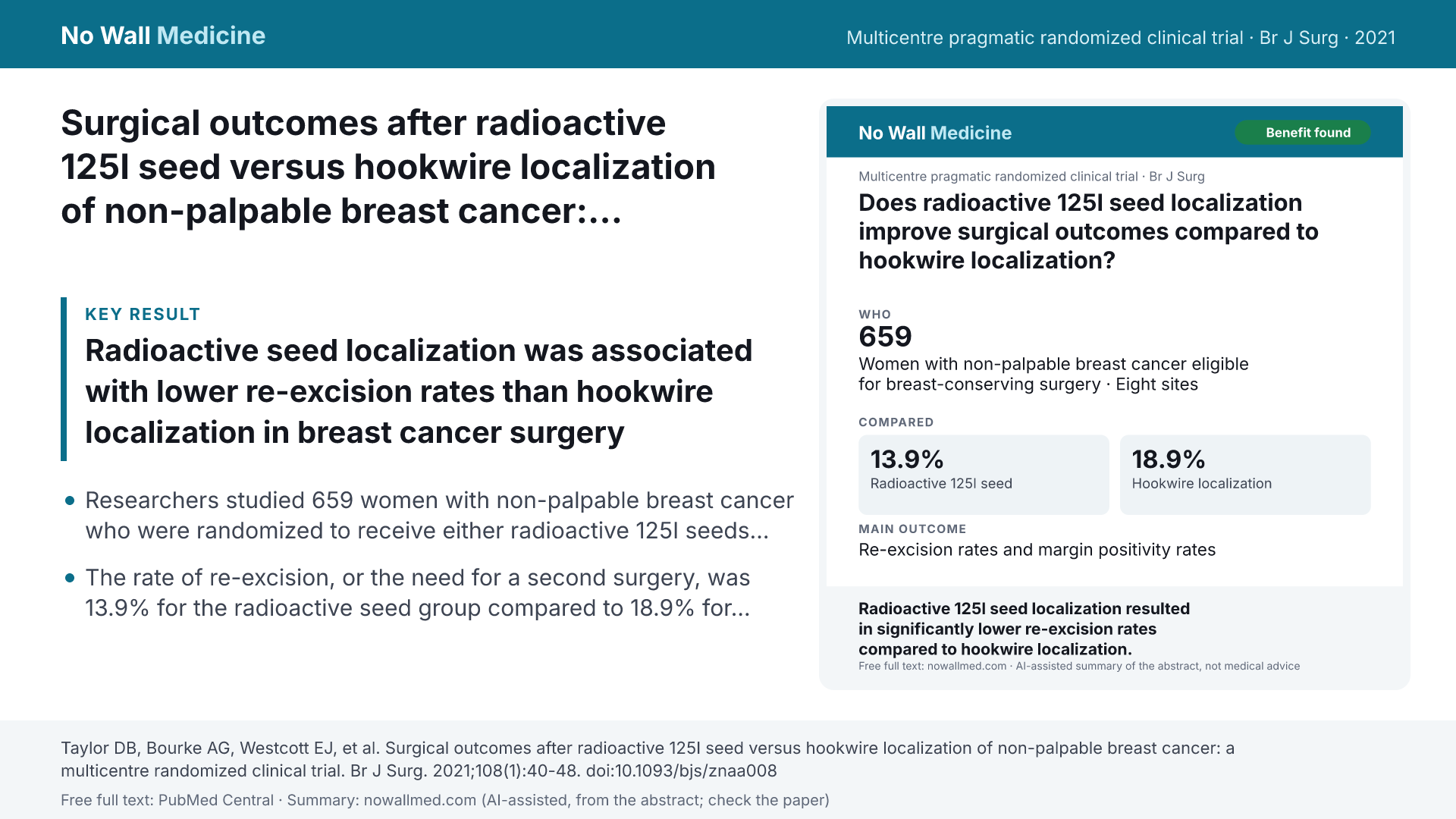
Key result: Radioactive seed localization was associated with lower re-excision rates than hookwire localization in breast cancer surgery
Multicentre pragmatic randomized clinical trialBenefit found
Does radioactive 125I seed localization improve surgical outcomes compared to hookwire localization?
Who
659
Women with non-palpable breast cancer eligible for breast-conserving surgery · Eight sites
Compared
13.9%Radioactive 125I seed
18.9%Hookwire localization
Main outcome
Re-excision rates and margin positivity rates
Bottom line: Radioactive 125I seed localization resulted in significantly lower re-excision rates compared to hookwire localization.
Br J Surg · 2021-02-28
Key points
- Researchers studied 659 women with non-palpable breast cancer who were randomized to receive either radioactive 125I seeds or hookwire localization, a method using a thin wire to mark the tumor.
- The rate of re-excision, or the need for a second surgery, was 13.9% for the radioactive seed group compared to 18.9% for the hookwire group.
- There were no significant differences between the two groups regarding positive margin rates, specimen weights, or specimen volumes.
Discussion prompts
- Would these patients look like yours? Who was left out?
- Is the main outcome one that matters to patients?
- Is the difference large enough to change what you do?
Cite: Taylor DB, Bourke AG, Westcott EJ, et al. Surgical outcomes after radioactive 125I seed versus hookwire localization of non-palpable breast cancer: a multicentre randomized clinical trial. Br J Surg. 2021;108(1):40-48. doi:10.1093/bjs/znaa008
Free full text: PubMed Central · Summary and visual abstract: nowallmed.com/a/surgical-outcomes-after-radioactive-125i-seed-versus-hookwire-1yyxxc0/ (AI-assisted from the abstract; check the paper before relying on it).