Surgery for sciatica may reduce leg pain more than non-surgical treatments in the short term
Surgical versus non-surgical treatment for sciatica: systematic review and meta-analysis of randomised controlled trials
Systematic review and meta-analysisBenefit found
Is surgery more effective and safer than non-surgical treatment for sciatica?
Who
1711
People with sciatica due to lumbar disc herniation
Compared
Discectomy: moderate effect at immediate term (mean difference -12.1 (95% confidence interval -23.6 to -0.5))
Non-surgical treatment
Main outcome
Leg pain and disability
Result: mean difference -12.1 (95% confidence interval -23.6 to -0.5)
Bottom line: Discectomy may reduce leg pain more than non-surgical treatments, but benefits decline over time.
Limitation: Very low to low certainty evidence
BMJ · 2023-04-19Download image
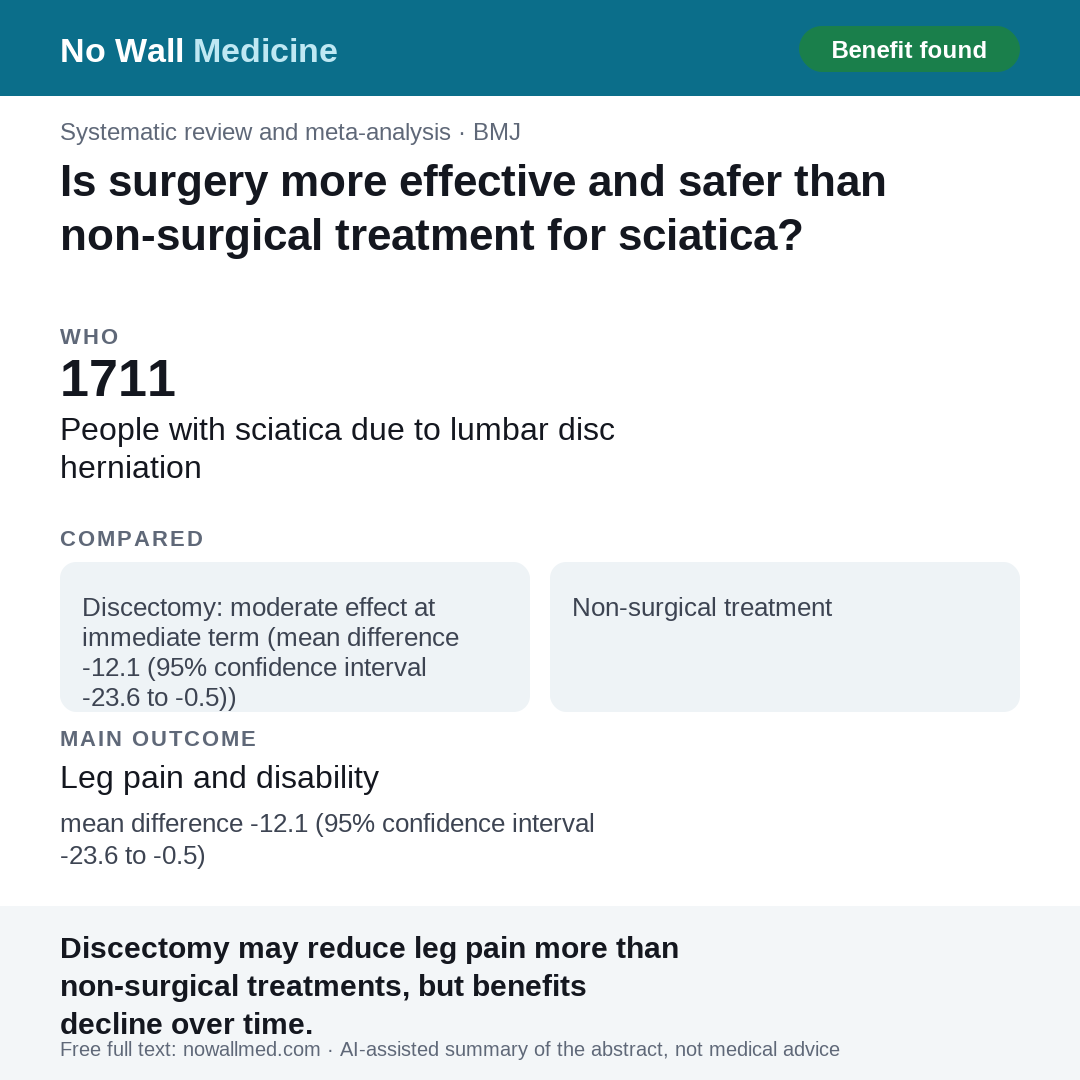
Clinical question: Is surgery more effective and safer than non-surgical treatment for sciatica?
Why it matters: It is unclear whether surgical discectomy is more effective than non-surgical treatments or steroid injections for managing leg pain and disability in sciatica.
Key points
- Researchers analyzed 24 randomized controlled trials involving participants with sciatica caused by lumbar disc herniation.
- Discectomy, or surgical removal of part of a spinal disc, showed moderate leg pain reduction at immediate term with a mean difference of -12.1 and short term at -11.7.
- The benefits for leg pain were small at medium term with a mean difference of -6.5 and negligible at long term with a mean difference of -2.3.
Limitation the authors note: The certainty of evidence for these findings was rated as very low to low.
Headline and key points written with AI from the paper’s abstract, with every number checked against it. Read the paper before relying on them.
Abstract
Objective
To investigate the effectiveness and safety of surgery compared with non-surgical treatment for sciatica. Design
Systematic review and meta-analysis. Data sources
Medline, Embase, CINAHL, Cochrane Central Register of Controlled Trials, ClinicalTrials.gov, and the World Health Organisation International Clinical Trials Registry Platform from database inception to June 2022. Eligibility criteria for selecting studies
Randomised controlled trials comparing any surgical treatment with non-surgical treatment, epidural steroid injections, or placebo or sham surgery, in people with sciatica of any duration due to lumbar disc herniation (diagnosed by radiological imaging). Data extraction and synthesis
Two independent reviewers extracted data. Leg pain and disability were the primary outcomes. Adverse events, back pain, quality of life, and satisfaction with treatment were the secondary outcomes. Pain and disability scores were converted to a scale of 0 (no pain or disability) to 100 (worst pain or disability). Data were pooled using a random effects model. Risk of bias was assessed with the Cochrane Collaboration's tool and certainty of evidence with the grading of recommendations assessment, development, and evaluation (GRADE) framework. Follow-up times were into immediate term (≤six weeks), short term (>six weeks and ≤three months), medium term (>three and <12 months), and long term (at 12 months). Results
24 trials were included, half of these investigated the effectiveness of discectomy compared with non-surgical treatment or epidural steroid injections (1711 participants). Very low to low certainty evidence showed that discectomy, compared with non-surgical treatment, reduced leg pain: the effect size was moderate at immediate term (mean difference -12.1 (95% confidence interval -23.6 to -0.5)) and short term (-11.7 (-18.6 to -4.7)), and small at medium term (-6.5 (-11.0 to -2.1)). Negligible effects were noted at long term (-2.3 (-4.5 to -0.2)). For disability, small, negligible, or no effects were found. A similar effect on leg pain was found when comparing discectomy with epidural steroid injections. For disability, a moderate effect was found at short term, but no effect was observed at medium and long term. The risk of any adverse events was similar between discectomy and non-surgical treatment (risk ratio 1.34 (95% confidence interval 0.91 to 1.98)). Conclusion
Very low to low certainty evidence suggests that discectomy was superior to non-surgical treatment or epidural steroid injections in reducing leg pain and disability in people with sciatica with a surgical indication, but the benefits declined over time. Discectomy might be an option for people with sciatica who feel that the rapid relief offered by discectomy outweighs the risks and costs associated with surgery. Systematic review registration
PROSPERO CRD42021269997.
Abstract reproduced under the article’s CC BY NC licence.
Topics
Cite this article
Liu C, Ferreira GE, Abdel Shaheed C, Chen Q, Harris IA, Bailey CS. Surgical versus non-surgical treatment for sciatica: systematic review and meta-analysis of randomised controlled trials. BMJ. 2023. doi:10.1136/bmj-2022-070730
Spotted a mistake? Suggest a correction