Adding a web component to hospital surveys increased response rates and representation of underserved patients
Survey Protocols, Response Rates, and Representation of Underserved Patients: A Randomized Clinical Trial
Randomized clinical trialBenefit found
Does adding an initial web mode to survey protocols improve response rates and representativeness?
Who
34335
Patients discharged from 46 US hospitals · 46 US hospitals
Compared
36.5%Web-mail-phone
Two-mode protocols: 30.3%-31.1%
Single-mode protocols: 22.1%-24.3%
Main outcome
Response rates and representativeness of underserved patient groups
Bottom line: Web-first multimode survey protocols significantly improved response rates and representativeness of patient surveys.
JAMA Health Forum · 2024-01-05Download image
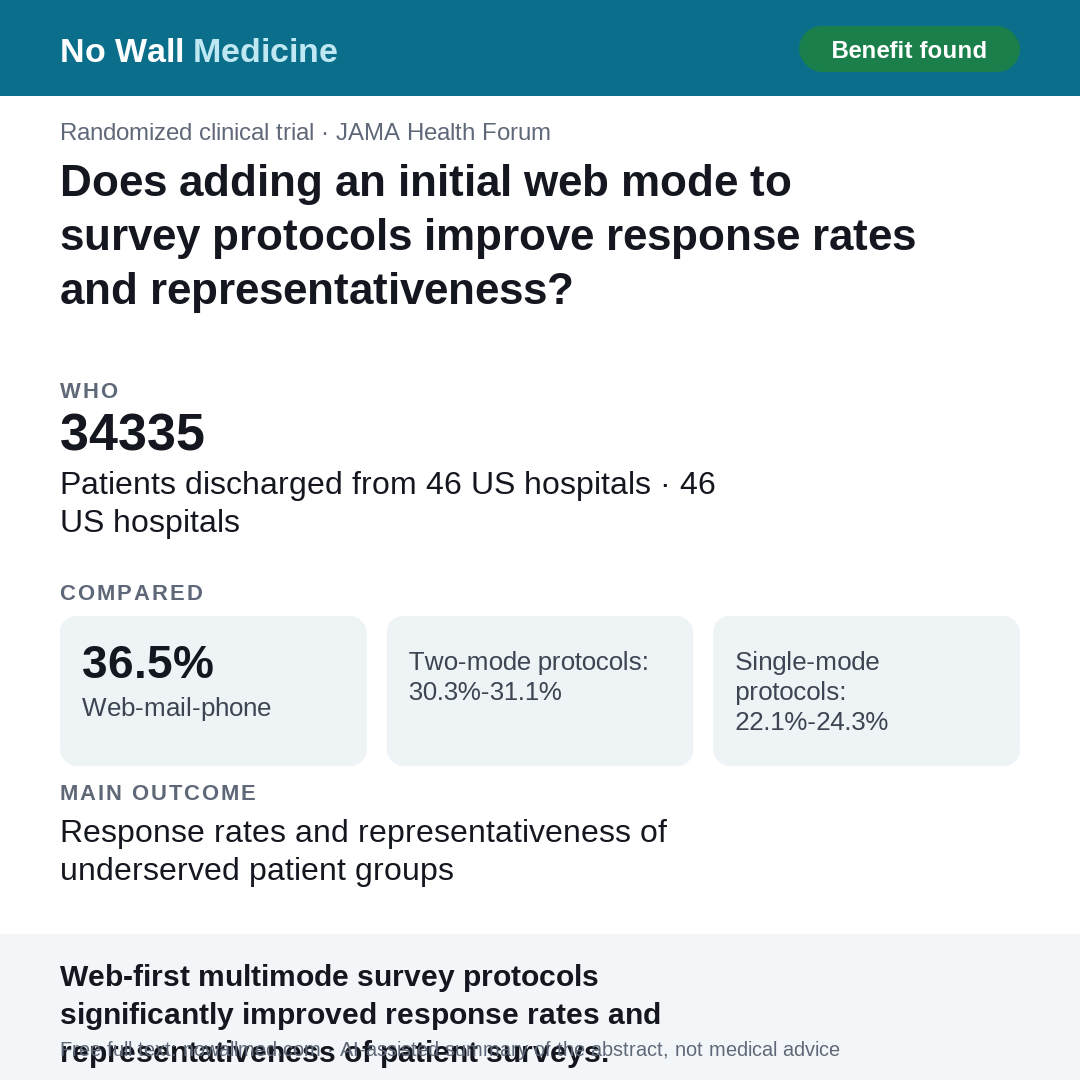
Clinical question: Does adding an initial web mode to survey protocols improve response rates and representativeness?
Why it matters: Patient surveys often underrepresent underserved groups, making it difficult to assess equity and quality improvement efforts.
Key points
- Researchers randomized 34,335 patients from 46 US hospitals to six different survey protocols, including single-mode and web-enhanced methods.
- The web-mail-phone protocol achieved the highest response rate at 36.5%, compared to 22.1%-24.3% for single-mode mail or phone protocols.
- Gains from using multiple survey modes were 2 to 3 times larger for Black, Hispanic, multiracial, and Asian American or Native Hawaiian or Other Pacific Islander patients than for White patients.
Headline and key points written with AI from the paper’s abstract, with every number checked against it. Read the paper before relying on them.
Was this summary helpful?
Subject terms
Cite this article
Elliott MN, Brown JA, Hambarsoomian K, Parast L, Beckett MK, Lehrman WG. Survey Protocols, Response Rates, and Representation of Underserved Patients: A Randomized Clinical Trial. JAMA Health Forum. 2024. doi:10.1001/jamahealthforum.2023.4929
Spotted a mistake? Suggest a correction
Top studies every Monday
The week’s key trials and guidelines in your specialties, plus any topics you follow. By email, free.
Get the weekly digest