Surgery and radiation therapy showed no survival advantage for stage IIIA Merkel cell carcinoma
Survival after lymph node dissection, radiotherapy, and combined treatment in sentinel node-positive stage IIIA Merkel cell carcinoma: A systematic review and meta-analysis
Systematic review and meta-analysisNo clear difference
What are the survival outcomes for stage IIIA Merkel cell carcinoma treatments?
Who
1825
Patients with stage IIIA Merkel cell carcinoma
Compared
Complete lymph node dissection: 93% (95% CI, 89%-96%) 1-year survival
Radiotherapy
Complete lymph node dissection plus radiotherapy
Main outcome
Overall survival and Merkel cell carcinoma-specific survival
Bottom line: No significant survival superiority was found among complete lymph node dissection, radiotherapy, or combined treatment.
Limitation: Limited observational studies, data heterogeneity, missing immunotherapy data, and low evidence levels.
JAAD Int · 2026-07-30Download image
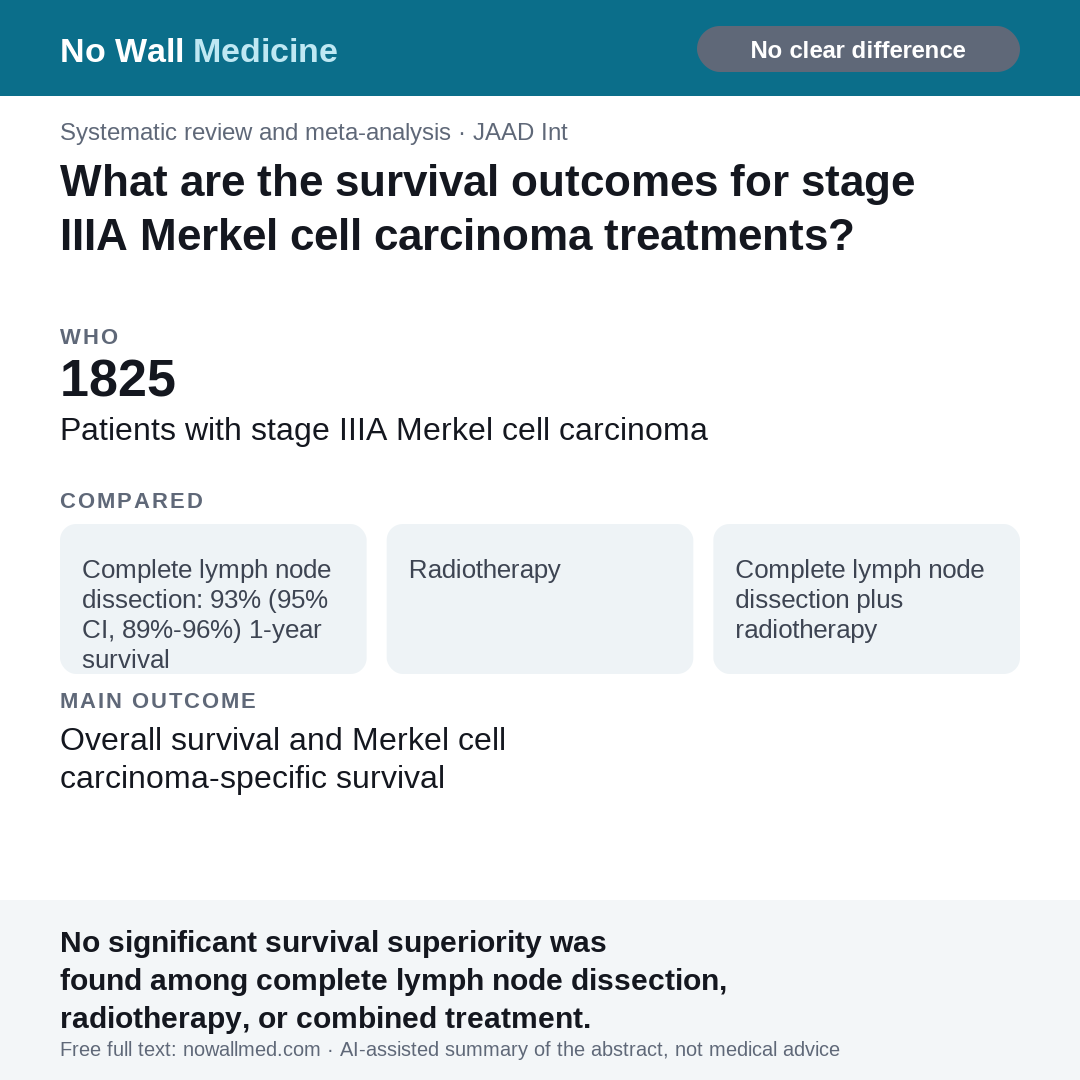
Clinical question: What are the survival outcomes for stage IIIA Merkel cell carcinoma treatments?
Why it matters: An evidence-based clinical approach is currently missing for patients with stage IIIA Merkel cell carcinoma who have lymphatic micrometastasis.
Key points
- Researchers analyzed eight studies involving 1825 patients to compare complete lymph node dissection, radiation therapy, or both for stage IIIA Merkel cell carcinoma.
- Complete lymph node dissection resulted in 93% 1-year and 71% 3-year survival rates, showing no significant difference compared to patients without the surgery.
- Radiation therapy alone or combined with surgery did not show superiority over other treatment options in the network meta-analysis.
Limitation the authors note: The authors noted a limited number of observational studies, data heterogeneity, missing data regarding immunotherapies, and low evidence levels.
Headline and key points written with AI from the paper’s abstract, with every number checked against it. Read the paper before relying on them.
Spotted a mistake? Suggest a correction
More in Dermatology
Pyoderma gangrenosum diagnosis and treatment remain challenging
Advances in the understanding and treatment of pyoderma gangrenosum
Ritlecitinib reduces T-cell activation and melanocyte killing in vitiligo
JAK3 and TEC-family kinase expression, spatial distribution and inhibition by ritlecitinib in vitiligo pathogenesis
Perifollicular crescentic pigmentation aids in recognizing flat facial basal cell carcinoma
Perifollicular Crescentic Pigmentation Improves Recognition of Flat Pigmented Facial Basal Cell Carcinoma: A Dermatoscopic Training and Artificial Intelligence Study
Estrogen decline affects skin structure and function during menopause
Cutaneous Manifestations of the Menopausal Transition - Part 1: Epidemiology, Biology, Diagnosis and Workup