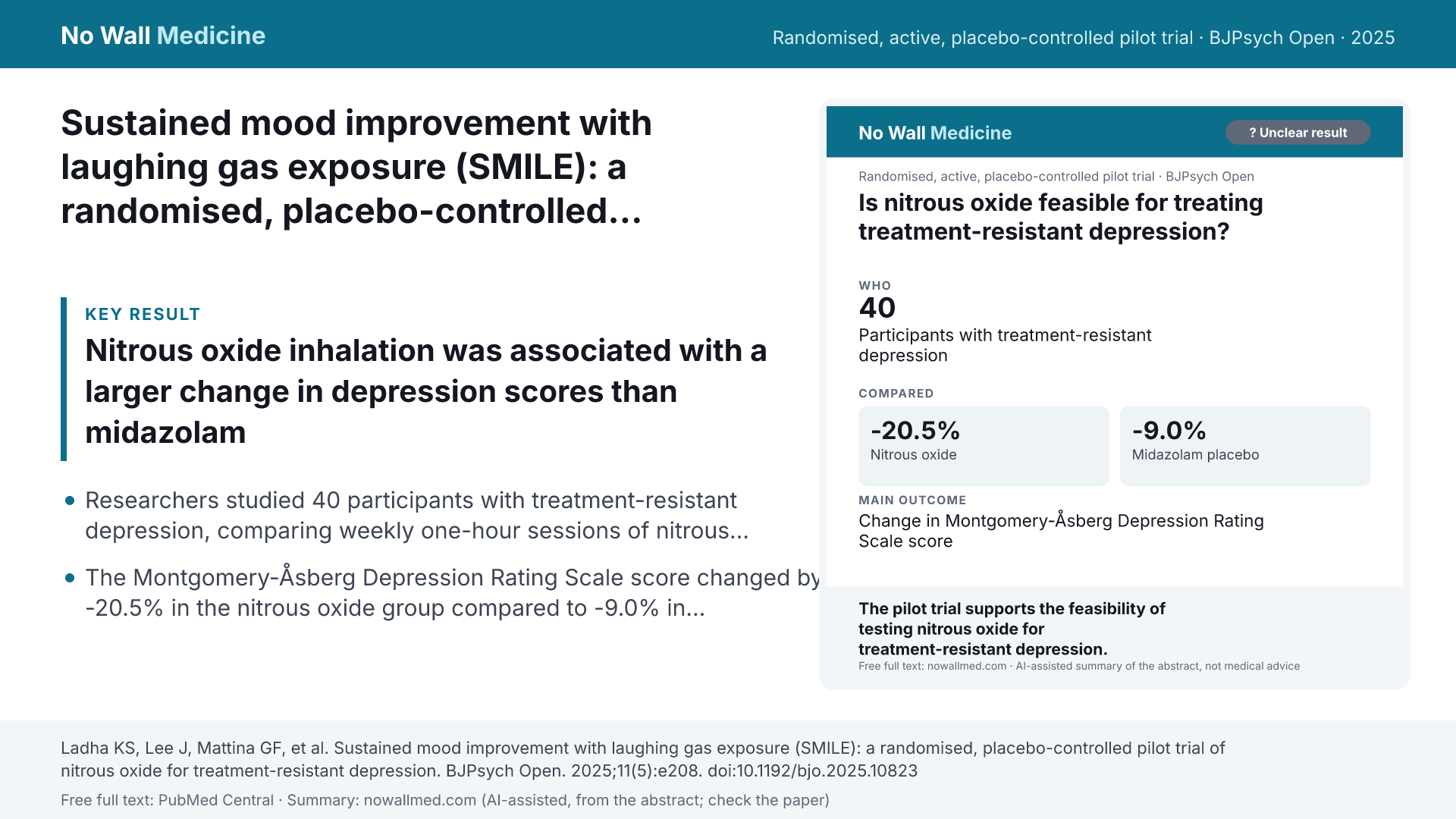
Nitrous oxide inhalation was associated with a larger change in depression scores than midazolam
Sustained mood improvement with laughing gas exposure (SMILE): a randomised, placebo-controlled pilot trial of nitrous oxide for treatment-resistant depression
Randomised, active, placebo-controlled pilot trialUnclear result
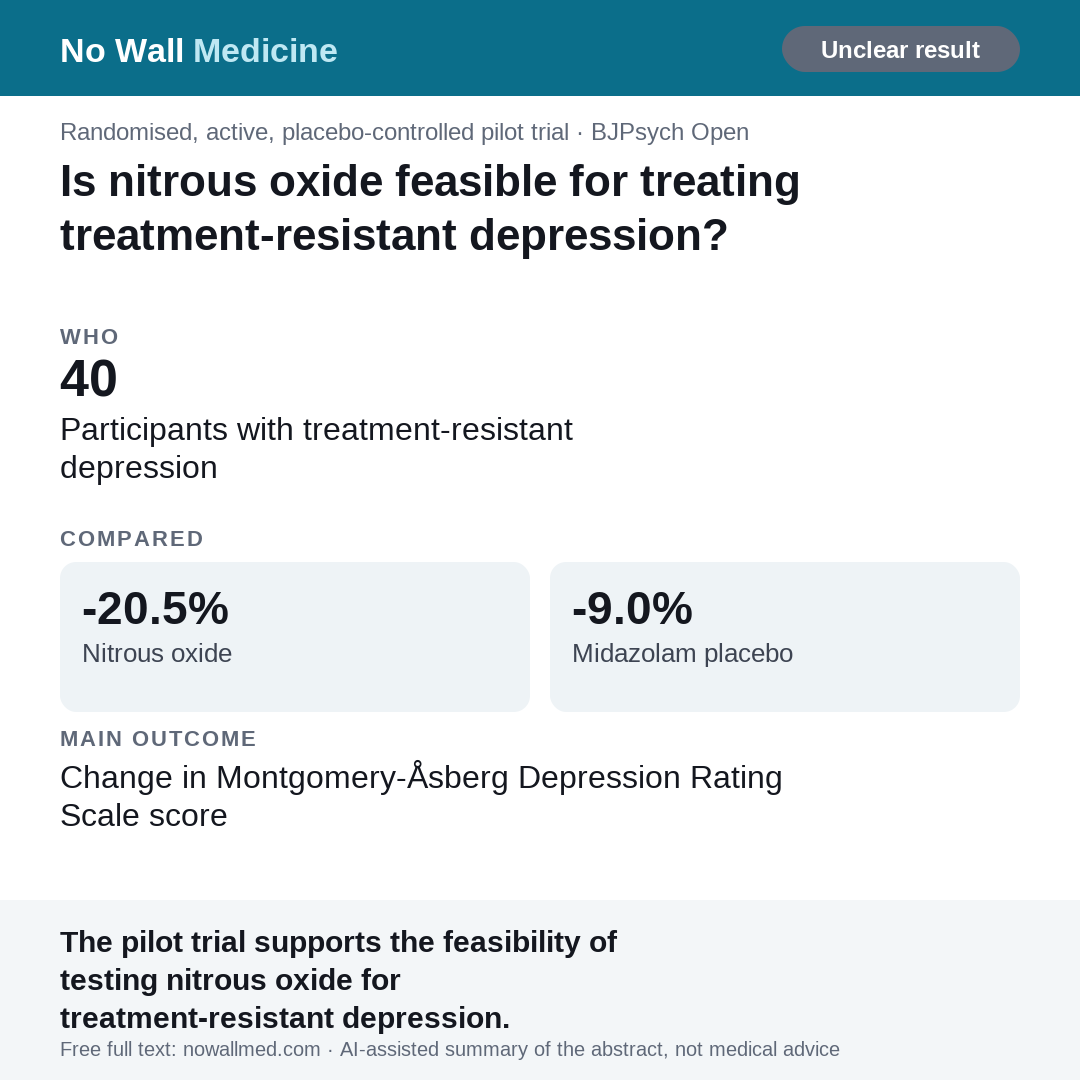
Is nitrous oxide feasible for treating treatment-resistant depression?
Who
40
Participants with treatment-resistant depression
Compared
-20.5%Nitrous oxide (95% CI -39.6 to -1.3)
-9.0%Midazolam placebo (95% CI -22.6 to 4.6)
Main outcome
Change in Montgomery-Åsberg Depression Rating Scale score
Bottom line: The pilot trial supports the feasibility of testing nitrous oxide for treatment-resistant depression.
Limitation: This was a pilot trial.
BJPsych Open · 2025-09-12Download image
Clinical question: Is nitrous oxide feasible for treating treatment-resistant depression?
Why it matters: Limited data exist regarding the effects of repeated administrations of nitrous oxide in active placebo-controlled studies for treatment-resistant depression.
Key points
- Researchers studied 40 participants with treatment-resistant depression, comparing weekly one-hour sessions of nitrous oxide to an active placebo of midazolam for 4 weeks.
- The Montgomery-Åsberg Depression Rating Scale score changed by -20.5% in the nitrous oxide group compared to -9.0% in the midazolam group.
- Adherence rates were 100.0% in the nitrous oxide group and 94.4% in the placebo group, with nearly all adverse events being mild to moderate and transient.
Headline and key points written with AI from the paper’s abstract, with every number checked against it. Read the paper before relying on them.
Was this summary helpful?
Cite this article
Ladha KS, Lee J, Mattina GF, et al. Sustained mood improvement with laughing gas exposure (SMILE): a randomised, placebo-controlled pilot trial of nitrous oxide for treatment-resistant depression. BJPsych Open. 2025. doi:10.1192/bjo.2025.10823
Spotted a mistake? Suggest a correction