Meta-analysisThe Lancet Respiratory Medicine · Aug 20, 2026
Asthma symptom scores show modest ability to predict future asthma attacks and treatment response
Symptom burden to characterise, predict, and prevent asthma attacks: a patient-level meta-analysis of randomised trials and translational prospective studies
Couillard S, Meulmeester FL, Charland P, Lemaire-Paquette S, Howell I, Celis-Preciado C, et al
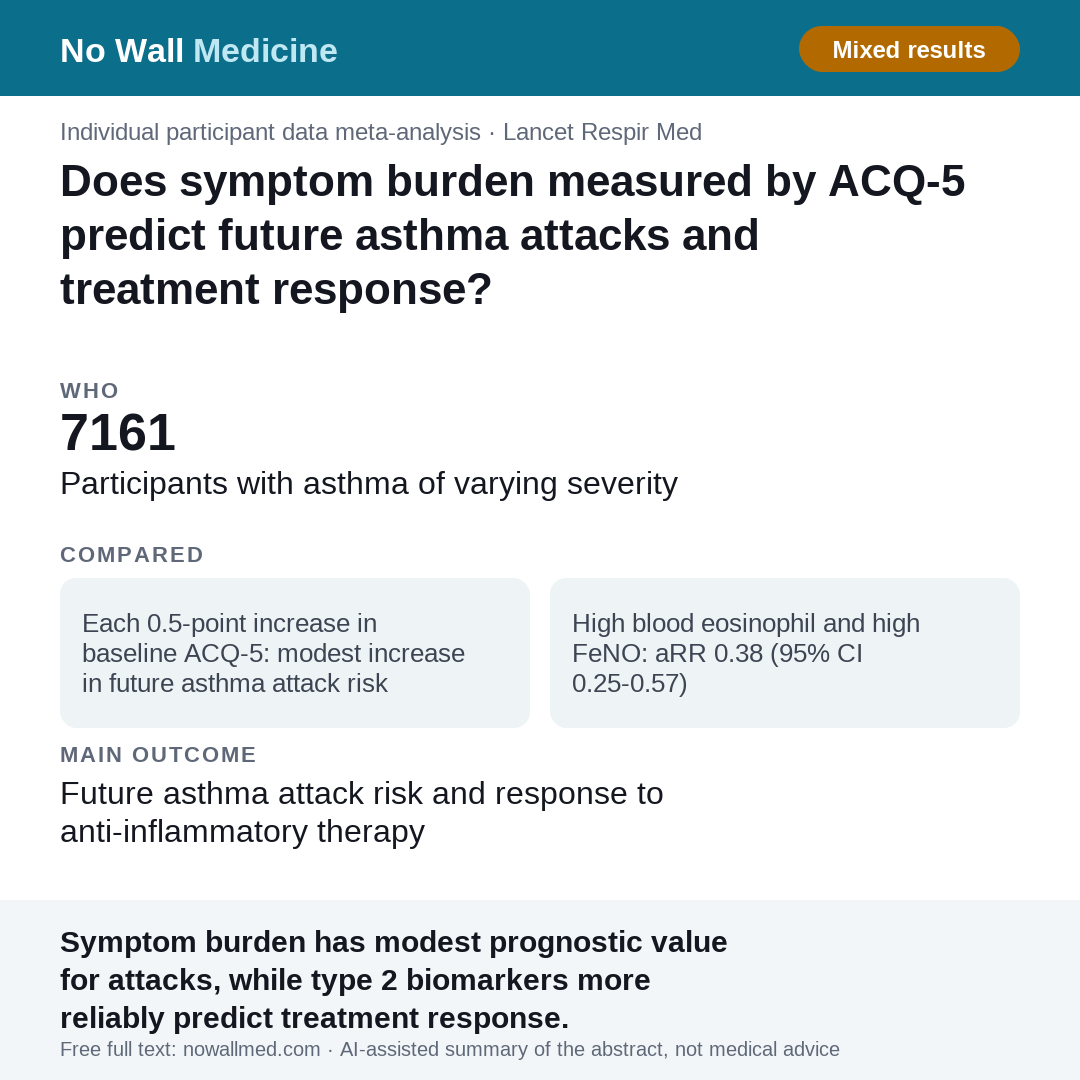
Clinical question: Does symptom burden measured by ACQ-5 predict future asthma attacks and treatment response?
Why it matters: It is unclear how well asthma symptom burden predicts future severe attacks or how patients will respond to anti-inflammatory therapy.
Key points
Researchers analyzed 7161 participants from randomized controlled trials and observational studies to see if the 5-item Asthma Control Questionnaire predicted asthma outcomes.
Each 0.5-point increase in the questionnaire score was associated with a modest increase in future asthma attack risk with an adjusted rate ratio of 1.09.
Symptom scores did not align with clinical or biological features, whereas blood eosinophil counts and fractional exhaled nitric oxide showed stronger associations with treatment response.
Headline and key points written with AI from the paper’s abstract, with every number checked against it. Read the paper before relying on them.
Background
Asthma symptoms often guide disease assessment and management, but their prognostic and predictive value is unclear. We evaluated the extent to which symptom burden measured by the 5-item Asthma Control Questionnaire (ACQ-5) predicts future severe asthma attacks and response to anti-inflammatory therapy. Methods
We conducted an individual participant data meta-analysis of selected randomised controlled trials and translational observational cohort studies of asthma of varying severity. Primary analyses used the ORACLE2 patient-level meta-analysis (n=6513) of control-group participants from 22 randomised controlled trials. Additional datasets from studies assessing type 2 targeting anti-inflammatory therapies were included on the basis of availability of data, to provide insight into the association between ACQ-5 and sputum cell counts or mediator data. Additional datasets were the DREAM intravenous mepolizumab group (n=461); a cross-sectional severe asthma cohort (SA-OT, n=74); and two acute asthma cohorts (PRISMA, biologic-naive, n=53; BOOST, anti-interleukin-5-treated, n=60). Associations between baseline ACQ-5 scores and clinical, physiological, and inflammatory profiles, asthma attack risk, and anti-inflammatory treatment responses were examined. Findings
Across five datasets encompassing 7161 distinct participants, asthma severity, lung function, inflammatory profiles, comorbidities, and ACQ-5 results varied widely. The proportion of patients with high symptom burden (ACQ-5 score >1·5) ranged from 39% to 100%. Baseline ACQ-5 showed no consistent cross-sectional association with other clinical, physiological, or inflammatory asthma features. Each 0·5-point increase in baseline ACQ-5 score was associated with a modest increase in future asthma attack risk (adjusted rate ratio [aRR] 1·09 [95% CI 1·06-1·12]; Δ R2=0·02 vs multivariable prediction model without ACQ-5). Baseline ACQ-5 score did not alter relative and absolute attack risk reduction from intravenous mepolizumab in DREAM. By contrast, patients with high blood eosinophil counts and high fractional exhaled nitric oxide (FeNO) had the highest relative and absolute risk reduction (2·81 vs 1·17 attacks; aRR 0·38 [95% CI 0·25-0·57]). In the PRISMA and BOOST datasets, ACQ-5 was not associated with post-corticosteroid lung function change. Across studies, relative and absolute treatment effects showed consistent associations with blood eosinophil counts and FeNO. Interpretation
In a large, individual patient-level meta-analysis of randomised controlled trials and translational prospective observational cohort studies, we observed little alignment of symptom burden with other clinical, physiological, or biological features of asthma and modest prognostic value for severe attacks. Conversely, type 2 biomarkers more reliably identified patients at high risk and those likely to respond to treatment. Symptoms might require contextual interpretation to guide anti-inflammatory escalation in asthma. Funding
National Institute for Health and Care Research, Association Pulmonaire du Québec, Fonds de Recherche du Québec-Santé, and The Academy of Medical Sciences.
Abstract reproduced under the article’s CC BY licence.
Topics
Humans; Asthma; Symptom Burden; Randomized Controlled Trials as Topic; Severity of Illness Index; Female; Prospective Studies; Anti-Asthmatic Agents; Adult; Prognosis; Surveys and Questionnaires; Male
Safety and efficacy of inhaled itraconazole in adults with asthma and allergic bronchopulmonary aspergillosis (PUR1900-ABPA): a randomised, double-blind, parallel group, placebo-controlled, multicentre, phase 2 trial