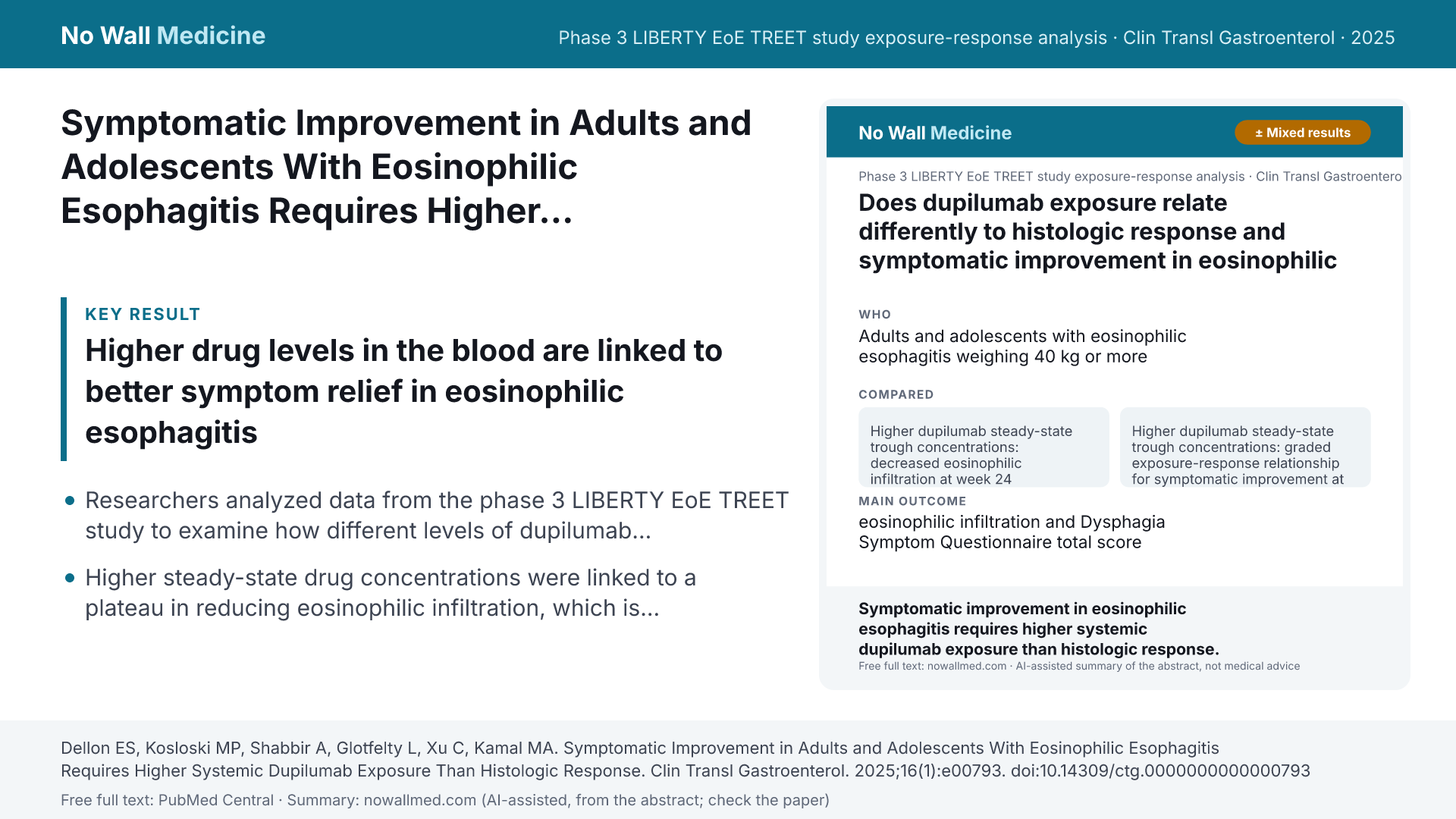
Higher drug levels in the blood are linked to better symptom relief in eosinophilic esophagitis
Symptomatic Improvement in Adults and Adolescents With Eosinophilic Esophagitis Requires Higher Systemic Dupilumab Exposure Than Histologic Response
Phase 3 LIBERTY EoE TREET study exposure-response analysisMixed results
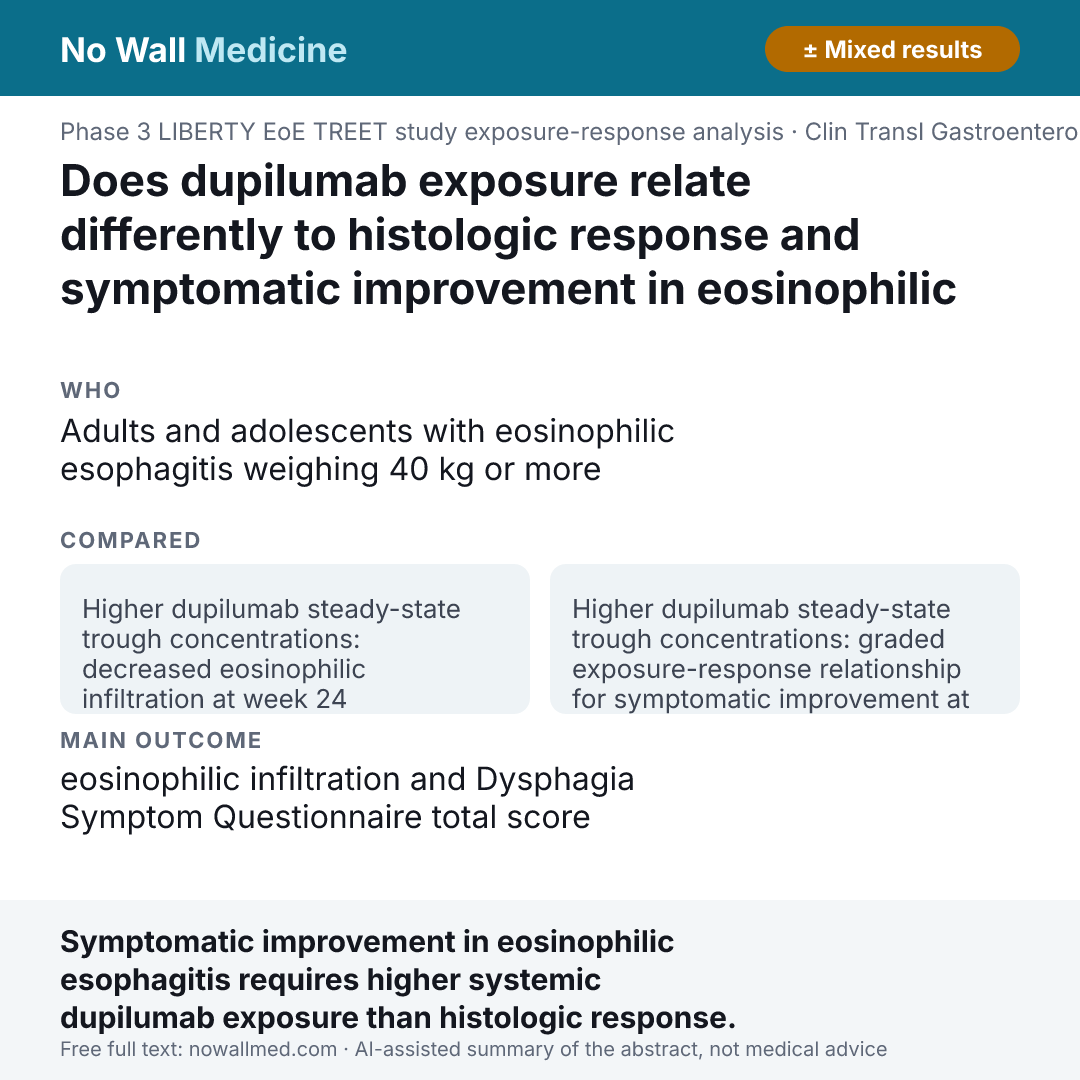
Does dupilumab exposure relate differently to histologic response and symptomatic improvement in eosinophilic esophagitis?
Who
Adults and adolescents with eosinophilic esophagitis weighing 40 kg or more
Compared
Higher dupilumab steady-state trough concentrations: decreased eosinophilic infiltration at week 24
Higher dupilumab steady-state trough concentrations: graded exposure-response relationship for symptomatic improvement at week 24
Main outcome
eosinophilic infiltration and Dysphagia Symptom Questionnaire total score
Bottom line: Symptomatic improvement in eosinophilic esophagitis requires higher systemic dupilumab exposure than histologic response.
Clin Transl Gastroenterol · 2025-01-01 · Save PNG
Clinical question: Does dupilumab exposure relate differently to histologic response and symptomatic improvement in eosinophilic esophagitis?
Key points
- Researchers analyzed data from the phase 3 LIBERTY EoE TREET study to examine how different levels of dupilumab exposure relate to tissue changes and symptoms.
- Higher steady-state drug concentrations were linked to a plateau in reducing eosinophilic infiltration, which is the buildup of white blood cells in the esophagus.
- Greater symptomatic improvement at week 24 was associated with a graded relationship to drug exposure, regardless of whether patients had esophageal strictures or a history of dilation.
Headline and key points written with AI from the paper’s abstract, with every number checked against it. Read the paper before relying on them.
Was this summary helpful?
Subject terms
Headline, design, result, key points, caveat and citation as plain text.
Cite this article
Dellon ES, Kosloski MP, Shabbir A, Glotfelty L, Xu C, Kamal MA. Symptomatic Improvement in Adults and Adolescents With Eosinophilic Esophagitis Requires Higher Systemic Dupilumab Exposure Than Histologic Response. Clin Transl Gastroenterol. 2025;16(1):e00793. doi:10.14309/ctg.0000000000000793
Spotted a mistake? Suggest a correction