Systematic, early rhythm control strategy for atrial fibrillation in patients with or without symptoms: the EAST-AFNET 4 trial
Randomized trialNo clear difference
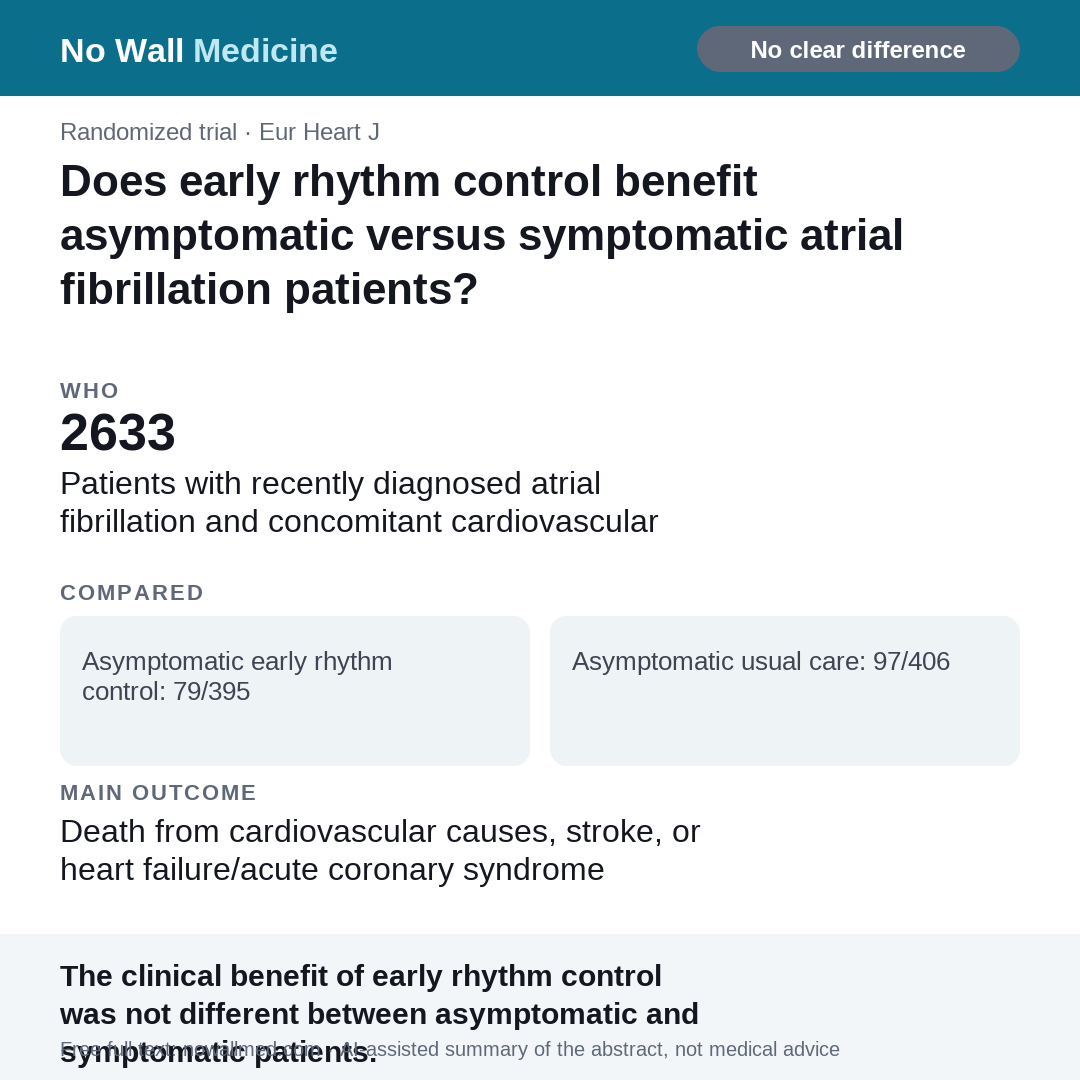
Does early rhythm control benefit asymptomatic versus symptomatic atrial fibrillation patients?
Who
2633
Patients with recently diagnosed atrial fibrillation and concomitant cardiovascular conditions
Compared
Asymptomatic early rhythm control: 79/395
Asymptomatic usual care: 97/406
Main outcome
Death from cardiovascular causes, stroke, or heart failure/acute coronary syndrome hospitalization
Result: hazard ratio 0.76 (95% confidence interval 0.6 to 1.03)
Bottom line: The clinical benefit of early rhythm control was not different between asymptomatic and symptomatic patients.
Eur Heart J · 2021-08-28Download image
Clinical question: Does early rhythm control benefit asymptomatic versus symptomatic atrial fibrillation patients?
Abstract
Aims
Clinical practice guidelines restrict rhythm control therapy to patients with symptomatic atrial fibrillation (AF). The EAST-AFNET 4 trial demonstrated that early, systematic rhythm control improves clinical outcomes compared to symptom-directed rhythm control. Methods and results
This prespecified EAST-AFNET 4 analysis compared the effect of early rhythm control therapy in asymptomatic patients (EHRA score I) to symptomatic patients. Primary outcome was a composite of death from cardiovascular causes, stroke, or hospitalization with worsening of heart failure or acute coronary syndrome, analyzed in a time-to-event analysis. At baseline, 801/2633 (30.4%) patients were asymptomatic [mean age 71.3 years, 37.5% women, mean CHA2DS2-VASc score 3.4, 169/801 (21.1%) heart failure]. Asymptomatic patients randomized to early rhythm control (395/801) received similar rhythm control therapies compared to symptomatic patients [e.g. AF ablation at 24 months: 75/395 (19.0%) in asymptomatic; 176/910 (19.3%) symptomatic patients, P = 0.672]. Anticoagulation and treatment of concomitant cardiovascular conditions was not different between symptomatic and asymptomatic patients. The primary outcome occurred in 79/395 asymptomatic patients randomized to early rhythm control and in 97/406 patients randomized to usual care (hazard ratio 0.76, 95% confidence interval [0.6; 1.03]), almost identical to symptomatic patients. At 24 months follow-up, change in symptom status was not different between randomized groups (P = 0.19). Conclusion
The clinical benefit of early, systematic rhythm control was not different between asymptomatic and symptomatic patients in EAST-AFNET 4. These results call for a shared decision discussing the benefits of rhythm control therapy in all patients with recently diagnosed AF and concomitant cardiovascular conditions (EAST-AFNET 4; ISRCTN04708680; NCT01288352; EudraCT2010-021258-20).
Subject terms
Cite this article
Willems S, Borof K, Brandes A, Breithardt G, Camm AJ, Crijns HJGM. Systematic, early rhythm control strategy for atrial fibrillation in patients with or without symptoms: the EAST-AFNET 4 trial. Eur Heart J. 2021. doi:10.1093/eurheartj/ehab593
Spotted a mistake? Suggest a correction
Top studies every Monday
The week’s key trials and guidelines in your specialties, plus any topics you follow. By email, free.
Get the weekly digest