Cell-free DNA screening is highly accurate for common trisomies in general-risk pregnancies
Systematic evidence-based review: The application of noninvasive prenatal screening using cell-free DNA in general-risk pregnancies
Systematic evidence review and random-effects meta-analysesBenefit found
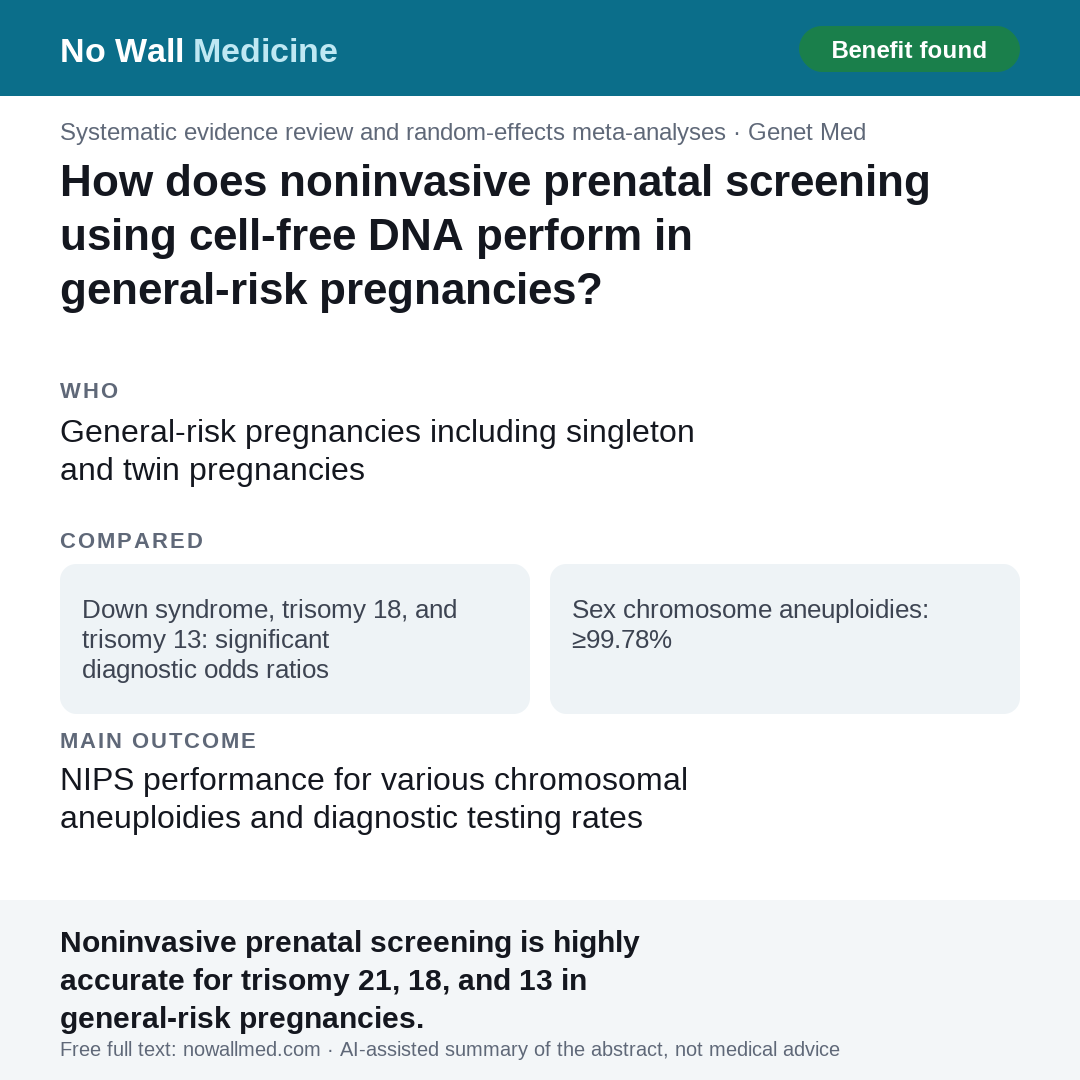
How does noninvasive prenatal screening using cell-free DNA perform in general-risk pregnancies?
Who
General-risk pregnancies including singleton and twin pregnancies
Compared
Down syndrome, trisomy 18, and trisomy 13: significant diagnostic odds ratios
Sex chromosome aneuploidies: ≥99.78%
Main outcome
NIPS performance for various chromosomal aneuploidies and diagnostic testing rates
Bottom line: Noninvasive prenatal screening is highly accurate for trisomy 21, 18, and 13 in general-risk pregnancies.
Limitation: Conclusions regarding psychosocial outcomes could not be drawn owing to lack of data.
Genet Med · 2022-05-24Download image
Clinical question: How does noninvasive prenatal screening using cell-free DNA perform in general-risk pregnancies?
Why it matters: The clinical validity and technical performance of cell-free DNA screening in general-risk populations, rather than high-risk populations, were not fully established.
Key points
- Researchers reviewed 87 studies to evaluate the performance of noninvasive prenatal screening using cell-free DNA in general-risk populations.
- The screening showed significant diagnostic odds ratios for Down syndrome, trisomy 18, and trisomy 13 in singleton and twin pregnancies.
- The use of this screening was associated with a 31% to 79% reduction in subsequent diagnostic tests.
Limitation the authors note: Conclusions regarding psychosocial outcomes could not be drawn owing to lack of data.
Headline and key points written with AI from the paper’s abstract, with every number checked against it. Read the paper before relying on them.
Was this summary helpful?
Subject terms
Cite this article
Rose NC, Barrie ES, Malinowski J, Jenkins GP, McClain MR, LaGrave D. Systematic evidence-based review: The application of noninvasive prenatal screening using cell-free DNA in general-risk pregnancies. Genet Med. 2022. doi:10.1016/j.gim.2022.03.019
Spotted a mistake? Suggest a correction
Top studies every Monday
The week’s key trials and guidelines in your specialties, plus any topics you follow. By email, free.
Get the weekly digest