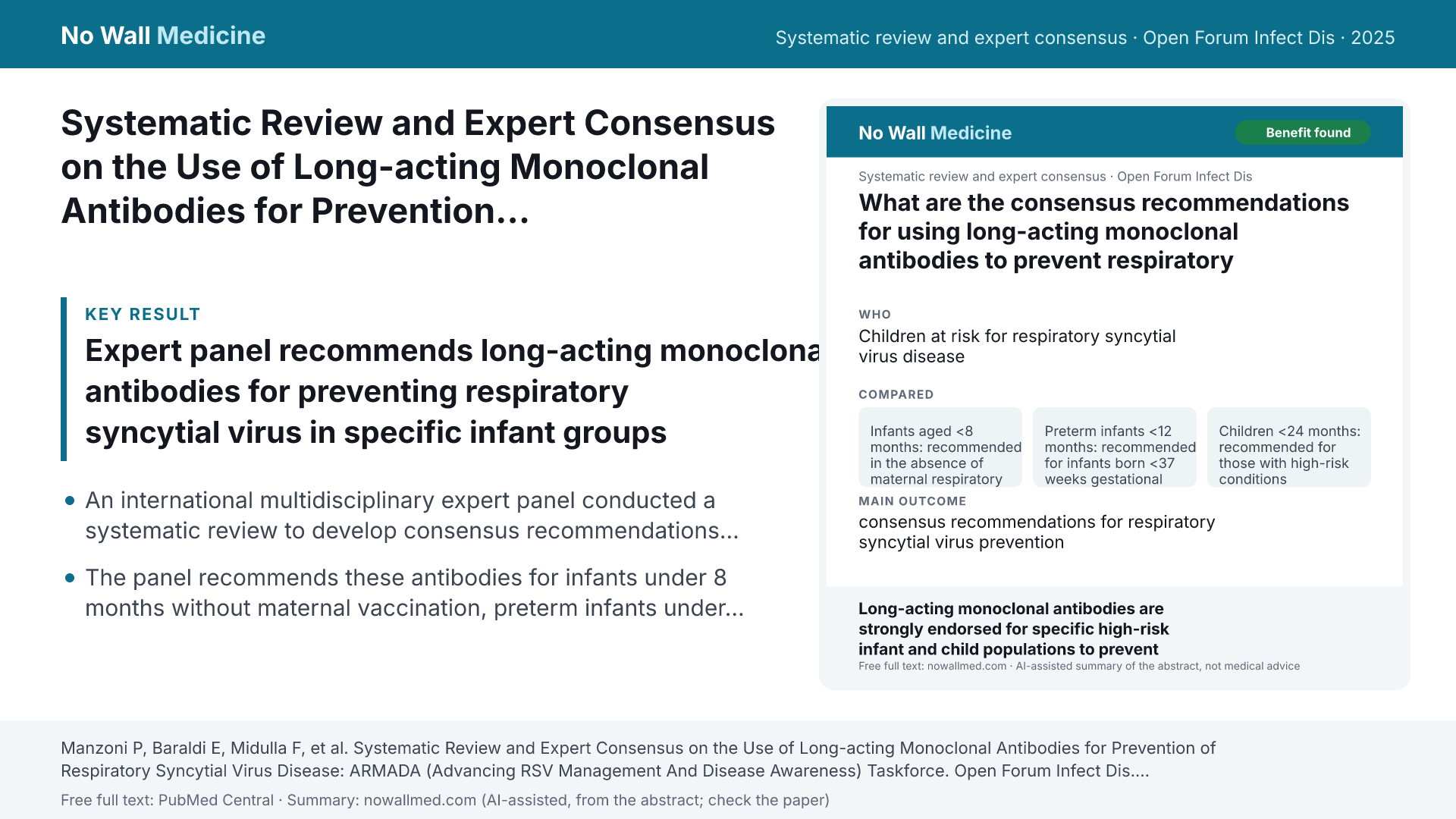
Expert panel recommends long-acting monoclonal antibodies for preventing respiratory syncytial virus in specific infant groups
Systematic Review and Expert Consensus on the Use of Long-acting Monoclonal Antibodies for Prevention of Respiratory Syncytial Virus Disease: ARMADA (Advancing RSV Management And Disease Awareness) Taskforce
Systematic review and expert consensusBenefit found
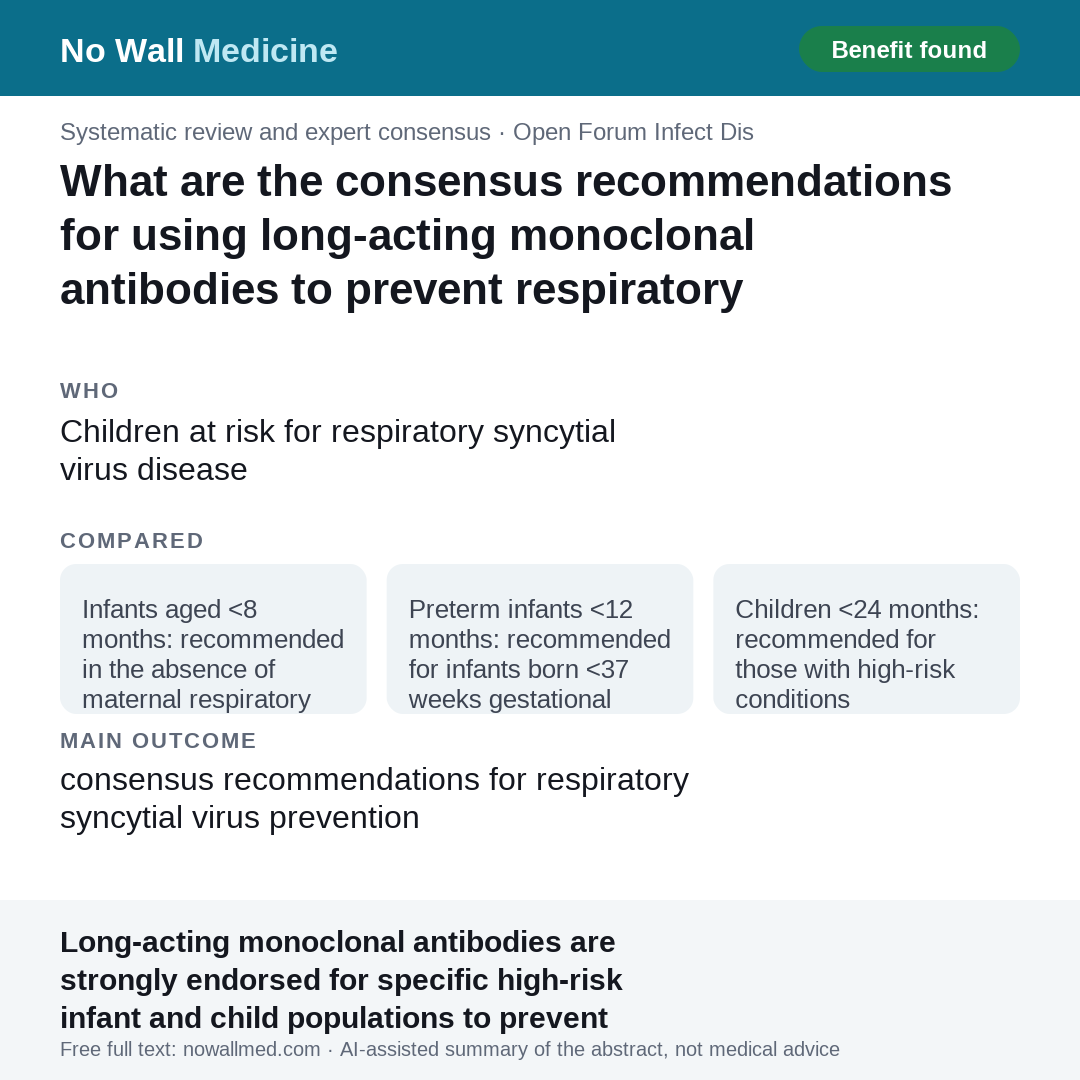
What are the consensus recommendations for using long-acting monoclonal antibodies to prevent respiratory syncytial virus?
Who
Children at risk for respiratory syncytial virus disease
Compared
Infants aged <8 months: recommended in the absence of maternal respiratory syncytial virus vaccination
Preterm infants <12 months: recommended for infants born <37 weeks gestational age
Children <24 months: recommended for those with high-risk conditions
Main outcome
consensus recommendations for respiratory syncytial virus prevention
Bottom line: Long-acting monoclonal antibodies are strongly endorsed for specific high-risk infant and child populations to prevent respiratory syncytial virus.
Open Forum Infect Dis · 2025-07-02Download image
Clinical question: What are the consensus recommendations for using long-acting monoclonal antibodies to prevent respiratory syncytial virus?
Why it matters: Clear, evidence-based recommendations are needed to implement long-acting monoclonal antibodies to reduce the respiratory syncytial virus disease burden in children.
Key points
- An international multidisciplinary expert panel conducted a systematic review to develop consensus recommendations for using long-acting monoclonal antibodies to prevent respiratory syncytial virus in children.
- The panel recommends these antibodies for infants under 8 months without maternal vaccination, preterm infants under 12 months, and children under 24 months with high-risk conditions.
- Recommendations suggest seasonal administration, though local decisions may favor year-round use in countries where the virus is endemic.
Headline and key points written with AI from the paper’s abstract, with every number checked against it. Read the paper before relying on them.
Was this summary helpful?
Cite this article
Manzoni P, Baraldi E, Midulla F, et al. Systematic Review and Expert Consensus on the Use of Long-acting Monoclonal Antibodies for Prevention of Respiratory Syncytial Virus Disease: ARMADA (Advancing RSV Management And Disease Awareness) Taskforce. Open Forum Infect Dis. 2025;12(7):ofaf396. doi:10.1093/ofid/ofaf396
Spotted a mistake? Suggest a correction