Artificial intelligence conversational agents reduced symptoms of depression and distress in mental health studies
Systematic review and meta-analysis of AI-based conversational agents for promoting mental health and well-being
Systematic review and meta-analysisMixed results
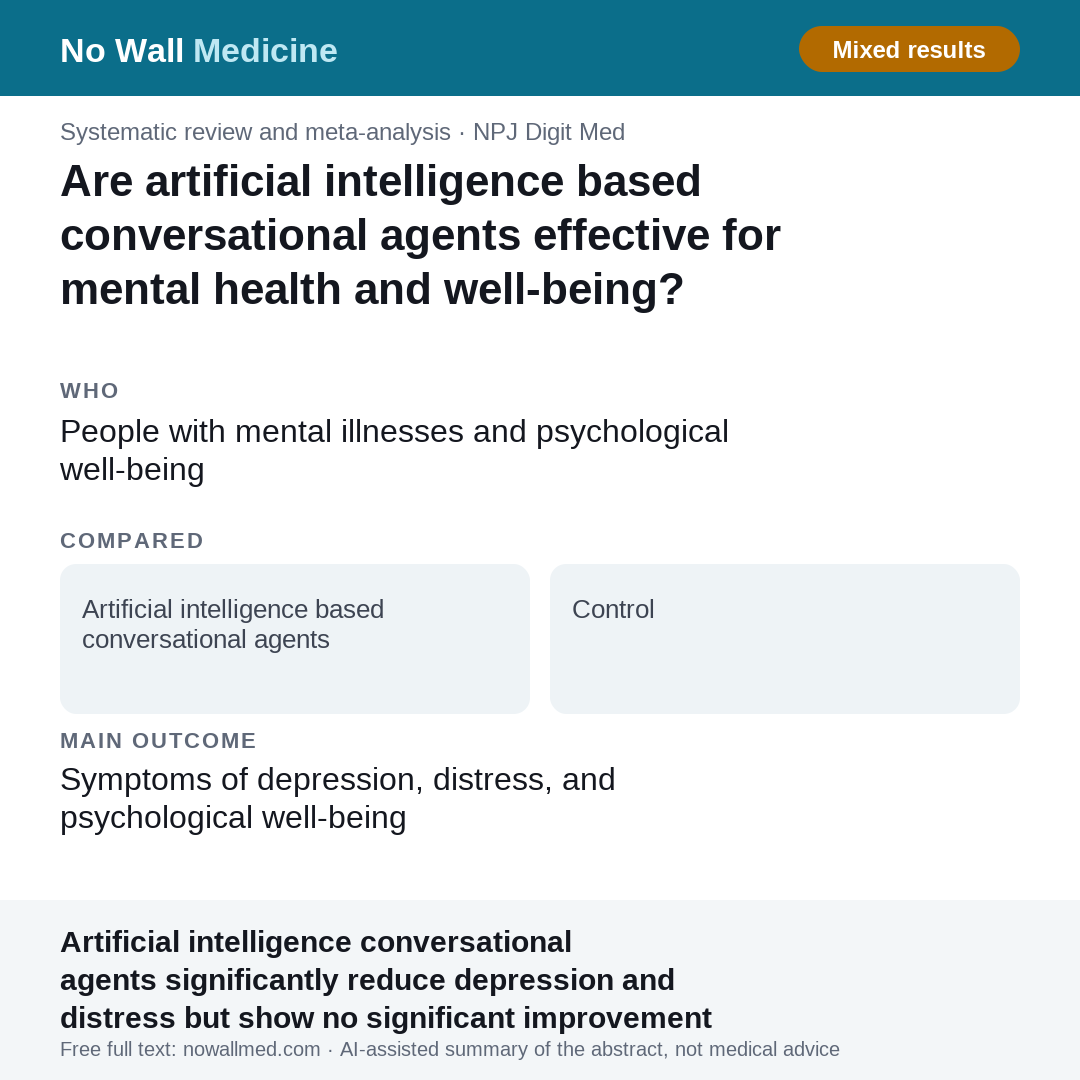
Are artificial intelligence based conversational agents effective for mental health and well-being?
Who
People with mental illnesses and psychological well-being
Compared
Artificial intelligence based conversational agents
Control
Main outcome
Symptoms of depression, distress, and psychological well-being
Result: Hedge's g 0.64 (95% CI 0.17-1.12) for depression; Hedge's g 0.7 (95% CI 0.18-1.22) for distress
Bottom line: Artificial intelligence conversational agents significantly reduce depression and distress but show no significant improvement in overall psychological well-being.
Limitation: Future research needs to investigate underlying mechanisms, long-term effects, and safe large language model integration.
NPJ Digit Med · 2023-12-19Download image
Clinical question: Are artificial intelligence based conversational agents effective for mental health and well-being?
Why it matters: There is a scarcity of comprehensive evaluations regarding the impact of conversational artificial intelligence on mental health and well-being.
Key points
- Researchers analyzed 35 studies, including 15 randomized controlled trials, to evaluate how conversational artificial intelligence affects mental health and well-being.
- The meta-analysis found that these agents reduced depression symptoms (Hedge's g 0.64 [95% CI 0.17-1.12]) and distress (Hedge's g 0.7 [95% CI 0.18-1.22]).
- The interventions showed no significant improvement in overall psychological well-being (Hedge's g 0.32 [95% CI -0.13 to 0.78]).
Headline and key points written with AI from the paper’s abstract, with every number checked against it. Read the paper before relying on them.
Was this summary helpful?
Cite this article
Li H, Zhang R, Lee YC, Kraut RE, Mohr DC. Systematic review and meta-analysis of AI-based conversational agents for promoting mental health and well-being. NPJ Digit Med. 2023. doi:10.1038/s41746-023-00979-5
Spotted a mistake? Suggest a correction
Top studies every Monday
The week’s key trials and guidelines in your specialties, plus any topics you follow. By email, free.
Get the weekly digest