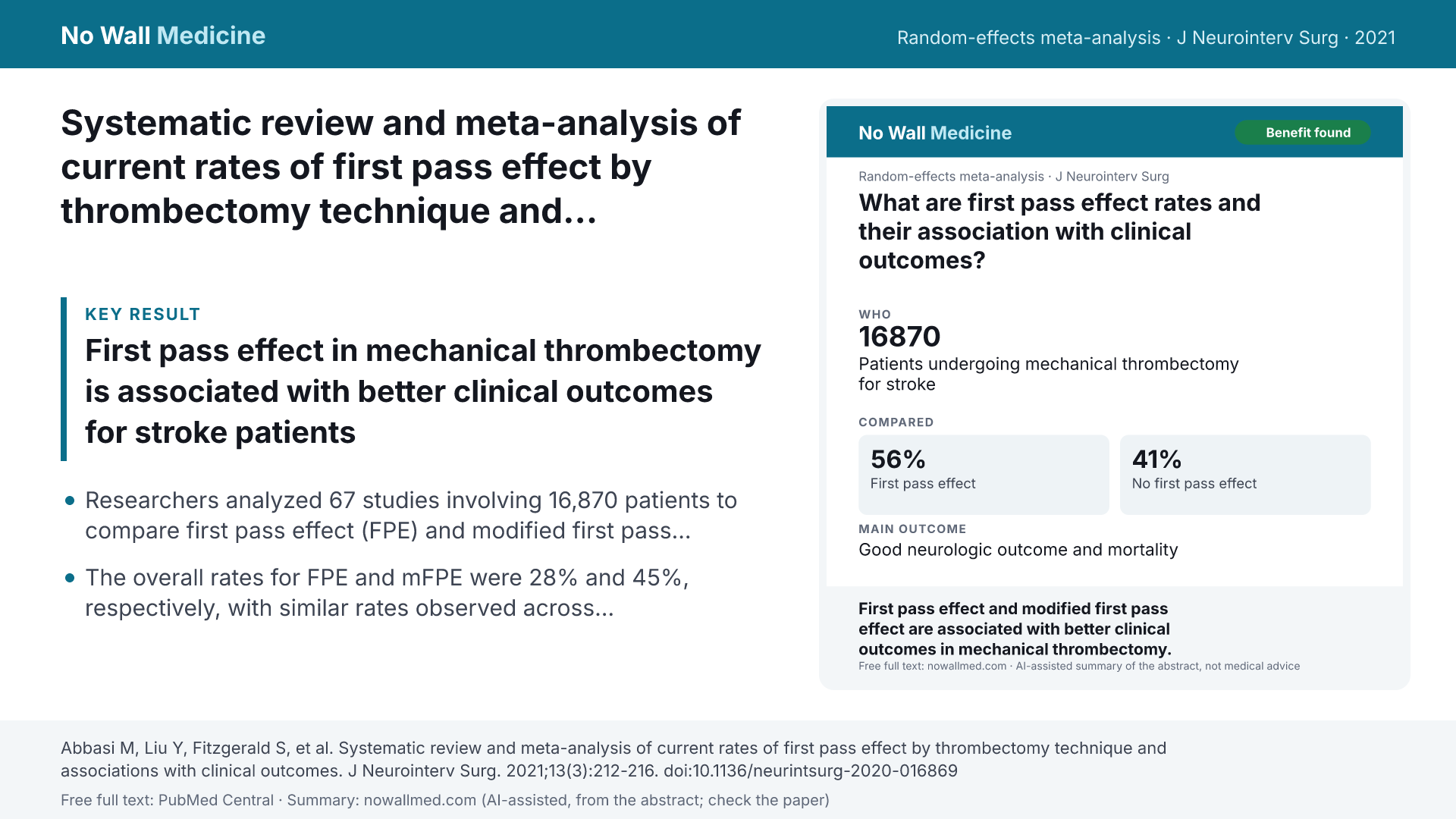
First pass effect in mechanical thrombectomy is associated with better clinical outcomes for stroke patients
Systematic review and meta-analysis of current rates of first pass effect by thrombectomy technique and associations with clinical outcomes
Random-effects meta-analysisBenefit found
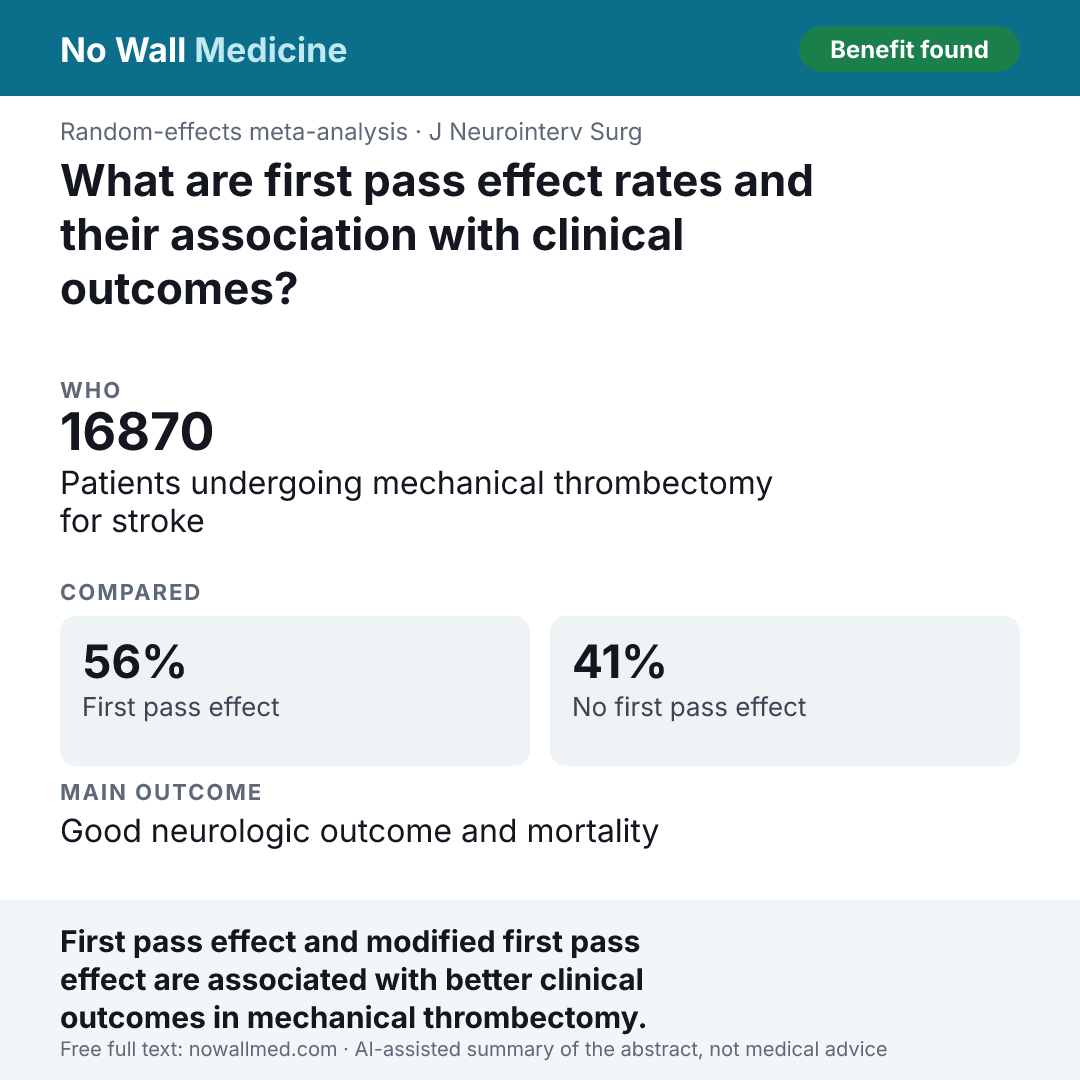
What are first pass effect rates and their association with clinical outcomes?
Who
16870
Patients undergoing mechanical thrombectomy for stroke
Compared
56%First pass effect (good neurologic outcome)
41%No first pass effect (good neurologic outcome)
Main outcome
Good neurologic outcome and mortality
Result: OR=1.78 (good neurologic outcome); OR=0.62 (mortality)
Bottom line: First pass effect and modified first pass effect are associated with better clinical outcomes in mechanical thrombectomy.
J Neurointerv Surg · 2021-01-13 · Save PNG
Clinical question: What are first pass effect rates and their association with clinical outcomes?
Key points
- Researchers analyzed 67 studies involving 16,870 patients to compare first pass effect (FPE) and modified first pass effect (mFPE) rates and outcomes.
- The overall rates for FPE and mFPE were 28% and 45%, respectively, with similar rates observed across different mechanical thrombectomy techniques.
- FPE was associated with a 56% rate of good neurologic outcome compared to 41% without FPE, and a 17% mortality rate compared to 25% without FPE.
Headline and key points written with AI from the paper’s abstract, with every number checked against it. Read the paper before relying on them.
Was this summary helpful?
Subject terms
Headline, design, result, key points, caveat and citation as plain text.
Cite this article
Abbasi M, Liu Y, Fitzgerald S, et al. Systematic review and meta-analysis of current rates of first pass effect by thrombectomy technique and associations with clinical outcomes. J Neurointerv Surg. 2021;13(3):212-216. doi:10.1136/neurintsurg-2020-016869
Spotted a mistake? Suggest a correction