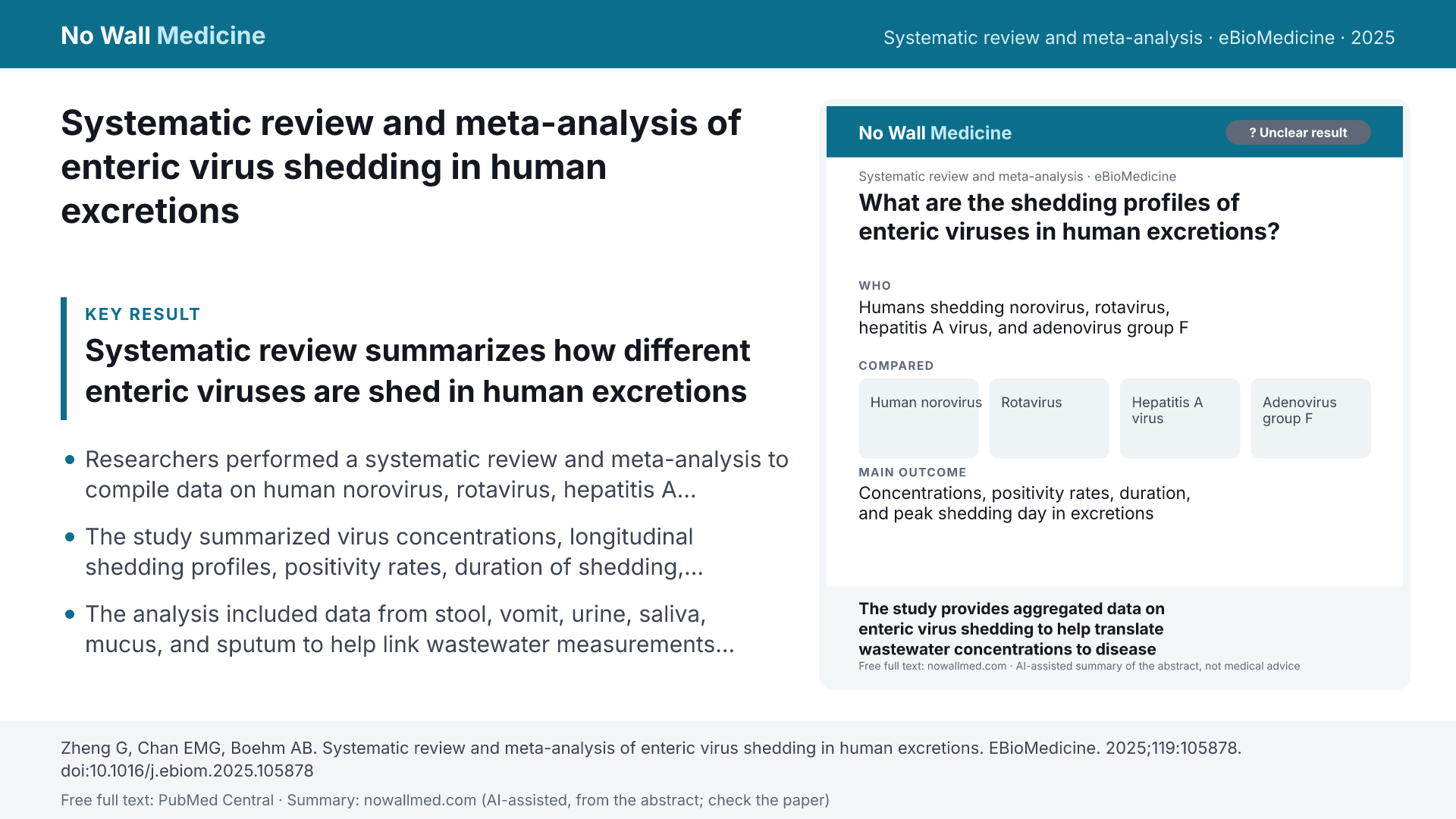
Systematic review summarizes how different enteric viruses are shed in human excretions
Systematic review and meta-analysis of enteric virus shedding in human excretions
Systematic review and meta-analysisUnclear result
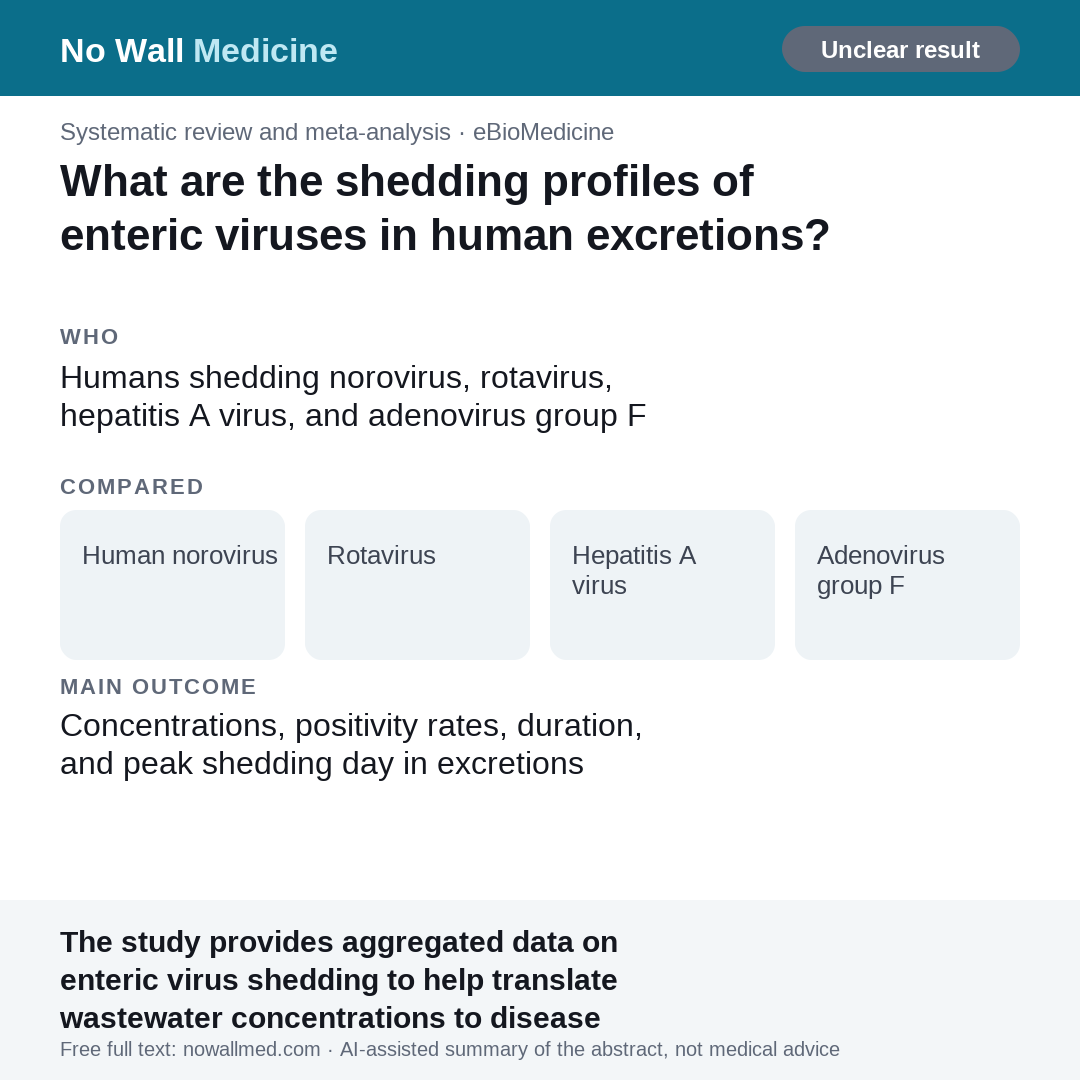
What are the shedding profiles of enteric viruses in human excretions?
Who
Humans shedding norovirus, rotavirus, hepatitis A virus, and adenovirus group F
Compared
Human norovirus
Rotavirus
Hepatitis A virus
Adenovirus group F
Main outcome
Concentrations, positivity rates, duration, and peak shedding day in excretions
Bottom line: The study provides aggregated data on enteric virus shedding to help translate wastewater concentrations to disease occurrence rates.
Limitation: Limited data available for excretions other than stool and for adenovirus group F.
Funded by: Sergey Brin Family Foundation
eBioMedicine · 2025-08-05Download image
Clinical question: What are the shedding profiles of enteric viruses in human excretions?
Why it matters: Quantitative information on pathogen biomarker shedding in various excretions is needed to link wastewater measurements to community disease occurrence rates.
Key points
- Researchers performed a systematic review and meta-analysis to compile data on human norovirus, rotavirus, hepatitis A virus, and adenovirus group F shedding.
- The study summarized virus concentrations, longitudinal shedding profiles, positivity rates, duration of shedding, and the day of peak shedding across various human excretions.
- The analysis included data from stool, vomit, urine, saliva, mucus, and sputum to help link wastewater measurements to disease occurrence rates.
Limitation the authors note: There are limited data available for excretions other than stool and limited data available for adenovirus group F.
Headline and key points written with AI from the paper’s abstract, with every number checked against it. Read the paper before relying on them.
Was this summary helpful?
Subject terms
Headline, design, result, key points, caveat and citation as plain text.
Cite this article
Zheng G, Chan EMG, Boehm AB. Systematic review and meta-analysis of enteric virus shedding in human excretions. eBioMedicine. 2025. doi:10.1016/j.ebiom.2025.105878
Spotted a mistake? Suggest a correction