Group B Streptococcus colonization prevalence was 18.0% among pregnant women in the Asia-Pacific region
Systematic Review and Meta-analysis of Group B Streptococcus Rectovaginal Colonization Rates and Serotype Distribution among Pregnant Women, Asia-Pacific Region, 2014-2025
Systematic review and meta-analysisBenefit found
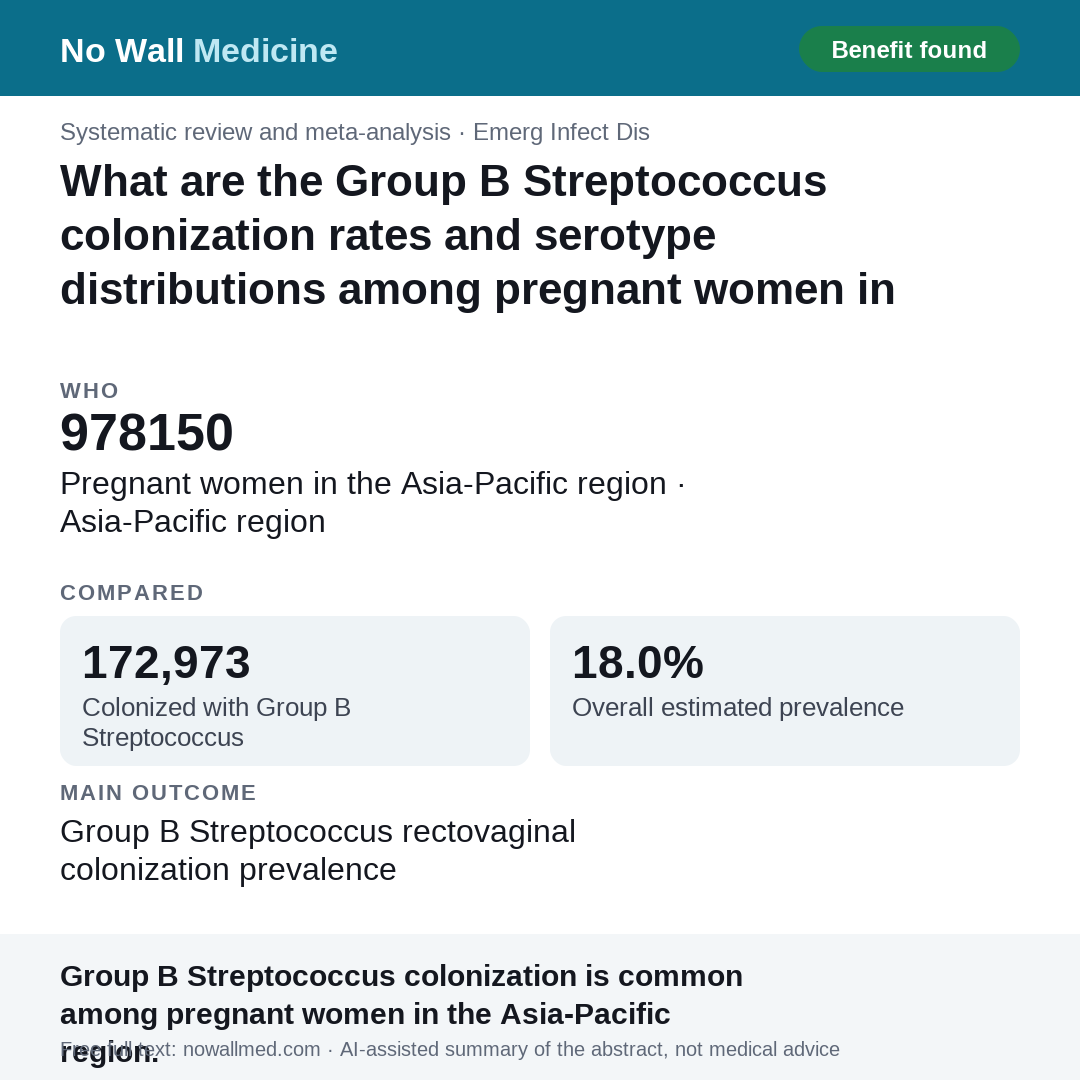
What are the Group B Streptococcus colonization rates and serotype distributions among pregnant women in Asia-Pacific?
Who
978150
Pregnant women in the Asia-Pacific region · Asia-Pacific region
Compared
172,973Colonized with Group B Streptococcus
18.0%Overall estimated prevalence (95% CI 12%-23%)
Main outcome
Group B Streptococcus rectovaginal colonization prevalence
Result: 18.0% (95% CI 12%-23%)
Bottom line: Group B Streptococcus colonization is common among pregnant women in the Asia-Pacific region.
Limitation: Studies from Southeast Asia were limited.
Emerg Infect Dis · 2026-09-30Download image
Clinical question: What are the Group B Streptococcus colonization rates and serotype distributions among pregnant women in Asia-Pacific?
Why it matters: There is a need to understand Group B Streptococcus prevalence and serotype distribution to guide prevention and treatment programs in the Asia-Pacific region.
Key points
- Researchers analyzed 98 studies involving 978,150 pregnant women to measure Group B Streptococcus colonization, serotype distribution, and antimicrobial drug resistance rates.
- The pooled estimated prevalence of Group B Streptococcus colonization was 18.0% (95% CI 12%-23%) among the studied population.
- Serotype III was the most common type found in 24 studies, and antimicrobial drug resistance to beta-lactams was low at 0%-2.0%.
Limitation the authors note: Studies from Southeast Asia were limited.
Headline and key points written with AI from the paper’s abstract, with every number checked against it. Read the paper before relying on them.
Topics
Spotted a mistake? Suggest a correction