Ferric derisomaltose had lower rates of serious hypersensitivity reactions than other high-dose intravenous iron formulations
Systematic review and meta-analysis of hypersensitivity reactions after high-dose IV iron
Systematic review and meta-analysis of randomized controlled trialsBenefit found
What is the incidence of serious or severe hypersensitivity reactions after high-dose intravenous iron?
Who
11268
Patients with iron deficiency anemia receiving high-dose intravenous iron
Compared
0.14%Ferric derisomaltose
0.59%Ferric carboxymaltose
0.50%Ferumoxytol
Main outcome
Serious or severe hypersensitivity reactions
Result: FDI vs FCM 0.21 (95% CrI 0.03-1.73); FDI vs FER 0.07 (95% CrI 0.00-1.93)
Bottom line: Ferric derisomaltose had the lowest likelihood of serious or severe hypersensitivity reactions compared to other high-dose intravenous iron formulations.
Blood Adv · 2026-09-16Download image
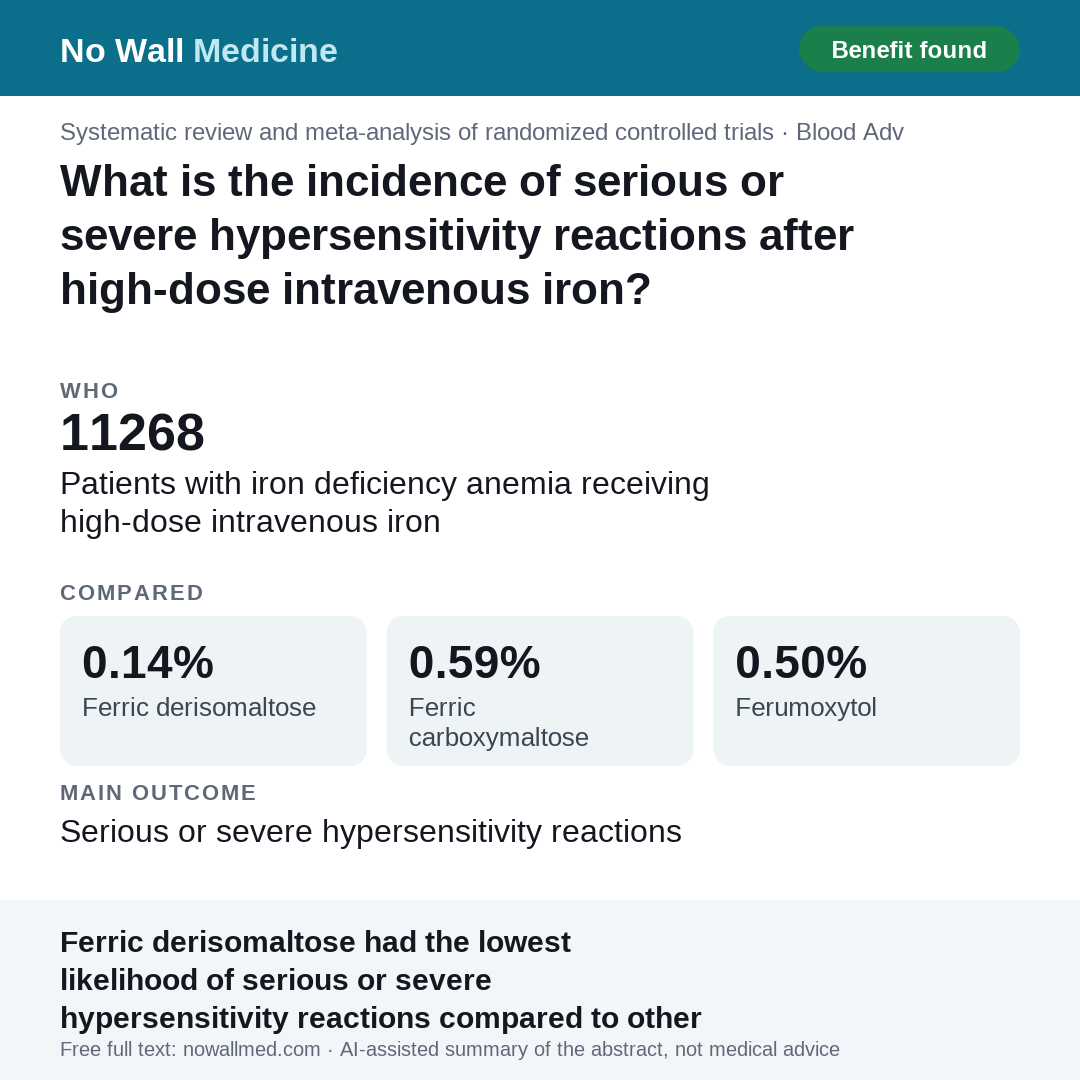
Clinical question: What is the incidence of serious or severe hypersensitivity reactions after high-dose intravenous iron?
Why it matters: Serious or severe hypersensitivity reactions can be life-threatening or fatal when they occur during the administration of modern intravenous iron formulations.
Key points
- Researchers analyzed data from randomized controlled trials involving 11,268 patients receiving different high-dose intravenous iron treatments for iron deficiency anemia.
- Serious or severe hypersensitivity reactions, such as anaphylactic reactions, occurred in 0.14% of patients receiving ferric derisomaltose, 0.59% receiving ferric carboxymaltose, and 0.50% receiving ferumoxytol.
- The likelihood of ferric derisomaltose having the lowest incidence of these serious reactions was 91.4%.
Headline and key points written with AI from the paper’s abstract, with every number checked against it. Read the paper before relying on them.
Abstract
Serious or severe hypersensitivity reactions (HSRs) are uncommon with modern IV iron formulations but, when occurring, can be life-threatening or even fatal. We synthesized available data on incidence of serious or severe HSR for ferric derisomaltose (FDI), ferric carboxymaltose (FCM), and ferumoxytol (FER) as treatments for iron deficiency anemia. A systematic literature review for randomized controlled trials (RCTs) was conducted in PubMed, Embase, and Cochrane Central Register of Controlled Trials. From eligible RCTs, proportions of patients experiencing serious or severe HSR after IV iron administration, reported using the Standardized Medical Dictionary for Regulatory Activities Query (SMQ) for anaphylactic reaction, were extracted. A Bayesian random-effects model was used to obtain posterior distributions of HSR incidence and surface under the cumulative ranking curve (SUCRA) plots, ranking formulations by HSR likelihood. Any serious or severe HSR falling under the anaphylactic reaction SMQ was experienced by 0.14% of patients receiving FDI, 0.59% of patients receiving FCM, and 0.50% of patients receiving FER. The meta-analysis indicated a reduced serious or severe HSR risk with FDI vs FCM (0.21; 95% credible interval [CrI], 0.03-1.73) and FER (0.07; 95% CrI, 0.00-1.93). SUCRA plots showed that the likelihood of FDI having the lowest serious or severe HSR incidence was 91.4% (FCM, 4.5%; FER, 4.2%). This meta-analysis of data from RCTs, including 11 268 patients, represents a comprehensive analysis of serious or severe HSRs among available high-dose, rapid-infusion IV iron formulations, detailing an important facet of formulation safety profiles.
Abstract reproduced under the article’s CC BY NC ND licence.
Topics
Cite this article
Divers S, Elder C, Foy PC, Freed JA, Peters B, Pöhlmann J. Systematic review and meta-analysis of hypersensitivity reactions after high-dose IV iron. Blood Adv. 2026. doi:10.1182/bloodadvances.2026019945
Spotted a mistake? Suggest a correction