Machine learning models showed acceptable accuracy for predicting acute kidney injury in hospitalized patients
Systematic Review and Meta-Analysis of Machine Learning Models for Acute Kidney Injury Risk Classification
NephrologyAdult and pediatric
Systematic review and meta-analysisBenefit found
How well do machine learning models classify acute kidney injury risk?
Who
3
Hospitalized adult and pediatric patients
Compared
0.82Internal validation (95% confidence interval, 0.80 to 0.84)
0.78External validation (95% confidence interval, 0.76 to 0.80)
Main outcome
Area under the receiver operating characteristic curve for acute kidney injury onset
Result: area under the receiver operating characteristic curve 0.82 (95% confidence interval, 0.80 to 0.84)
Bottom line: Machine learning models show acceptable performance for predicting acute kidney injury risk in internal and external validations.
Limitation: High heterogeneity and high risk of bias in most studies limit real-world implementation.
JASN · 2025-03-28Download image
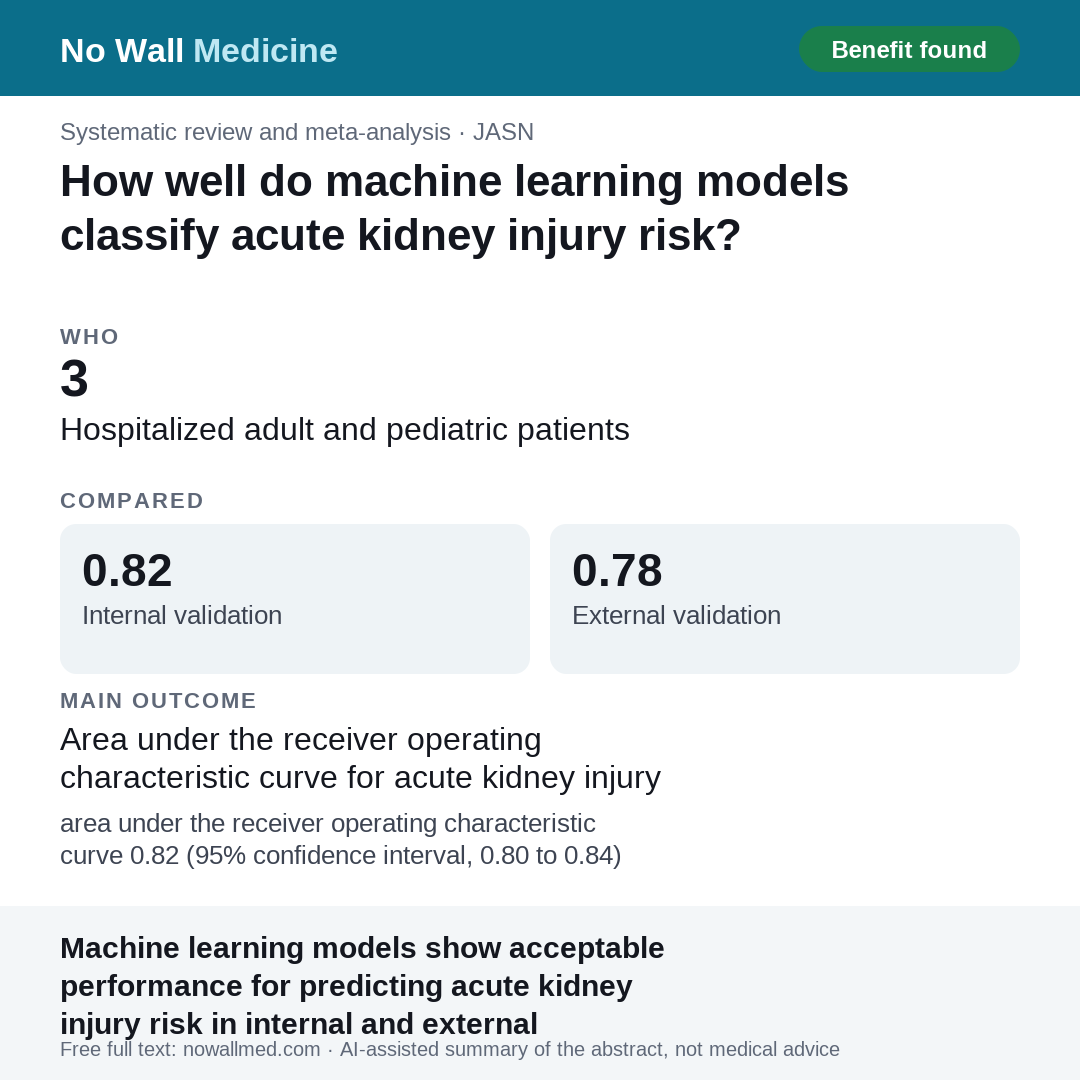
Clinical question: How well do machine learning models classify acute kidney injury risk?
Why it matters: The performance and real-world implementation of machine learning models for classifying acute kidney injury risk have not been established.
Key points
- Researchers analyzed 95 studies involving 3.8 million admissions to evaluate machine learning models for predicting acute kidney injury onset, severity, and complications.
- The pooled area under the receiver operating characteristic curve, a measure of prediction accuracy, was 0.82 for internal validation and 0.78 for external validation of kidney injury onset.
- Accuracy scores for various kidney injury outcomes across different clinical settings ranged from 0.78 to 0.87 for internal validation and 0.73 to 0.84 for external validation.
Limitation the authors note: High heterogeneity in patient populations, definitions, and predictors, along with 86% of studies having a high risk of bias, limits generalizability.
Headline and key points written with AI from the paper’s abstract, with every number checked against it. Read the paper before relying on them.
Cite this article
Cama-Olivares A, Braun C, Takeuchi T, O'Hagan EC, Kaiser KA, Ghazi L. Systematic Review and Meta-Analysis of Machine Learning Models for Acute Kidney Injury Risk Classification. JASN. 2025. doi:10.1681/ASN.0000000702
Spotted a mistake? Suggest a correction