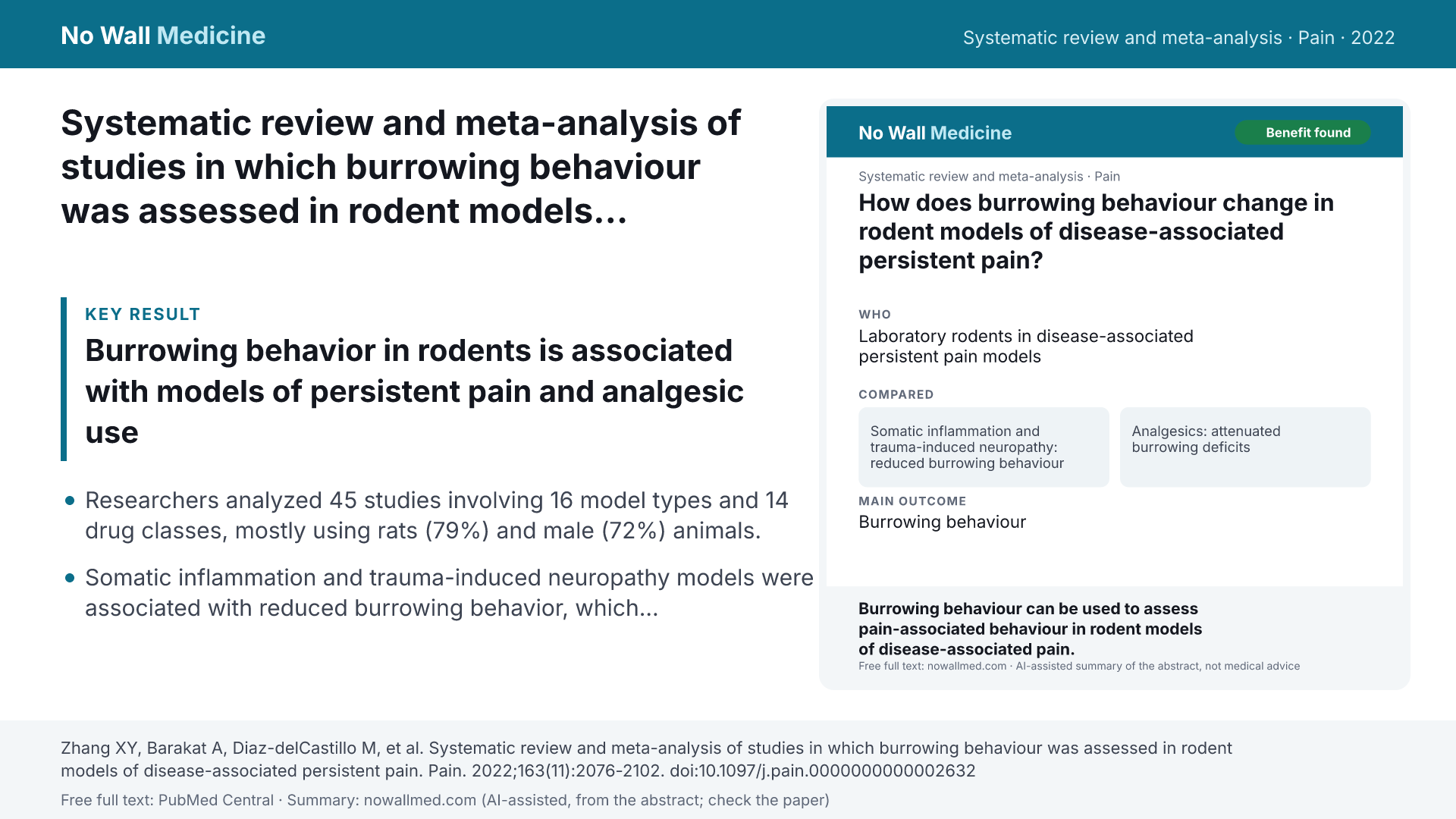
Burrowing behavior in rodents is associated with models of persistent pain and analgesic use
Systematic review and meta-analysis of studies in which burrowing behaviour was assessed in rodent models of disease-associated persistent pain
Systematic review and meta-analysisBenefit found
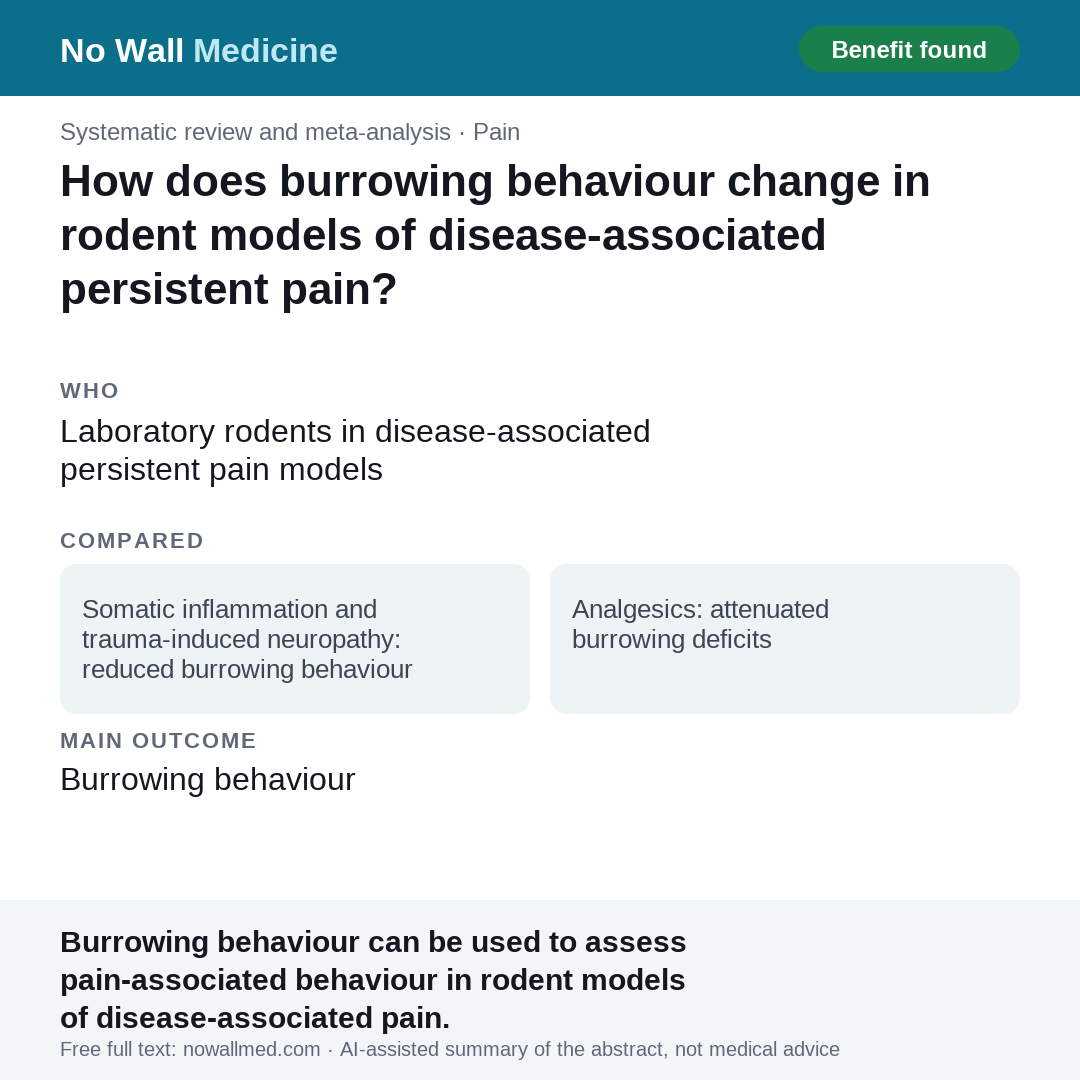
How does burrowing behaviour change in rodent models of disease-associated persistent pain?
Who
Laboratory rodents in disease-associated persistent pain models
Compared
Somatic inflammation and trauma-induced neuropathy: reduced burrowing behaviour
Analgesics: attenuated burrowing deficits
Main outcome
Burrowing behaviour
Bottom line: Burrowing behaviour can be used to assess pain-associated behaviour in rodent models of disease-associated pain.
Limitation: Reporting of measures to reduce risk of bias was unclear.
Pain · 2022-03-29Download image
Clinical question: How does burrowing behaviour change in rodent models of disease-associated persistent pain?
Why it matters: It was unknown how models of disease-associated persistent pain and various analgesics affect burrowing behavior in laboratory rodents.
Key points
- Researchers analyzed 45 studies involving 16 model types and 14 drug classes, mostly using rats (79%) and male (72%) animals.
- Somatic inflammation and trauma-induced neuropathy models were associated with reduced burrowing behavior, which was attenuated by nonsteroidal anti-inflammatory drugs and gabapentinoids.
- There was no correlation (R2 = 0.1421) between burrowing and limb withdrawal caused by monofilament stimulation.
Limitation the authors note: Reporting of measures to reduce risk of bias was unclear except for randomization, which was high.
Headline and key points written with AI from the paper’s abstract, with every number checked against it. Read the paper before relying on them.
Was this summary helpful?
Subject terms
Cite this article
Zhang XY, Barakat A, Diaz-delCastillo M, Vollert J, Sena ES, Heegaard AM. Systematic review and meta-analysis of studies in which burrowing behaviour was assessed in rodent models of disease-associated persistent pain. Pain. 2022. doi:10.1097/j.pain.0000000000002632
Spotted a mistake? Suggest a correction