Double kissing crush technique was associated with lower risks in coronary bifurcation procedures
Systematic Review and Network Meta-Analysis Comparing Bifurcation Techniques for Percutaneous Coronary Intervention
Network meta-analysis of 29 randomized clinical trialsBenefit found
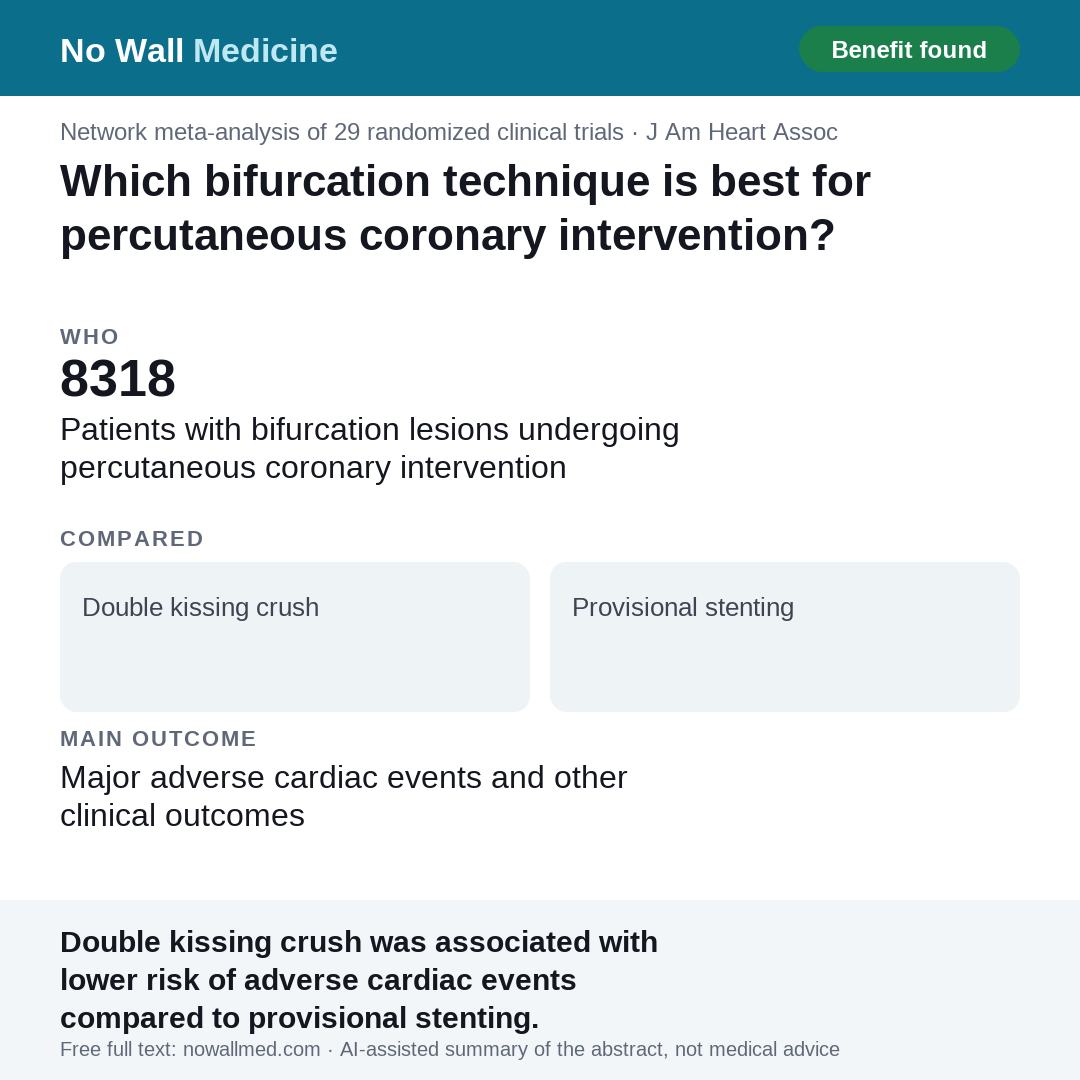
Which bifurcation technique is best for percutaneous coronary intervention?
Who
8318
Patients with bifurcation lesions undergoing percutaneous coronary intervention
Compared
Double kissing crush
Provisional stenting
Main outcome
Major adverse cardiac events and other clinical outcomes
Result: RR 0.50 (95% CI 0.39-0.64) for major adverse cardiac events
Bottom line: Double kissing crush was associated with lower risk of adverse cardiac events compared to provisional stenting.
J Am Heart Assoc · 2022-06-20Download image
Clinical question: Which bifurcation technique is best for percutaneous coronary intervention?
Why it matters: The ideal technique for treating complex artery branch points remains unknown despite these lesions being associated with lower procedural success and higher restenosis rates.
Key points
- Researchers analyzed 8318 patients from 29 randomized clinical trials comparing different methods for treating artery branch points during percutaneous coronary intervention.
- Double kissing crush was associated with lower cardiac death (RR, 0.57; 95% CI, 0.38-0.84), major adverse cardiac events (RR, 0.50; 95% CI, 0.39-0.64), and myocardial infarction (RR, 0.60; 95% CI, 0.39-0.90).
- The double kissing crush technique was also associated with lower stent thrombosis (RR, 0.50; 95% CI, 0.28-0.88), target lesion revascularization, and target vessel revascularization compared to provisional stenting.
Headline and key points written with AI from the paper’s abstract, with every number checked against it. Read the paper before relying on them.
Was this summary helpful?
Cite this article
Park DY, An S, Jolly N, Attanasio S, Yadav N, Rao S. Systematic Review and Network Meta-Analysis Comparing Bifurcation Techniques for Percutaneous Coronary Intervention. J Am Heart Assoc. 2022. doi:10.1161/JAHA.122.025394
Spotted a mistake? Suggest a correction
Top studies every Monday
The week’s key trials and guidelines in your specialties, plus any topics you follow. By email, free.
Get the weekly digest